
In the next 20 years, 70% of the world's population may be affected by increases in extreme weather.
Rapid changes will still affect at least 20 percent of the population, even if we manage to reduce greenhouse gas emissions.

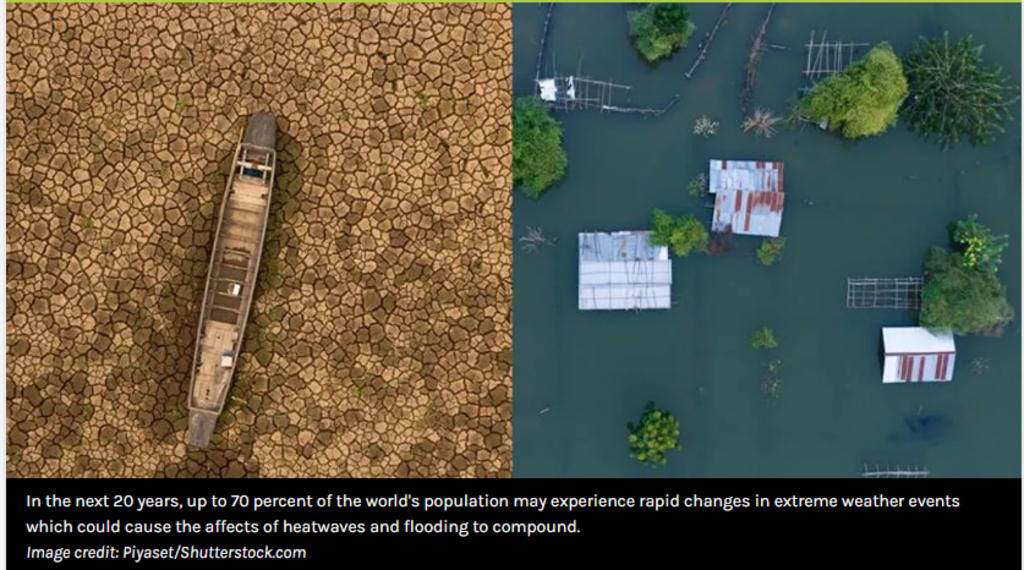
According to a recent analysis, almost three-quarters of the world's population will see notable and swift changes in rainfall and temperature over the course of the next 20 years. This is a sobering message to many people everywhere. Reducing greenhouse gas emissions dramatically is the only way to prevent this.
Even though there is a wealth of evidence indicating that we are entering conditions not seen in millennia, the topic of climate change is still contentious. While it is true that different timelines and variations in the environment are acclimated to different parts of nature and civilization, abrupt shifts can have disastrous effects.
One prominent illustration of this is the 2021 heatwave in North America that broke records and caused melting, which was thought to be impossible in the absence of climate change.
Such dramatic occurrences can have a range of effects. Heatwaves, for example, can cause heat stress, which can result in human and animal mortality. They can also harm ecosystems, reduce agricultural yields, cause transportation problems, and even affect the cooling systems of power plants.
In addition to increasing erosion, lowering local water quality, and destroying crops, excessive rainfall can also cause floods, which harms houses and infrastructure. Additionally, there's a chance that these severe occurrences will coincide, compounding to create effects that are even more significant than they would be if they happened separately. One instance of this complex circumstance would be the floods that occurred in Pakistan in 2022.
Dr. Carley Lles and colleagues from the Centre for International Climate Research (CICERO), in partnership with the University of Reading, have investigated how global warming can combine with typical weather variations to form rapid changes in both extreme temperatures and rainfall. To date, few studies have looked at how extreme weather will impact different countries.
"We identify regions projected to experience substantial changes in rates of one or more extreme event indices over the coming decades," Lles said in a statement. "We focus on regional changes, due to their increased relevance to the experience of people and ecosystems compared with the global mean."
Uncertain times to come
According to the research, if the event that greenhouse gas emissions are reduced in line with the Paris Agreement, 20 percent of the world's population may be exposed to comparable extreme weather hazards over the following 20 years. If efforts aren't increased, though, this might increase to as much as 70% of the population.
To arrive at these conclusions, the team ran extensive climate simulations that demonstrated how, under what they refer to as the "high-emissions scenario," a significant portion of the tropics and subtropics, which together account for about 70% of the world's current population, will probably see strong joint rates of change for extreme temperatures and rainfall for the next 20 years. However, the situation is still grave even with significant carbon mitigation: almost 1.5 billion people would still be affected.
Even with our best attempts to clean up the mess, there will always be hazards as our understanding of the climate crisis grows.
The University of Reading co-author Dr. Laura Wilcox continued, "We also find that rapid clean-up of air pollution, mostly over Asia, leads to accelerated co-located increases in warm extremes and influences the Asian summer monsoons."
“While cleaning the air is critical for health reasons, air pollution has also masked some of the effects of global warming. Now, over the ensuing decades, the required cleanup could interact with global warming to produce extremely significant changes in extreme weather.
The findings have important ramifications for climate adaptation, the research emphasizes. Preparing for what is far more likely to lead to unprecedented extreme disasters in the coming years is the only approach to deal with this worldwide issue. In this manner, we can lessen the harshest effects.
About the Creator
Keep reading
More stories from Francis Dami and writers in Earth and other communities.
Rethinking the "Doomsday Glacier": Researchers Question Alarming Predictions of Antarctic Ice Collapse
Positive news concerning Earth's climate has been scarce in recent years due to the prevalence of frightening occurrences such as strong heat waves, destructive floods, powerful hurricanes, and blazing wildfires.
By Francis Damiabout a year ago in Earth
The Dryads Are Calling
Deep within the heart of ancient forests, where sunlight filters through towering canopies and the air hums with life, there exists a world few humans truly understand. It is a world of dryads, the mythical tree spirits of folklore, silently observing, nurturing, and sometimes guiding the creatures that dwell among the trees. Today, their legend continues to captivate the imagination, blending myth, nature, and a touch of magic.
By Aarif Lashariabout 11 hours ago in Earth
Inside Trump's $11 Billion Health Plan to Replace “Neo-Colonial” USAID
In the landscape of global health aid, few proposals have stirred as much debate as former President Donald Trump’s ambitious plan to restructure American assistance abroad. Dubbed an $11 billion health initiative aimed at replacing USAID’s current framework, the plan seeks to pivot away from what Trump and his allies have criticized as the “neo-colonial” approach of U.S. foreign aid. While the plan promises greater efficiency and impact, experts are split on whether it is a practical solution or a politically driven gamble. Trump’s Critique of USAID The United States Agency for International Development (USAID) has long been a central pillar of American foreign assistance, distributing billions in aid annually to address health crises, food insecurity, and development challenges worldwide. However, Trump’s administration and its supporters have often described USAID’s approach as bureaucratic, inefficient, and reflective of a “neo-colonial” mindset. In public statements, Trump argued that the U.S. was spending taxpayer dollars on programs that benefited foreign governments or contractors more than the intended local communities. Critics of the plan say that while USAID has flaws—as any large bureaucracy does—its extensive networks and decades of experience provide an unmatched capacity to deliver aid efficiently and safely. The Core of the $11 Billion Proposal At the heart of Trump’s proposal is an $11 billion fund designed to consolidate, modernize, and streamline U.S. health aid. Unlike the traditional USAID model, which relies heavily on long-term partnerships with governments and NGOs, the new plan emphasizes: Direct Impact Funding: Allocating resources to frontline health workers and local initiatives rather than intermediaries. Data-Driven Investments: Using real-time health data to target outbreaks and crises more efficiently. Private Sector Partnerships: Leveraging U.S. pharmaceutical companies, tech firms, and healthcare startups to deliver vaccines, treatments, and medical infrastructure. Shorter Program Cycles: Moving away from multi-year funding commitments in favor of more flexible, results-oriented programs. Proponents argue that this approach could reduce bureaucratic overhead and ensure U.S. aid reaches communities faster. By “cutting out the middlemen,” Trump supporters claim, America can avoid the pitfalls of slow-moving aid programs that sometimes fail to adapt to crises. Reactions from the Global Health Community Global health experts, however, have expressed concern about both the logistics and philosophy of the plan. Dr. Melissa Ortega, a senior researcher at the Global Health Policy Institute, explained, “The idea of bypassing established structures like USAID may sound appealing on paper, but in practice, it risks undermining decades of institutional knowledge. Health systems are complex, and short-term projects cannot replace long-term capacity building.” Some critics have also questioned the characterization of USAID as “neo-colonial.” While U.S. foreign aid has historically been tied to geopolitical interests, many programs today are designed collaboratively with recipient countries and local organizations. Reducing oversight could unintentionally increase the risk of misuse, corruption, or health inequities. On the other hand, supporters of Trump’s plan point to examples of inefficiency in USAID programs, citing cases where aid was delayed or mismanaged. By introducing more direct funding models, they argue, U.S. taxpayer dollars could achieve a higher “return on health outcomes.” Political Implications Trump’s health aid overhaul proposal is not just about international development—it is also deeply political. Framing USAID as a “neo-colonial” institution resonates with a populist narrative that America should prioritize its own citizens and assert greater control over how taxpayer money is spent abroad. Domestically, the $11 billion plan faces scrutiny from Congress. Lawmakers from both parties have questioned whether dismantling USAID’s systems could destabilize ongoing health programs in countries where the U.S. has long-term commitments. The potential impact on global health security—including the fight against pandemics like COVID-19—adds another layer of concern. Internationally, U.S. allies and partner nations are watching closely. Sudden shifts in aid delivery could disrupt health programs in low- and middle-income countries, many of which rely on predictable funding cycles to maintain vaccination campaigns, maternal health services, and disease surveillance. Possible Benefits and Risks If executed carefully, the Trump-backed model could bring several benefits: Faster Response Times: Direct funding could accelerate delivery of vaccines, treatments, and emergency support. Innovation Boost: By partnering with private sector companies, the plan could accelerate development of new health technologies. Accountability: With performance-based metrics, the plan may better measure the impact of U.S. aid. However, the risks are equally significant: Disruption of Existing Programs: Abrupt changes could destabilize ongoing health projects. Loss of Expertise: USAID’s decades of experience in navigating local governance, supply chains, and community engagement may be hard to replace. Geopolitical Fallout: Allies accustomed to collaborating with USAID might see the move as destabilizing, reducing cooperation on global health initiatives. Looking Ahead As Trump and his allies continue to advocate for this $11 billion overhaul, the debate over the future of U.S. health aid is intensifying. Proponents view it as a necessary modernization of an outdated system, while critics fear it could undercut decades of carefully built infrastructure and global partnerships. Ultimately, the success of this plan will hinge on its ability to balance efficiency with stability, innovation with oversight, and political objectives with humanitarian needs. For now, the proposal remains controversial, representing a dramatic departure from traditional approaches to U.S. foreign aid. Whether it will reshape global health for the better—or simply create more uncertainty—remains to be seen. In the end, the Trump health plan is as much about ideology as it is about dollars. It challenges the conventional wisdom of international development and asks whether a more streamlined, results-focused approach can truly replace a system built over decades. As the world watches, the stakes could not be higher: the future of U.S. global health aid—and the lives it touches—hangs in the balance.
By Muhammad Hassan5 days ago in Earth



Comments
There are no comments for this story
Be the first to respond and start the conversation.