
Huge Landslide Leaves Sicilian Homes Teetering on Cliff Edge
“Relentless rains and unstable slopes force evacuations as Sicilian homes hang perilously over a massive landslide.”
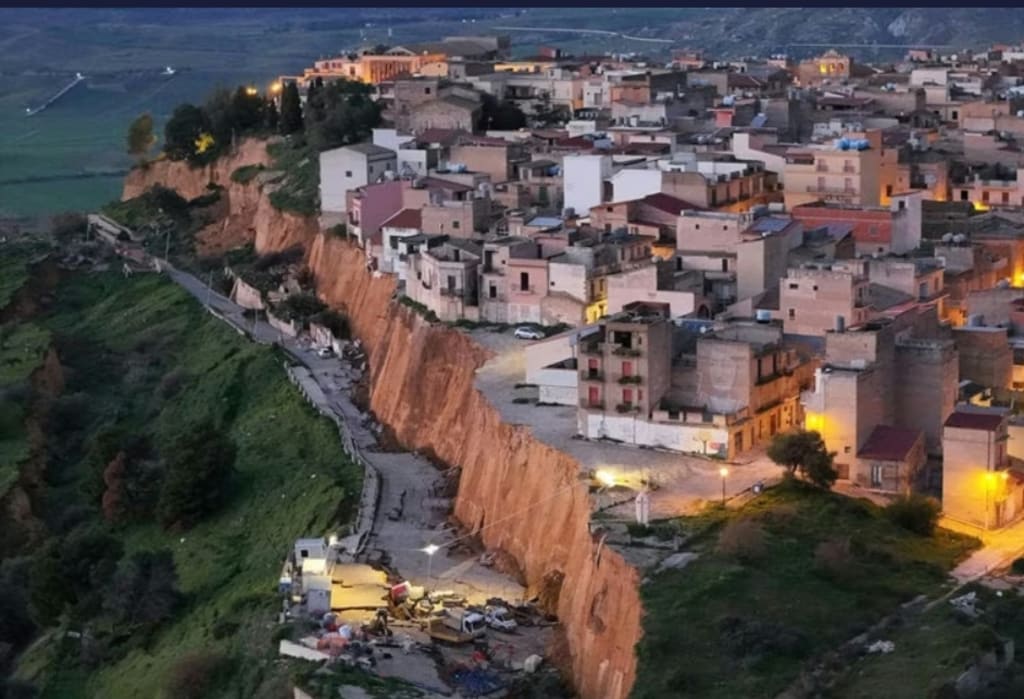
In the early hours of a frigid January morning in southern Sicily, a quiet hilltop town transformed into a landscape of fear and upheaval. What was once a cluster of sturdy homes overlooking rolling plains and vineyards became a precarious tableau of buildings perched on the brink of disaster—teetering on the edge of a newly formed cliff. �
PBS
For residents of Niscemi, a small town of around 25,000 people in southwest Sicily, the alarm came not with a thunderous crash but with a slow, sinister shift beneath their feet. Days of unrelenting rain—brought by Cyclone Harry and a powerful storm system that battered southern Italy—saturated the earth, weakening centuries-old soil and sending a vast swath of hillside sliding toward the plain below. By the time civil protection crews could fully assess the damage, an estimated 4 kilometers (2.5 miles) of terrain had given way, leaving entire neighborhoods on the verge of collapse. �
PBS
The Collapse That Brought a Town to Its Knees
Local officials say the landslide began quietly on Sunday and progressed through Monday and Tuesday, until, by Wednesday, what remained of the hill seemed ready to slide at any moment. The ground beneath homes fractured; roads split, and some buildings were left suspended above yawning chasms. Cars hang over the edge like forgotten toys, their tires spinning in mid-air. �
PBS
“Niscemi sits on layers of sand and clay that become especially unstable when they are saturated with water,” explained Fabio Ciciliano, head of Italy’s civil protection agency, during a tense briefing. “To be honest, there are houses located on the edge of the landslide that obviously can no longer be inhabited.” �
PBS
With the ground still shifting, authorities established a 150-meter wide ‘no-go zone’ to keep residents and emergency workers out of harm’s way. People whose homes once stood proud on safe ground are now huddled in gyms, community centers, sports halls, and with relatives in neighboring towns, waiting uncertainly for what comes next. �
Sky News
A Community Uprooted
More than 1,500 people have been evacuated as a result of the landslide, according to civil protection figures—a number that could rise as assessments continue. One by one, families packed belongings into cars or hastily stacked bags into waiting vans, holding pets in anxious arms and clutching important documents as they left behind the lives they had built. �
Sky News
“My house has always been safe,” said one resident, speaking with the tremor of disbelief still in her voice. “But now it’s hanging above a terrible drop. We were told to leave immediately. We don’t know if we’ll ever return.” �
Inquirer.com
Local schools have closed, and access roads linking Niscemi to neighboring cities like Gela have been shut down due to safety concerns, isolating parts of the town entirely. Emergency services work around the clock to survey the worst damage, monitor for further movement, and coordinate relief for displaced families. �
Sky News
Leaders Tour Damage and Promise Support
Italy’s Prime Minister Giorgia Meloni visited Niscemi in the aftermath of the disaster, touring the ravaged hillside from a helicopter and meeting with local and regional officials. The government has declared a state of emergency for Sicily, as well as nearby regions of Sardinia and Calabria also impacted by the storm. An initial emergency fund of €100 million has been released to support urgent needs, including temporary housing, infrastructure repair, and critical services. �
Anadolu Ajansı
Meloni pledged that this was only the beginning of support for affected communities, emphasizing that the government would do its utmost to assist residents who have lost their homes and livelihoods. Regional officials estimate that the total economic toll of storm damage across Sicily may reach €2 billion or more when infrastructure, agriculture, and private property losses are combined. �
Anadolu Ajansı
An Unstable History and a Warming Climate
Niscemi is no stranger to landslides. In 1997, a significant slope failure forced the evacuation of hundreds of residents in similar circumstances. But scientists and local experts say the frequency and severity of such events are increasing. Climate change-driven weather patterns are bringing heavier rainfalls and sudden downpours to the Mediterranean region, overwhelming natural drainage systems and destabilizing slopes once considered relatively secure. �
PBS
“Extreme weather is simply more common now,” said one geologist consulting on the disaster. “The record-warm temperatures in the Mediterranean Sea create more powerful storms, and when those storms hit land with saturated soils, the ground can fail catastrophically.” �
The Times
Sicily’s soil composition—often sandy and clay-rich—makes it particularly vulnerable. Because these soils are highly permeable, extended rains can turn them into unstable, sliding masses. Combine that with human development on slopes and aging infrastructure that wasn’t designed for today’s climatic extremes, and the result is a recipe for disaster. �
Sky News
Looking Forward
As the sun sets on another unsettled day in Niscemi, the future remains unclear for many of its residents. Some hope to return once geologists deem parts of the town safe again, while others brace for permanent displacement. With the ground still shifting and meteorological models predicting more rain across the region in the coming weeks, anxiety runs high. �
Sky News
But even as families grapple with loss and disruption, there is a growing conversation about resilience and planning. The Italian government faces mounting pressure to reconsider construction policies on vulnerable terrain and to invest in more robust climate adaptation strategies. Without such measures, the story of Niscemi may not be an isolated event but a harbinger of what’s to come for other towns perched on Italy’s rugged and beautiful—but increasingly unstable—landscape. �
PBS
For the families whose homes now dangle above empty space, the phrase “living on the edge” has taken on a chilling, literal meaning. But beyond the immediate crisis, their experience underscores a larger truth: that climate resilience, responsible urban planning, and respect for the power of nature are no longer optional—they are essential.
About the Creator
Polar Vortex Collapse Forecast: What It Means and Why It Matters
As winter progresses in the Northern Hemisphere, scientists are closely monitoring forecasts suggesting a potential polar vortex collapse. The term “polar vortex” has entered mainstream conversations in recent years, often associated with extreme cold snaps in North America, Europe, and parts of Asia. But what exactly is a polar vortex collapse, why does it happen, and why should people care? Understanding this phenomenon is crucial, not just for weather enthusiasts, but for anyone concerned about climate change, energy infrastructure, and global weather patterns. What Is the Polar Vortex? The polar vortex is a large area of low pressure and extremely cold air surrounding both of Earth’s poles, contained by a fast-moving band of winds known as the polar jet stream. In the Northern Hemisphere, it sits over the Arctic, spinning in a counterclockwise direction. Under normal conditions, the vortex keeps the Arctic air largely contained. However, fluctuations in atmospheric pressure and temperature can cause the vortex to weaken, shift, or even split, allowing frigid air to escape southward into populated regions. This is often what leads to extreme winter weather events in the United States, Canada, Europe, and Asia. What Does a Polar Vortex Collapse Mean? A “polar vortex collapse” refers to a significant weakening or breakdown of the vortex, often caused by sudden stratospheric warming events high in the atmosphere. When the polar vortex collapses: Arctic air can spill into mid-latitudes, leading to extreme cold in regions unaccustomed to such temperatures. Weather patterns become more erratic, causing longer-lasting cold spells or shifts in precipitation. Jet streams weaken or meander, which can contribute to storms, heavy snowfall, or unusual weather events across continents. The term “collapse” doesn’t mean the vortex disappears entirely — it is still present — but its structural integrity is compromised, allowing Arctic air to move into areas that typically enjoy milder winter conditions. Why Scientists Are Concerned Meteorologists and climate scientists pay close attention to the polar vortex because its behavior has far-reaching implications: Energy Demand: Sudden cold snaps increase heating demand, which can strain power grids and fuel supply chains. Agriculture: Extreme cold can damage crops, delay planting, and reduce yields for sensitive crops like winter wheat. Transportation: Snowstorms and icy conditions disrupt travel, affecting both local commuting and international logistics. Global Weather Links: A collapsed polar vortex can influence weather far beyond North America, including unusual rainfall patterns, storms, and temperature anomalies in Europe and Asia. Recent studies suggest that climate change may be making the polar vortex more unpredictable, with warmer Arctic temperatures affecting the jet stream’s stability. This could lead to more frequent or intense cold waves in regions far from the pole. Historical Examples of Polar Vortex Events The polar vortex has been linked to some of the most memorable winter events in recent decades: January 2014 (United States): Millions faced record-breaking cold as Arctic air plunged southward, with temperatures in the Midwest dropping to -30°F (-34°C) in some areas. February 2021 (North America): A weakened polar vortex contributed to extreme cold across Texas and the central U.S., causing widespread power outages and water supply disruptions. Europe 2018–2019: Fluctuations in the Arctic vortex led to extended cold spells across parts of northern and eastern Europe. Each of these events illustrates how disruptions in the Arctic atmosphere can quickly translate into severe conditions thousands of miles away. Why a Polar Vortex Collapse Matters Globally Although the polar vortex is centered over the Arctic, its collapse affects global weather in multiple ways: Economic Impacts: Cold snaps can halt industrial activity, increase heating costs, and strain insurance systems due to property damage. Climate Feedback Loops: Extreme Arctic events can accelerate ice melt, altering sea levels and global weather patterns. Human Health: Extended periods of extreme cold increase risks of hypothermia, frostbite, and other health emergencies, particularly for vulnerable populations. Ecosystem Effects: Wildlife adapted to stable seasonal patterns may struggle to survive sudden temperature fluctuations, affecting biodiversity in affected regions. The interconnectedness of global systems means that an Arctic event can ripple across continents, affecting agriculture, energy, and even food security. What Can People Do to Prepare? While individuals cannot control atmospheric phenomena, there are practical steps to prepare for polar vortex-related extreme cold: Home Safety: Insulate homes, check heating systems, and prepare emergency kits with blankets, food, and water. Travel Caution: Monitor forecasts before traveling and have contingency plans for snow or ice-related disruptions. Community Awareness: Check on neighbors, especially the elderly or vulnerable, during prolonged cold events. Government Preparedness: Authorities often increase readiness of power grids, emergency services, and transportation systems ahead of forecasted events. Being informed and proactive can reduce the human and economic impact of a polar vortex collapse. Looking Ahead: Climate Change and the Polar Vortex Scientists warn that the Arctic is warming faster than the rest of the planet, which may make the polar vortex more unstable. As the vortex weakens, the frequency of extreme cold events in mid-latitudes may rise, even while the planet as a whole becomes warmer. This paradox — colder extremes amid global warming — can be confusing but is consistent with climate models. It emphasizes the need for global cooperation in climate mitigation, adaptation, and disaster preparedness. Final Thoughts The forecast of a potential polar vortex collapse is a reminder that Earth’s climate system is complex and interconnected. What happens in the Arctic does not stay in the Arctic; it has tangible consequences for energy, health, ecosystems, and economies across the Northern Hemisphere. Understanding these dynamics, staying informed, and taking proactive steps can help societies mitigate risks and adapt to a changing climate. Whether you’re a casual weather watcher or a climate enthusiast, the polar vortex collapse is a phenomenon worth following — because its reach extends far beyond the Arctic Circle.
By Muhammad Hassan5 days ago in Earth
Sea Levels Are Rising Across the World. But in Greenland, Scientists Say They’re About to Fall
When it comes to climate change, one of the clearest signs has been rising sea levels worldwide. From the melting ice sheets of Antarctica to flooding in coastal cities, the narrative has been straightforward: global temperatures rise, ice melts, and oceans expand.
By Aarif Lashariabout 23 hours ago in Earth



Comments
There are no comments for this story
Be the first to respond and start the conversation.