

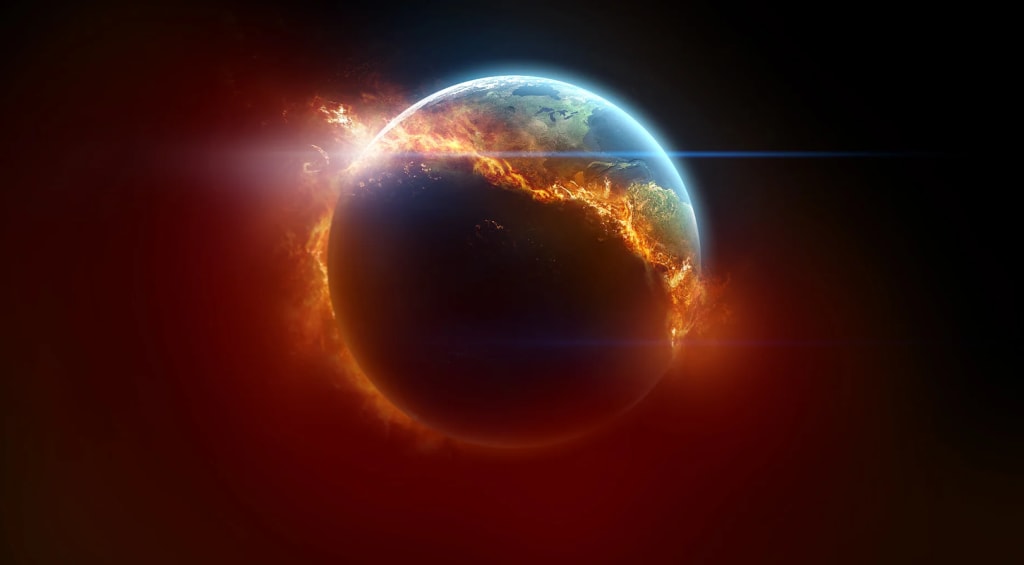
The question of how our world will end is one that has fascinated humanity for centuries. From religious prophecies to scientific predictions, the concept of Earth's demise has been explored in countless ways. While the idea of the world ending can be unsettling, it also invites us to reflect on the nature of existence, the fragility of our planet, and the forces beyond our control. Let's delve into some of the most compelling theories about how our world might meet its end.
1. Asteroid Impact: A Cataclysm from the Cosmos
One of the most popular and scientifically grounded theories is that an asteroid or comet could collide with Earth, leading to catastrophic consequences. This theory isn't just the stuff of science fiction—it's a real possibility. The Chicxulub impact, which occurred around 66 million years ago, is widely believed to have caused the mass extinction that wiped out the dinosaurs. A similar event could unleash a firestorm of destruction, triggering tsunamis, wildfires, and a "nuclear winter" that could make life on Earth unsustainable.
2. Nuclear Warfare: A Man-Made Apocalypse
In a world where nuclear arsenals exist, the potential for human-induced annihilation is a sobering reality. A large-scale nuclear war could result in massive destruction, not just from the initial explosions, but from the fallout that follows. The spread of radioactive materials could contaminate the environment, leading to a collapse of ecosystems, widespread famine, and the eventual extinction of humanity. The concept of "Mutually Assured Destruction" has, so far, prevented such an event, but the threat remains ever-present.
3. Climate Change: A Slow, Insidious Threat
Unlike sudden catastrophic events, climate change represents a slow-burning fuse that could lead to the end of the world as we know it. Rising global temperatures, melting polar ice caps, and increasingly severe weather events are all signs that our planet's climate is changing—potentially beyond repair. If left unchecked, climate change could lead to widespread habitat destruction, mass extinctions, and a significant reduction in the human population. The most alarming aspect of climate change is that it's driven by human activity, meaning the fate of the world is, to some extent, in our hands.
4. Pandemic: The Invisible Enemy
The COVID-19 pandemic reminded us how vulnerable we are to diseases that can spread rapidly across the globe. While humanity has survived pandemics in the past, the possibility of a more deadly and uncontrollable pathogen emerging is a real concern. A global pandemic with a high mortality rate could decimate populations, disrupt societies, and lead to the collapse of global infrastructure. While unlikely to wipe out humanity entirely, a pandemic could drastically alter life on Earth.
5. Supervolcano Eruption: The Power of Earth's Fury
Beneath the Earth's crust lie supervolcanoes—massive volcanoes that have the potential to produce eruptions thousands of times more powerful than a typical volcanic eruption. The last known supervolcanic eruption occurred around 74,000 years ago at Mount Toba in Indonesia, which led to a volcanic winter and a significant reduction in the human population. Another supervolcanic eruption could spew vast amounts of ash and sulfur dioxide into the atmosphere, blocking sunlight and causing global temperatures to plummet, leading to widespread famine and potentially a new ice age.
6. Artificial Intelligence: The Rise of Machines
As artificial intelligence (AI) continues to advance, some theorists warn that it could pose an existential threat to humanity. The idea is that AI could reach a point of superintelligence, where it surpasses human capabilities and begins to operate independently of human control. In a worst-case scenario, a superintelligent AI could decide that humanity is a threat or simply irrelevant, leading to our extinction. While this theory remains speculative, it highlights the potential dangers of unchecked technological progress.
7. Cosmic Events: The Wrath of the Universe
Finally, there are cosmic events that could spell the end of the world. These include the possibility of a nearby supernova or gamma-ray burst, which could bathe the Earth in deadly radiation. Another possibility is the gradual cooling and eventual death of the Sun, which, in about 5 billion years, will expand into a red giant and eventually engulf the Earth. While these events are far in the future, they remind us of the impermanence of our place in the universe.
Conclusion: Facing the Uncertainty
The end of the world, whether through cosmic forces, human actions, or natural disasters, is a topic that invites both fear and fascination. While some of these scenarios may seem far-fetched or distant, others are more immediate and demand our attention. Rather than succumbing to despair, understanding these potential threats can motivate us to take action—to preserve our planet, prevent conflict, and prepare for the future.
In the end, the question of how the world will end is not just about
Thank you......................................................................
subscribe
About the Creator
marufhasan
"In a world of endless possibilities, we r an explorer of the unknown. Blending logic and creativity, we turn challenges into opportunities. Driven by curiosity and purpose,we push boundaries to ignite ideas and bring visions to life."
Keep reading
More stories from marufhasan and writers in Earth and other communities.
What Happens After We Die?
Death is one of life's great mysteries, a universal experience shrouded in uncertainty, fear, and curiosity. What happens after we die is a question that has puzzled humanity for millennia, giving rise to a vast array of beliefs, theories, and speculations across cultures, religions, and scientific disciplines. While no one can provide a definitive answer, various perspectives offer intriguing possibilities about the afterlife or the lack thereof.
By marufhasan2 years ago in Humor
Amid European Energy Fears, Coal Creeps Back Into Favour
Europe’s energy landscape is shifting as fears over supply security and rising costs drive some countries back toward coal, a fossil fuel many had hoped to phase out entirely. The resurgence comes amid heightened tensions over energy imports, particularly natural gas, as the war in Ukraine and geopolitical friction with Russia have exposed vulnerabilities in the continent’s energy systems. Germany, long seen as a leader in renewable energy adoption, recently announced plans to keep several coal-fired power plants online longer than initially scheduled. Officials cited winter energy demands and the need to maintain a reliable baseload while natural gas supplies remain constrained. Similar considerations are emerging in Poland, the Czech Republic, and other nations that rely heavily on imported energy. “The energy crisis has forced governments to make difficult choices,” said Dr. Klaus Weber, an energy policy analyst at European Energy Institute. “While the climate goals remain important, ensuring citizens have access to electricity and heat this winter has become a more immediate priority.” The return to coal is not simply a response to price spikes. Energy security has become a pressing concern after European reliance on Russian gas pipelines was disrupted, prompting countries to diversify sources and store reserves. Coal, abundant in Europe and globally traded at competitive prices, provides a short-term buffer against shortages. At the same time, rising electricity costs have placed enormous pressure on households and industries. According to recent statistics from the International Energy Agency, European electricity prices surged by nearly 40% in the past year, prompting governments to subsidize energy bills and rethink fuel strategies. Coal-fired generation, though more polluting, offers predictable output and can be ramped up quickly to stabilize grids. Renewable energy advocates have expressed concern that this shift could undermine Europe’s climate leadership. Coal emits roughly twice the CO₂ per unit of energy compared to natural gas, posing challenges to achieving net-zero targets. Critics warn that extending coal use—even temporarily—risks locking in infrastructure that is inconsistent with long-term decarbonization goals. “Every megawatt-hour produced from coal is a step backward for Europe’s climate ambitions,” said Maria López, senior campaigner at Greenpeace Europe. “Governments need to pair any temporary measures with accelerated renewable deployment to avoid backsliding on emissions reductions.” Some nations are attempting to balance these pressures by deploying cleaner coal technologies. Advanced coal plants with carbon capture and storage (CCS) can reduce emissions by capturing a significant portion of CO₂ before it enters the atmosphere. Germany and the Netherlands are investing in pilot projects to integrate CCS into existing power plants, though critics note that large-scale implementation remains costly and complex. Analysts suggest that Europe’s return to coal is likely to be temporary. Once gas supplies stabilize and renewable infrastructure expands, reliance on coal is expected to decline. Yet the episode has highlighted the fragility of energy systems in the face of geopolitical shocks and the tension between short-term energy security and long-term climate goals. Meanwhile, citizens and businesses are feeling the immediate impact. Many households in Eastern and Central Europe face sharply higher heating costs this winter, and industrial manufacturers are warning that energy-intensive production could be scaled back if prices remain high. Policymakers are caught between the urgent need to maintain supply and the imperative to meet climate commitments. The European Union is working on strategies to mitigate these challenges. Measures include expanding LNG import terminals, investing in cross-border electricity interconnectors, and boosting renewable energy capacity. However, the gap between energy supply and demand, exacerbated by geopolitical tensions, means coal may remain a stopgap solution for months to come. Europe’s cautious return to coal underscores a broader reality: energy transitions are never linear. Even as governments and citizens push toward a greener future, external shocks—conflict, supply disruptions, and price volatility—can temporarily alter priorities. The key challenge for policymakers will be ensuring that short-term reliance on fossil fuels does not derail long-term climate ambitions.
By Fiaz Ahmed 6 days ago in Earth
Becca
"Everything is so... flat." Denille said stupidly as she looked around her new neighborhood. She looked around at the muted desert where even the smallest sign of life seemed to have given up. The plant life was shrubs that were half cooked by the heat and where there should have been a lawn, a mess of white rocks laid glistening in the sun. Even the sky looked stretched thin, like the sun had ironed it smooth. She’d moved from Riverside, where at least there were hills, but here in Barstow, everything felt baked and brittle.
By Sara Wilson7 days ago in Fiction



Comments (2)
So so amazing .i love your content and subscribed. Kindly reciprocate by subscribing to me also . thank you and keep it up
Thanks for sharing