
How to find a habitable planet? Planetary geology research is the key, and we'll know the answer in October
Planetary geology research will provide answers

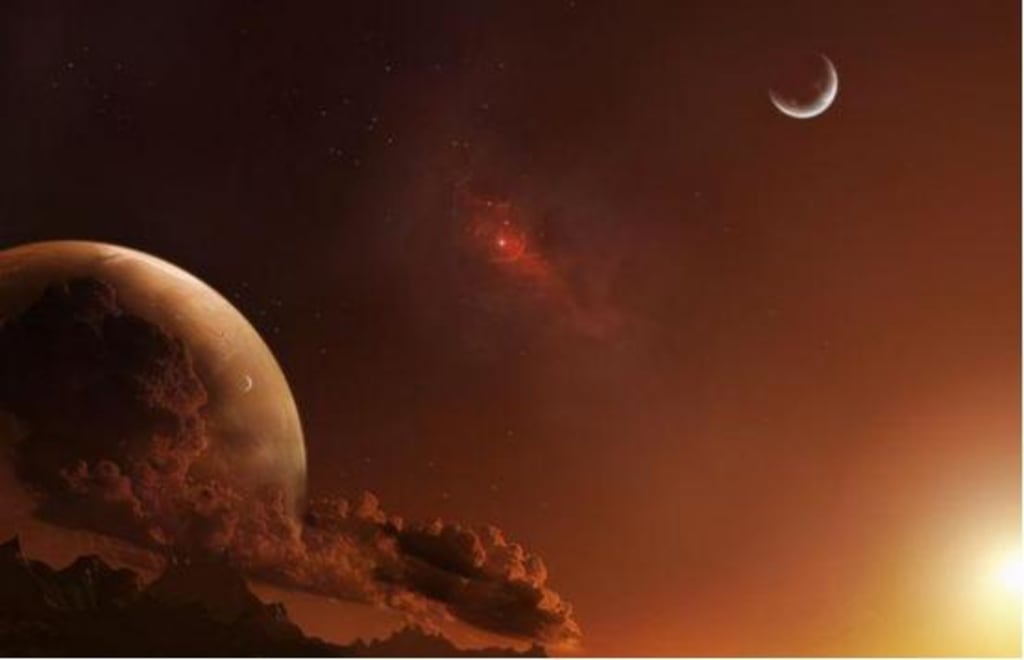
For years, mankind has dreamed of finding a new "turnkey" home in the vastness of the universe, but although more than 4,000 exoplanets have been found today, only a small fraction of them meet the criteria for a habitable planet, so how can we streamline this small fraction again?
At this stage, scientists judge whether an exoplanet is a habitable planet by two main criteria: first, whether it is a rocky planet similar to Earth; and second, whether the distance between it and the star is moderate enough to give the surface a chance to be rich in liquid water.
If an exoplanet meets both of these criteria, then it has the potential to become a living planet, and possibly one of the new homes for humans after they fly out of the solar system in the future.
Of course, even if an exoplanet is in the habitable zone, it does not mean that there is life on it, because there are 2 very vivid examples in our solar system - Mars and Venus.
They are also planets in the habitable zone, but one is too hot and the other is too cold, resulting in their surfaces being very dry and not supporting the existence of liquid water.
So, what should humans do? A team of scientists from the University of British Columbia believes that in the search for exoplanets, it may be possible to determine the iron content of its mantle, and thus its surface, by determining whether it supports the presence of a thick atmosphere and liquid water.
Experts say: planetary geology study will give answers
For Earth-like planets, whether they are in the habitable zone or not, they all have one thing in common - the mantle and core, both contain iron. In the process of planetary evolution, if a planet is small, then its mantle and core will be richer in iron, and thus the planet will have a chance to evolve into a habitable planet if it is in the habitable zone.
Of course, this approach to finding habitable planets outside the system is obviously more difficult and requires more advanced observation equipment, until October this year, after the successful launch of the James Webb Space Telescope, which has been postponed several times in the United States, it will allow scientists to detect exoplanet chemicals, thus helping scientists to better find habitable homes outside the system.
Can humans really find habitable planets?
The so-called habitable planets are relative to human needs. To sustain life and civilization on Earth, humans need sufficient liquid water, abundant oxygen, and the right temperature, as well as a large amount of extractable resources on Earth.
These seemingly simple, but in fact extremely demanding requirements for humans are one of the key factors limiting the ability of humans to find exoplanets that are habitable, because modern scientific research has found that oxygen is not universally available on planets, including some of the potentially habitable planets that have been previously detected.
However, because the universe is so large and the number of exoplanets is countless, there is a sense in which humans have a chance to find exoplanets that meet the conditions for human habitation, but finding them is one thing and arriving is another, and many researchers believe that humans may never leave our solar system.
Is it true that humans cannot leave the solar system?
To give a familiar example, in 1077, the United States launched the Voyager series of space probes, today, they have been flying for 44 years, but still have not left the solar system, and according to the time given by scientists some time ago, the Voyager series of probes want to leave the solar system, it will take at least 300 years.
And this is still in the outer part of the solar system, and does not exist Oort cloud, if the Oort cloud exists, even according to its smallest radius range, there is a distance of 1 light year, then, from the Voyager series of probes to leave the solar system, it will take 10-20 thousand years.
The same is true for humans. The limit of human life expectancy is about 120 years, according to the current human flight speed, even to Mars, it will take at least 6-7 months, if to the periphery of the solar system, let's say into the Kuiper belt, it will take half a century, which for humans, once left, is there is no return.
This is why some researchers say that the speed of humans is too slow, and this has become one of the key factors that binds humans to the Earth, if humans want to leave the solar system, they need to find a way to increase their speed, or to find the "wormhole" predicted by Einstein, and crack the wormhole traversal mechanism, otherwise, even if The solar system beyond, there are a large number of habitable planets, we can never reach, this, what do you think?
Open UC Browser See more great pictures
About the Creator
tannie rusty
little science knowledge
Keep reading
More stories from tannie rusty and writers in Earth and other communities.
Scientists predicted the existence of dark energy, more mysterious than dark matter, does it really exist?
The undeniable point is that, although humans currently detect the universe, about 93 billion light years in diameter range, however, in fact, scientists generally believe that this is just the tip of the iceberg.
By tannie rusty4 years ago in Earth
Why Didn't Anyone Tell Us
Men, move along. This is not for you. This is for the women. I was forty-five when I began menopause. It is pretty young for that to be going on in a woman’s life, but I had undiagnosed PCOS, my entire life. Thank you to all the gynecologists I had seen my entire life. That in itself should encourage women to keep seeking second opinions, especially when you are not getting correct answers or any at all.
By Alexandra Grant6 days ago in Humans


Comments
There are no comments for this story
Be the first to respond and start the conversation.