
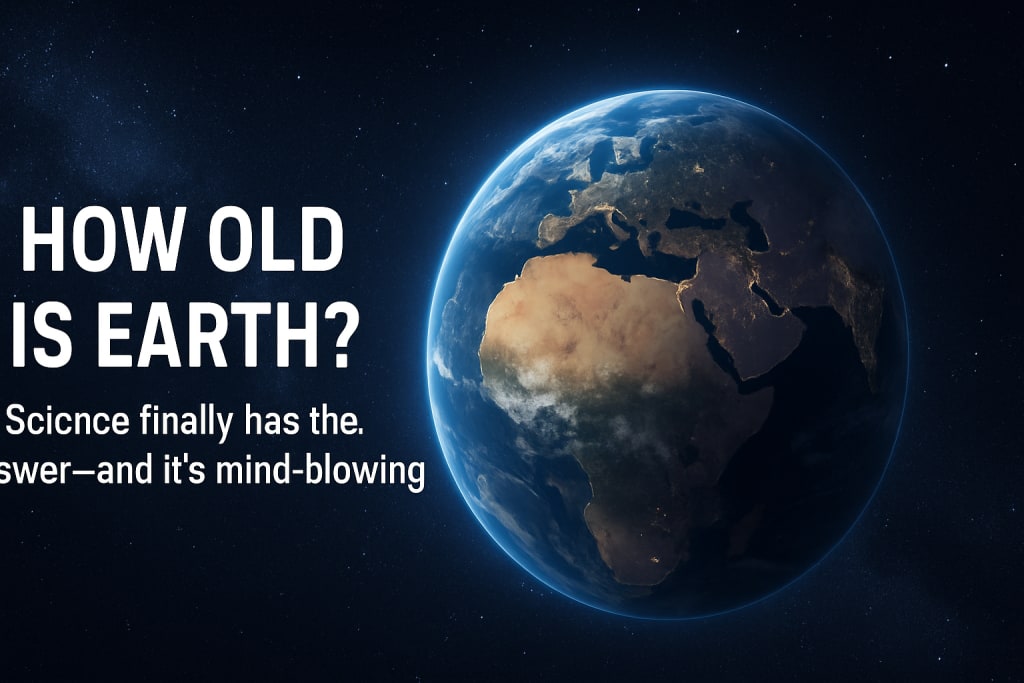
How Old Is Earth? Science Finally Has the Answer—and It’s Mind-Blowing
Discover how scientists calculated Earth's age, how early theories shaped our understanding, and when life first appeared.

One Question, Billions of Years in the Making
We’re told not to ask someone their age—but Earth doesn’t seem to mind. From ancient legends to cutting-edge science, humans have always wondered how old our planet really is. Thanks to powerful scientific tools and decades of research, we now have an answer grounded in fact, not folklore.
The quest to understand Earth’s age is more than just scientific trivia—it’s a story of curiosity, debate, and astonishing discovery. For thousands of years, humans have made guesses, drawn conclusions from holy texts, and later, used science to uncover the real story. That journey is as fascinating as the number itself.
---
Earth’s True Age: 4.54 Billion Years
Today, scientists agree that Earth is about 4.54 billion years old, with a margin of error of approximately 50 million years. In cosmic terms, that’s an incredibly precise estimate. To put this in perspective, the Milky Way Galaxy is believed to be between 11 to 13 billion years old, and the Universe itself may be around 13.8 billion years old.
This makes Earth a relatively young planet in the cosmic timeline, yet old enough to have undergone immense geological, atmospheric, and biological changes. From molten rock to a world teeming with life, our planet has evolved dramatically over billions of years.
---
How Scientists Figured It Out
The method scientists use to determine Earth’s age is known as radiometric dating. This process measures the decay of radioactive elements, such as uranium, within rocks and minerals. When these materials form, they contain a fixed amount of radioactive isotopes. Over time, these isotopes decay into stable elements at a predictable rate. By measuring how much of each isotope remains, scientists can calculate the rock's age.
One of the best tools in this process came not from Earth itself, but from space. A meteorite called Canyon Diablo, which fell in what is now Arizona, has provided critical data. Since it formed at the same time as Earth and the rest of the solar system, dating it gave researchers an important benchmark to work from.
Thanks to samples like these—and advancements in laboratory technology—scientists have built a timeline of Earth's formation that is both reliable and widely accepted in the scientific community.
---
How Old Did People Think Earth Was?
Before radiometric dating, Earth’s age was a subject of speculation and controversy. In the 1800s, William Thomson (also known as Lord Kelvin) calculated that the Earth was between 20 and 40 million years old, based on how long it would take a molten planet to cool. At the time, he didn’t know about radioactive decay, which generates internal heat and dramatically changes cooling time estimates.
Other theories included those of John Joly, who estimated that Earth must be at least 80 to 100 million years old based on how much salt had accumulated in the oceans due to erosion.
Religious scholars offered vastly different views. Using genealogies and timelines from the Bible, some Christian theologians concluded that the Earth was only about 6,000 years old. While this belief still persists among some groups today, it is not supported by geological or astronomical evidence.
These differing estimates highlight how much our understanding has changed with scientific advancement.
---
When Did Life Begin on Earth?
The Earth may be 4.54 billion years old, but it didn’t remain a barren rock for long. Scientists estimate that the earliest life began between 3.77 and 4.28 billion years ago. These primitive organisms were not animals or plants but single-celled microorganisms, such as bacteria.
In 2017, scientists from University College London reported evidence of ancient microfossils that may be as old as 3.77 billion years. Found in rocks from Canada, these microscopic traces were likely left by iron-eating bacteria—some of the earliest life forms to exist.
Animal life, on the other hand, is a more recent development. The oldest known animal fossils date back to around 890 million years ago, showing just how long Earth remained home only to simple organisms.
---
Our Ever-Evolving Understanding
From early guesses based on salt and cooling rates to precise radiometric dating, our understanding of Earth’s age has grown immensely. Today, scientists can confidently say our planet formed 4.54 billion years ago—a number supported by countless studies, meteorite samples, and decades of research.
This knowledge not only answers a fundamental question but also helps us understand the conditions that gave rise to life itself. Earth’s long and dynamic history continues to shape the world we live in today.
So while it might be impolite to ask someone their age, go ahead and ask the Earth. It has nothing to hide—and billions of years’ worth of stories to tell.
About the Creator
O-Ring Seals Market Size and Forecast 2025–2033
Introduction In an era defined by advanced engineering, sustainability goals, and performance efficiency, the smallest components often play the biggest roles. Among these unsung heroes of modern manufacturing are O-ring seals—simple, circular devices that quietly prevent leaks, ensure safety, and keep critical systems functioning under extreme conditions.
By Aaina Oberoi4 days ago in Earth
The Refrigerant Transition
Cooling seldom features in climate headlines, yet it is one of the quietest success stories of the last decade. Under the Kigali Amendment to the Montreal Protocol, countries are phasing down hydrofluorocarbons (HFCs)—super-pollutant refrigerants—while retailers and manufacturers rapidly switch to ultra-low-GWP “natural” refrigerants such as carbon dioxide (R744) and propane (R290). Fully implemented, Kigali alone can avert roughly 0.4–0.5°C of warming by 2100; paired with efficiency improvements, the avoided warming can be closer to ~1°C—an enormous contribution from a single policy family [1–2].
By Futoshi Tachino6 days ago in Earth
Wild Card Weekend Recap: What Happens Now?
I think I figured out why I love Wild Card Weekend so much. It's because it's the first playoff anything of the calendar year. The NFL season starts in the fall, and once upon a time, the champion was crowned either on or slightly before New Year's. The evolution of the NFL schedule has resulted in the playoffs starting just into the New Year, and currently, the final week of the season falls on the first weekend of the New Year, with Wild Card Weekend coming a week after that. So yes, chronologically, the NFL's Wild Card Weekend serves as the first playoff anything of the calendar year.
By Clyde E. Dawkins5 days ago in Unbalanced




Comments
There are no comments for this story
Be the first to respond and start the conversation.