
How much gold is there on the planet?
Why did all ancient civilizations coincidentally recognize gold?

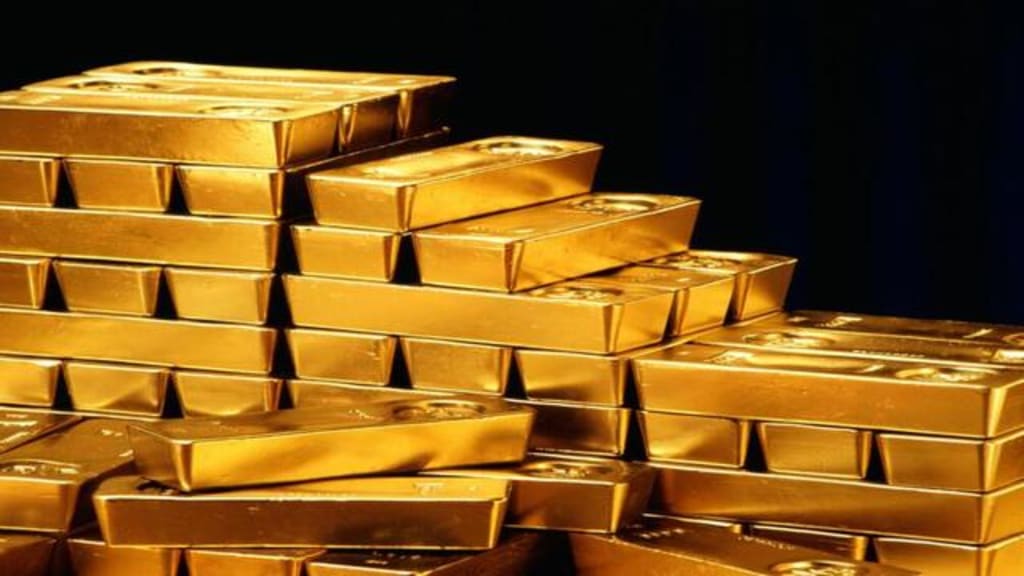
Among all the metals on earth, the most loved by human beings is undoubtedly gold human beings have loved gold for a long time, and from the current archaeological data, all the known ancient civilizations on earth regarded gold as a precious thing.
Why all ancient civilizations are unanimously recognized gold? There are two main reasons for this: one is that gold has unique chemical and physical properties, and the other is that there is very little gold to be found on earth.
The chemical properties of gold are so stable that in the natural environment of the earth, gold is almost always present in a monolithic state, which allows any ancient civilization to obtain gold directly in nature, and because gold has great resistance to corrosion and oxidation, people soon notice that this metal is well worth having because it will not rust, deteriorate or be eaten by worms.
Physically, gold in its natural state has a very beautiful and recognizable golden color, and it is easy to associate its metallic luster with the sun, which was worshipped by the ancient civilizations of the earth as a sacred object that was consciously collected and stored.
On the other hand, the texture of gold is relatively soft and has excellent ductility and malleability, in addition, the melting point of gold is also relatively low (about 1064.43 ℃), even ancient civilizations can melt it, and in the case of being melted, the chemical properties of gold are still very stable, when it cools down and solidifies, it is still shining gold.
These characteristics make the ancient civilizations can carry out various processing of gold, and will be widely used for rituals, decorations, money, etc. On this basis, coupled with the scarcity of gold, there is "all ancient civilizations coincidentally recognized gold" this situation is also natural.
Even modern humans can only mine some relatively concentrated gold on the surface of the earth, so from the overall perspective, how much gold is there on the earth? This can be estimated.
According to the mainstream view of the scientific community, the solar system was formed by the gravitational collapse of a primitive nebula, in the process, the sun was first formed in the center of the nebula, and the residual material of this nebula formed various celestial bodies in the solar system, including the earth, that is, the gold on the earth is actually from this primitive nebula.
If we go back to the source, there are two sources of gold, one is the supernova explosion of a massive star after its internal "nuclear fuel" is exhausted, and the other is the neutron star collision.
Compared to the Earth, the masses of the objects that produce gold are so large that each supernova explosion or neutron star collision produces gold with a mass much larger than the Earth's, which is thrown across the vast expanse of space and spreads over time, some of which enters the primordial nebula that formed the solar system.
During the same period when the Earth was formed, a large number of small objects were formed in the solar system, and a large part of them are still "wandering around" in the solar system, while the Earth is in the process of revolving around the Sun, from time to time there will be some "same age" as the Earth During the Earth's orbit around the Sun, from time to time, small objects of the same age as the Earth are captured by the Earth, and the debris that falls to the Earth's surface is called meteorites.
Theoretically, the gold content of these meteorites should be the same as that of the original Earth, after all, they all formed in the same nebula, so we only need to collect a large sample of such meteorites and measure them to deduce the gold content of the original Earth.
Scientists did, and by analyzing a large number of samples, they gave the result that the gold content of the original Earth was about 0.32 parts per million, and since the mass of the Earth is known to be about 60 trillion billion tons, a simple calculation shows that there are about 1920 trillion tons of gold on the Earth.
Needless to say, this is an astonishing figure, but the problem is that we simply do not find so much gold on the earth, why is that? The reason is that the vast majority of this gold is in the core of the Earth.
If we keep hitting a nail with a hammer, it won't take long for the temperature of the nail to rise significantly, and from a physical point of view, this is a process of converting kinetic energy into heat energy.
In the same way, the formation of the Earth is a large number of material collision and accretion processes, in this process, a large number of kinetic energy will be converted into heat energy, which makes the temperature of the original Earth rise sharply when the temperature reaches a certain level, the entire original Earth will be in a high-temperature molten state.
In this case, the material of the primordial Earth will appear a phenomenon called "gravitational differentiation", specifically the heavier material will "sink", while the lighter material will "float". "Gold of course belongs to the "heavier material", so a large number of gold will "sink" to the core of the Earth.
According to the scientists' estimation, the gold in the crust is very little, only about 0.0044% of the earth's gold reserves, the gold in the mantle is not much, only about 0.185% of the earth's gold reserves, and the rest of the gold, are all in the earth's core.
It is worth mentioning that there is also a certain amount of gold in the earth's oceans, and measurement data shows that each cubic kilometer of seawater contains 10 to 30 grams of gold, although this can be said to be minimal compared to the earth's huge gold reserves.
Although there is so much gold on the earth, the vast majority of this gold is either hidden deep in the earth or is too dispersed, so the amount of gold that humans can access is very little, and as was the case with the ancient civilizations on earth, modern humans are no better.
Statistics show that before the 19th century, the most gold mined by humans was only 10,000 tons, and by the end of 2021, humans have mined only 200,000 tons of gold, it is foreseeable that in the future for a long time, gold will still be widely recognized by humans.
About the Creator
Robert Jack
One of the secrets of emotional stability for adults is to keep the expectations of others to a minimum.
Keep reading
More stories from Robert Jack and writers in Earth and other communities.
What is the special significance of -273.15°C?
toThereisIf someone asks, what is the lowest temperature in the universe? I believe we can all answer: -273.15℃, but if pressed, what is the special meaning of this -273.15℃ with zero and whole? Why is the minimum temperature of the universe limited to -273.15℃? Some people may not be able to answer, but it's okay to answer, let's talk about this knowledge below.
By Robert Jack4 years ago in Earth
Seven Earth-Sized Planets Discovered Beyond Our Solar System
In one of the most exciting breakthroughs in modern astronomy, scientists have discovered a system of seven Earth-sized planets orbiting a distant star. This extraordinary finding has captured global attention because several of these planets exist in the “habitable zone,” where conditions may allow liquid water to exist. The discovery not only expands our understanding of planetary systems but also strengthens the possibility that life might exist beyond our solar system.
By Irshad Abbasi 3 days ago in Earth


Comments
There are no comments for this story
Be the first to respond and start the conversation.