
How Ancient Humans Survived a Cosmic Disaster
41,000 years ago, Earth’s magnetic shield collapsed just as a deadly solar storm struck

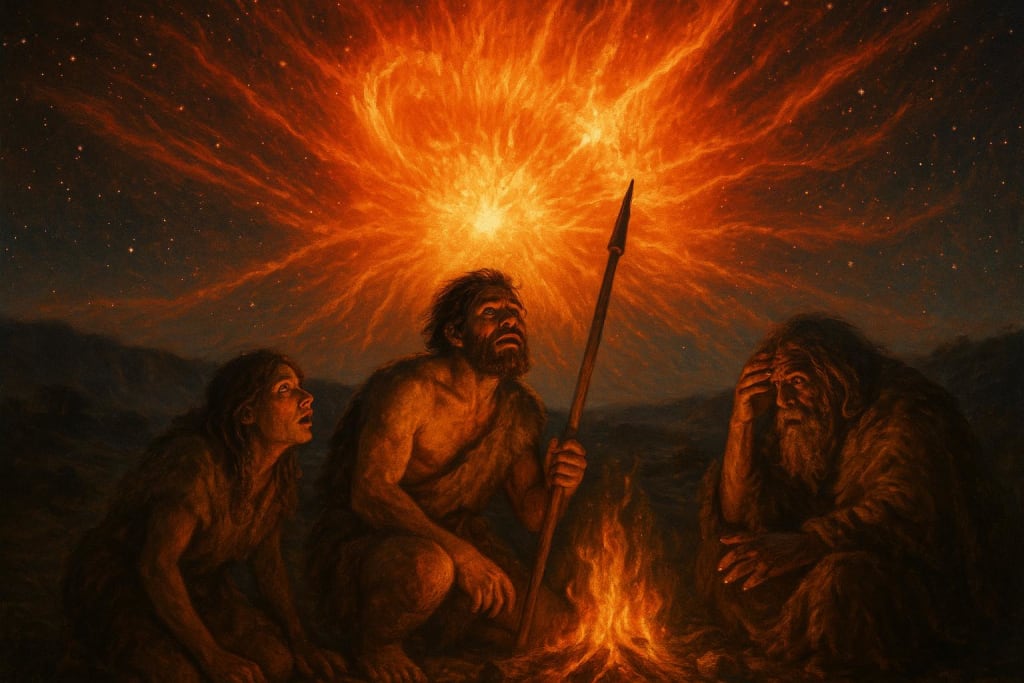
Imagine a world in which the Earth's magnetic shield weakened, exposing early humans to lethal cosmic radiation, the sky suddenly lit up with auroras, and the air vibrated with electricity. This was not a scene from a sci-fi movie; rather, it was a real-life occurrence that took place 41,000 years ago during a devastating solar storm.
Scientists have uncovered evidence of a massive geomagnetic disturbance known as the Laschamps Excursion, when Earth’s magnetic field nearly collapsed. At the same time, a powerful solar storm bombarded the planet with radiation. How did early humans managed to survive this cosmic catastrophe? Let’s dive into the mysteries of our ancient past.
The Laschamps Excursion, a brief reversal of the planet's magnetic poles, occurred approximately 41,000 years ago, and it was a rare and dramatic event. Life was exposed to solar and cosmic radiation because the magnetic field weakened to only 6% of its normal strength during this time.
At the same time, a massive solar storm that hit Earth with charged particles was launched by the Sun. Normally, these particles are deflected by our magnetic field; however, with its shield down, radiation levels increased. The environment and early humans would have been devastated by this double whammy of a weakening magnetic field and intense solar activity.
How do we know this happened? Scientists have found clues in:
- Ice Cores: Greenland and Antarctic ice cores show spikes in radioactive isotopes like beryllium-10 and chlorine-36, which form when cosmic rays hit the atmosphere.
- Tree Rings: Ancient trees preserved in bogs reveal increased radiocarbon levels from the same period.
- Geological Records: Rocks and sediments from the Laschamps period show signs of extreme magnetic fluctuations.
These findings confirm that Earth's magnetic defenses were down when it was struck by an unprecedented solar storm.
How Did Early Humans Survive?
Homo sapiens were still hunter-gatherers at this time, living in small, dispersed groups. European Neanderthals also existed, but they perished a few thousand years later. So, how did our ancestors endure this cosmic crisis?
1. Shelter in Caves and Natural Barriers: Early humans relied on caves and rock shelters for protection. These natural structures would have shielded them from increased UV radiation and solar particles. Some researchers suggest that the rise in cave art around this time (like the famous Chauvet Cave paintings) might be linked to humans spending more time underground.
2. Migration to Safer Regions: With the ozone layer weakened, ultraviolet radiation would have been deadly in open areas. Humans may have migrated toward lower latitudes where the magnetic field was slightly stronger, or to dense forests that provided natural cover from radiation.
3. Fire as a Survival Tool: Early humans relied heavily on fire to cook food, keep warm, and protect themselves. It could have also helped purify water by boiling it during this time, thereby warding off predators that were also struggling to survive in the harsh environment.
4. Biological Adaptations: Humans with darker skin pigmentation, which provides better protection from UV radiation, may have been more likely to survive, according to some scientists. During and after the occurrence, this may have had an impact on early human evolution.
5. Social Cooperation: Surviving a global catastrophe required teamwork. Early humans lived in tight-knit groups, sharing resources and knowledge. This social structure would have been crucial in weathering environmental crises.
The Laschamps Excursion and the accompanying solar storm occurred around the same time as:
- The decline of Neanderthals (though their extinction was likely due to multiple factors).
- A mini-ice age that may have been triggered or worsened by the solar event.
Human evolution may have been influenced by the acceleration of genetic mutations caused by climate change and radiation, according to some researchers. However, to support this theory, additional evidence is required.
Modern humans rely heavily on technology, which is vulnerable to solar storms. A similar event today could:
- Knock out satellites (disrupting GPS and communications).
- Damage power grids, causing widespread blackouts.
- Increase cancer rates due to higher radiation exposure.
The last major solar storm, the Carrington Event of 1859, caused telegraph systems to fail—but a storm like the one 41,000 years ago would be far worse. Scientists are now working on early warning systems and shielding technologies to protect our infrastructure.
The survival of early humans through a solar storm apocalypse 41,000 years ago is a testament to their resilience. By relying on natural shelters, social cooperation, and adaptability, they endured one of Earth’s most extreme cosmic disasters.
As modern humans, we face similar threats but with advanced science, we can prepare. Studying these ancient events reminds us of our planet’s vulnerability and the ingenuity required to survive.
Would we fare as well as our ancestors did if another solar storm struck today? Only time will tell.
About the Creator
Morsalin Russell
I’m a passionate writer with a knack for dissecting the issues that matter. Whether it’s culture, politics, or everyday life, I don’t just observe—I take a stand. My articles are more than just words; they also provoke thought.
Keep reading
More stories from Morsalin Russell and writers in Earth and other communities.
Did We Break the Planet?
One of the most pressing issues of our time is climate change, with headlines dominated by rising global temperatures, extreme weather, and melting ice caps. However, a crucial question remains: Do humans in fact contribute to climate change? While natural climate variability has existed for millions of years, the overwhelming scientific consensus points to human activities as the primary driver of recent rapid changes.
By Morsalin Russell11 months ago in Earth
Evidence Suggests a Large Hidden Planet May Exist in Our Solar System
For centuries, scientists believed the major members of our Solar System were fully known. From the rocky inner planets to the gas giants and icy bodies beyond, astronomers thought they had mapped most of the significant objects orbiting the Sun. However, new research by American scientists suggests that a large, hidden planet may still be lurking in the distant reaches of our Solar System.
By Irshad Abbasi 6 days ago in Earth
Pandora’s Burden
“My brother warned me to not accept gifts from the one who commissioned you,” said Epimetheus to the woman clad in silvery raiments standing at the entrance to the temple. Her silver tiara and the silver rings on her fingers and toes glinted in the firelight cast by torches set on either side of the doorway. Lingering in the shadows, beyond the reach of the flames as she was, he could not tell what she held in her hands. At first what appeared to be a box was perhaps a funerary urn, or maybe merely an apple.
By J. Otis Haasabout 23 hours ago in Fiction


Comments
There are no comments for this story
Be the first to respond and start the conversation.