
How AI Is Becoming the Next Geopolitical Frontier
Why algorithms, data, and computer chips are shaping global power faster than armies

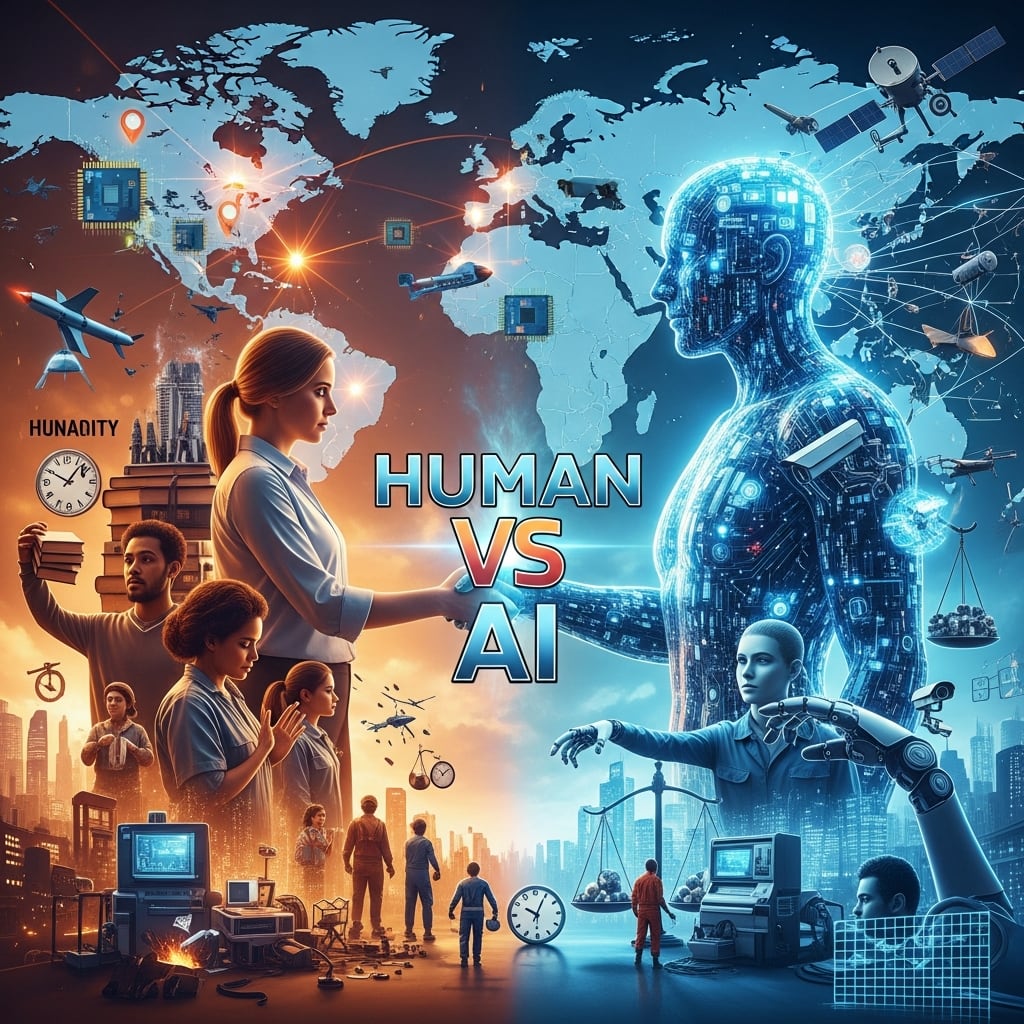
Why This Matters Right Now
The world is changing faster than ever. Wars, trade, jobs, and even daily life are being reshaped—not only by soldiers and weapons, but by artificial intelligence (AI).
Right now, countries are racing to control AI. The reason is simple: whoever leads in AI will likely lead in power, money, and influence. This race is already affecting global politics—and it is quietly touching the lives of ordinary people everywhere.
AI is no longer just a technology.
It is becoming the next geopolitical frontier.
From Guns to Algorithms
In the past, global power depended on land, oil, and military strength.
Today, power also depends on data, computer chips, and smart software.
AI can:
Analyze huge amounts of information in seconds
- Guide drones and military systems
- Control cyberattacks and digital defense
- Shape public opinion on social media
- Increase productivity in factories and offices
- Because of this, governments now treat AI as a strategic weapon.
The U.S. and China: A Global AI Race
The clearest example of AI geopolitics is the competition between the United States and China.
The U.S. leads in advanced AI research and top tech companies.
China leads in large-scale data use, surveillance technology, and fast deployment.
Both countries are spending billions of dollars on:
- Military AI systems
- Supercomputers and data centers
- Education and AI talent
In recent years, the U.S. has limited the export of advanced computer chips to China. The fear is that these chips could be used to build powerful military AI. As a result, technology trade has become a political tool.
🗺 Visual Suggestion:
A world map highlighting the U.S. and China, with arrows showing chip bans, data flows, and AI investments.
- AI Is Changing Modern Warfare
- AI is already present in today’s conflicts.
- Recent wars have shown:
- AI-powered drones that identify targets
- Satellites that analyze battlefields in real time
- Cyberattacks guided by machine learning
This reduces the need for large armies, but it increases speed and risk.
Decisions once made by humans in hours are now made by machines in seconds.
⚠️ The danger:
If AI makes mistakes, damage can happen before anyone can stop it.
Surveillance, Security, and Freedom
AI is also changing how governments watch and control societies.
In some countries, AI is used for:
- Facial recognition in public spaces
- Monitoring online activity
- Predicting protests or unrest
- Supporters say this improves safety.
- Critics warn it threatens privacy and freedom.
👤 Human Impact:
People may be tracked, judged, or punished by algorithms—often without knowing how decisions are made.
📸 Visual Suggestion:
A city image with cameras, data lines, and digital faces showing AI surveillance.
The Global Chip War
AI cannot work without semiconductors, also known as computer chips.
Only a few places in the world produce the most advanced chips. Taiwan is the most important of them all. This makes Taiwan a key geopolitical hotspot.
If chip production is disrupted:
- AI development slows
- Cars, phones, and medical devices become scarce
- Prices rise worldwide
💰 Economic Impact:
A serious chip crisis could cost the global economy trillions of dollars.
🗺 Visual Suggestion:
- A map showing Taiwan’s role in the global chip supply chain.
- AI, Jobs, and Inequality
- AI is not just a political issue. It directly affects workers and families.
AI can:
- Replace repetitive jobs
- Create new careers in tech and data
- Increase efficiency and profits
- But the benefits are uneven.
- Rich countries adopt AI faster
- Poor countries struggle to keep up
- Workers without skills face job loss
This creates a new divide:
AI-rich nations vs. AI-poor nations
📉 Human Cost:
Without training and support, millions of people risk being left behind.
Warnings From Experts
Many scientists and leaders are raising concerns.
One common message is clear:
“An uncontrolled AI race could be dangerous for everyone.”
There are growing calls for:
- Global AI rules
- Limits on autonomous weapons
- Protection of human rights
But trust between nations is weak, and competition is strong.
⏳ Timeline Visual:
- 2015–2019: AI research boom
- 2020–2022: AI enters surveillance and warfare
- 2023–Present: Global AI arms race intensifies
Why This Affects You
Even if you are not in politics or technology, AI geopolitics affects your life.
It influences:
- Job security
- Online privacy
- Cost of products
- National and global stability
Decisions made by governments and tech companies today will shape your future—often without headlines.
Final Thought
- AI is not just about smarter machines.
- It is about who controls power in the modern world.
- If countries use AI responsibly, it can bring growth and safety.
- If they chase dominance without rules, it could bring conflict and fear.
- The real challenge is not building intelligent systems—but using them wisely, while keeping humanity at the center.
About the Creator
LegacyWords
"Words have a Legancy all their own—I'm here to capture that flow. As a writer, I explore the melody of language, weaving stories, poetry, and insights that resonate. Join me as we discover the beats of life, one word at a time.
Keep reading
More stories from LegacyWords and writers in Earth and other communities.
USA vs Iran: A Military Mismatch in 2026
Comparing the U.S. and Iranian militaries is not about who would win a fair fight. It's about understanding two completely different ways of thinking about war. By 2026, the gap between their traditional strength will be wider than ever. The U.S. is a global superpower built to fight and win anywhere. Iran is a regional survivor, built to make an invasion so painful that no one would ever try.
By LegacyWords2 months ago in Earth
When the Stars Whispered
The Night Sky Like Never Before I had always been fascinated by astronomy, spending countless nights in my backyard with a modest telescope, charting constellations, tracking planets, and occasionally glimpsing distant galaxies as faint smudges of light against the infinite darkness. But on one crisp night in March 2026, something extraordinary occurred that defied both expectation and explanation, a cosmic phenomenon that no scientific journal could easily classify, and yet it felt intimately personal, as if the universe itself were reaching out to communicate. The sky was unusually clear, the stars sharp and luminous like diamonds scattered across black velvet, and the Milky Way stretched overhead in a ribbon of silvery light that seemed to pulse ever so slightly, a rhythm I hadn’t noticed before.
By The Curious Writerabout 3 hours ago in Earth


Comments
There are no comments for this story
Be the first to respond and start the conversation.