
High Ammonia in a Fish Tank: Safe Levels, Symptoms, and How to Fix It Fast
Ammonia damages fish gills within hours, blocking oxygen absorption even in well-aerated water immediate action prevents permanent injury and death.


High ammonia in a fish tank occurs when beneficial bacteria cannot convert fish waste fast enough, causing toxic buildup that burns gill tissue and blocks oxygen exchange. Safe ammonia levels are 0 ppm any reading above 0.25 ppm requires immediate action. Ammonia poisoning kills fish through respiratory failure, not suffocation, because damaged gills cannot extract oxygen from water regardless of aeration. Emergency treatment involves immediate 50% water changes, stopping feeding, and adding beneficial bacteria supplements.
High ammonia in aquariums occurs when fish waste exceeds beneficial bacteria capacity. Any ammonia above 0 ppm damages gills, blocks oxygen absorption, and can kill fish within days. Immediate water changes and biological filtration are required.
What Ammonia Actually Is
Ammonia is a nitrogen-based compound (NH₃/NH₄⁺) that fish excrete continuously through their gills and waste as their primary metabolic byproduct.

Every time a fish breathes, eats, or defecates, it releases ammonia directly into the water column. This compound exists in two forms: toxic unionized ammonia (NH₃) and less toxic ionized ammonium (NH₄⁺), with the ratio determined by pH and temperature—higher pH and warmer water increase the deadly unionized form.
Aquarium filters do not remove ammonia through mechanical or chemical filtration. Instead, beneficial bacteria colonies (primarily Nitrosomonas species) living in filter media, substrate, and surfaces convert ammonia to nitrite, then other bacteria (Nitrobacter) convert nitrite to nitrate. This biological process is the nitrogen cycle, and without established bacterial colonies, ammonia accumulates faster than any chemical can neutralize it.
Ammonia concentration is measured in parts per million (ppm) using liquid test kits or test strips. Liquid tests provide more accurate readings and are essential for emergency diagnosis.
Once ammonia is converted by beneficial bacteria, it can lead to high nitrite in a fish tank a situation involving a highly toxic compound that requires immediate control.
Safe vs Dangerous Ammonia Levels

Any ammonia reading above 0 ppm causes damage over time, with severity increasing rapidly above 0.5 ppm.
Even brief exposure to 0.5 ppm causes microscopic gill damage that accumulates over repeated incidents. Fish surviving ammonia spikes often develop chronic health issues that reduce their lifespan by months or years.
Why Ammonia Test Kits Can Be Misleading
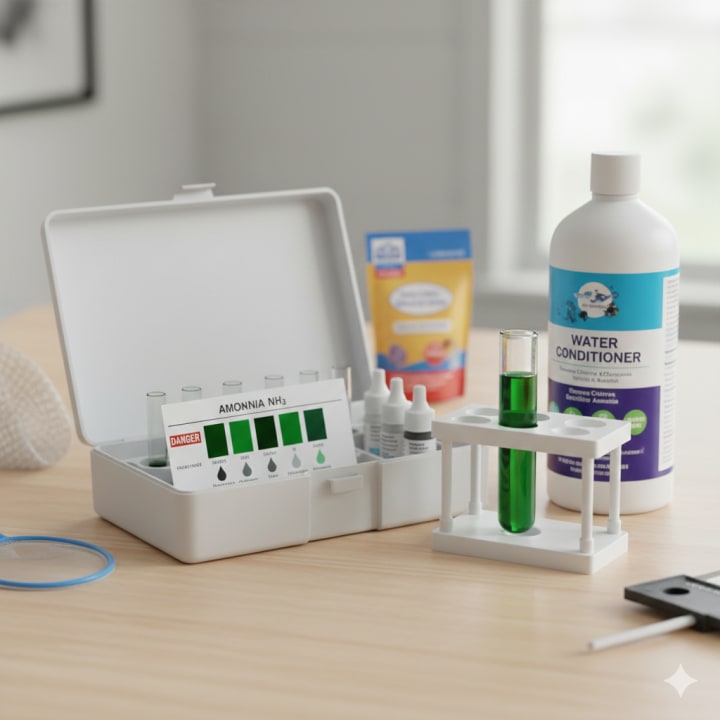
Most aquarium test kits measure total ammonia (NH₃ + NH₄⁺), not just the toxic form. This means a reading of 0.25–0.5 ppm can be mildly irritating or immediately lethal depending on pH and temperature.
Common causes of confusion:
- Water conditioners like Seachem Prime bind ammonia but do not remove it
- Bound ammonia still appears on test kits for 24–48 hours
- Fish may look stable while chemical ammonia remains present
If ammonia is detectable and fish show stress, treat it as toxic regardless of conditioner use or test kit interpretation.
Why Ammonia Kills Fish
Ammonia molecules are small enough to pass through gill membranes and enter fish bloodstreams, where they disrupt cellular function and damage delicate respiratory tissue.

The compound burns gill filaments—the feathery structures where gas exchange occurs—causing inflammation, mucus overproduction, and scarring. As gill tissue swells and deteriorates, the surface area available for oxygen absorption shrinks dramatically.
This is why fish gasp at the surface despite adequate oxygen levels in the water. Their gills are physically incapable of extracting oxygen efficiently, regardless of how much oxygen is present. The damage extends beyond respiration: ammonia in the bloodstream interferes with enzyme function, disrupts osmoregulation (the fish's ability to balance internal salt and water), and causes internal chemical burns to organs.
At concentrations above 1.0 ppm, ammonia begins breaking down red blood cells and damaging the central nervous system, leading to erratic behavior, loss of coordination, and eventual organ failure. Death results from a combination of respiratory failure, internal bleeding, and systemic toxicity.
How pH and Temperature Make Ammonia More Deadly
Ammonia toxicity depends on water chemistry, not just test kit numbers. The toxic form of ammonia (NH₃) increases as pH and temperature rise, meaning the same ppm reading can be far more dangerous under certain conditions.
- At pH 6.5, most ammonia exists as less toxic ammonium (NH₄⁺)
- At pH 8.0 and above, a much larger percentage converts to toxic NH₃
- Warmer water increases ammonia absorption and reduces dissolved oxygen
This explains why fish may die at "low" ammonia readings in warm or high-pH tanks. Always interpret ammonia alongside pH and temperature.
Key Takeaway: Ammonia kills fish by burning gill tissue, not by removing oxygen from water. Even well-aerated tanks cannot prevent death once gill damage occurs.
Symptoms of Ammonia Poisoning

Early Signs (0.25-0.5 ppm)
Fish exhibit increased gill movement and respirations per minute, spending more time near the surface or filter output where water flow is strongest. Appetite decreases noticeably, with fish showing less interest in food or refusing to eat entirely. Colors may appear slightly faded, and fish become less active, hovering in corners or behind decorations rather than swimming normally.
Moderate Poisoning (0.5-1.0 ppm)
Red or inflamed gills become visible, often with excess mucus production creating a slimy appearance. Fish develop clamped fins held tight against their bodies and may exhibit rapid, labored breathing or gasping at the water surface. Lethargy increases significantly, with fish lying on the bottom or floating motionless except when disturbed. Small red streaks may appear in fins (hemorrhaging) as blood vessels rupture under toxic stress.
Severe/Lethal Stage (1.0+ ppm)
Fish display frantic, erratic swimming or complete immobility, sometimes lying on their sides. Gills turn dark red or purple and may bleed visibly. Eyes bulge (exophthalmia) due to fluid accumulation behind the eyeball. Fish lose equilibrium and cannot maintain proper orientation in the water. Convulsions, violent twitching, or seizure-like movements occur shortly before death.
Common Causes of Ammonia Spikes
1. Uncycled Tank
New aquariums lack established bacterial colonies needed to process fish waste, causing ammonia to accumulate immediately after adding fish. Confirm by checking tank age—any aquarium less than 4-6 weeks old without fishless cycling is at high risk. Test kits showing ammonia but zero nitrite and nitrate indicate the nitrogen cycle has not begun.
2. Overstocking
Too many fish produce waste faster than bacteria can process it, even in cycled tanks. Calculate total fish bioload using adult sizes, not current juvenile sizes. Confirm by comparing current stocking to the "one inch of fish per gallon" guideline (though species-specific requirements vary). Tanks showing persistent low-level ammonia despite regular maintenance are typically overstocked.
3. Overfeeding
Uneaten food decays rapidly, releasing ammonia directly into the water within 24 hours. Fish should consume all food within 2-3 minutes. Confirm by inspecting the substrate for accumulated food debris or cloudy water indicating bacterial blooms from excess organics.
4. Dead Fish or Plant Decay
Decomposing organic matter releases massive ammonia amounts concentrated in small areas. A single dead fish can spike ammonia in small tanks within hours. Confirm by performing thorough visual inspection of all tank areas, especially behind decorations and inside dense plants. Decaying plant matter appears brown, mushy, and disintegrates when touched.
5. Filter Failure or Cleaning Error
Beneficial bacteria live primarily in filter media—cleaning with tap water or replacing all media simultaneously destroys these colonies, crashing the cycle. Confirm by reviewing recent maintenance: filters should be rinsed only in removed tank water, never tap water, and media should be replaced gradually (25% maximum at once).
6. Tap Water or Chloramine Issues
Some municipal water contains ammonia or chloramine (chlorine bonded to ammonia) that standard dechlorinators break apart, releasing free ammonia. Confirm by testing tap water directly before adding to the tank. If tap water shows ammonia, use dechlorinator products specifically labeled for chloramine neutralization.
Ammonia vs Chlorine vs Chloramine (Critical Distinction)
Chlorine and chloramine harm fish in different ways, but chloramine causes hidden ammonia spikes after water changes.
- Chlorine damages gills directly and dissipates quickly
- Chloramine breaks into chlorine and ammonia when neutralized
- Standard dechlorinators must explicitly neutralize chloramine
Many post–water change ammonia spikes occur because chloramine-treated tap water releases ammonia after dechlorination. Always test tap water separately.
If ammonia is detectable, fish are already being harmed—even if they appear normal.
How to Fix High Ammonia Fast

The steps below reduce ammonia immediately while protecting fish from further gill damage.
- Perform immediate 50% water change using temperature-matched, dechlorinated water
- Stop all feeding for 24-48 hours until ammonia drops below 0.25 ppm
- Add bottled beneficial bacteria supplement directly to filter
- Increase aeration with air stone or raise filter output above water surface
- Test ammonia every 4-6 hours to monitor decline
- Remove any visible dead fish, uneaten food, or decaying plant matter
- Reduce lighting to 6-8 hours daily to minimize stress
Step-by-Step Emergency Action Plan
Step 1: Test and Document Current Levels
Before taking any action, use a liquid test kit to establish baseline ammonia, nitrite, and nitrate readings. This information determines severity and helps track progress. Testing only ammonia misses critical context—high ammonia with zero nitrite indicates a stalled or uncycled tank, while high ammonia with elevated nitrite suggests an overwhelmed cycle.
Step 2: Perform Immediate 50% Water Change

Large water changes dilute ammonia concentration instantly, providing immediate relief to fish while biological solutions take effect. Use a gravel vacuum to remove debris and waste while draining. Match new water temperature within 2°F of tank temperature to avoid shock. Add dechlorinator to the full volume of new water before adding to tank—never assume tap water is safe.
Step 3: Stop Feeding Completely
Every feeding adds ammonia through fish waste and uneaten food breakdown. Healthy fish tolerate 3-5 days without food without harm, but cannot survive continued ammonia exposure. Resume feeding only after ammonia reads 0 ppm for 24 consecutive hours, starting with half normal portions.
Step 4: Add Beneficial Bacteria Supplement
Bottled bacteria products (Seachem Stability, API Quick Start, Fritz Turbo Start) introduce ammonia-processing bacteria directly into the system. Pour directly into filter intake or onto filter media for maximum effectiveness. These products accelerate but do not replace the natural cycling process—continued daily dosing for 7-14 days produces best results.
Step 5: Maximize Oxygenation
Ammonia-damaged gills struggle to extract oxygen, making supplemental aeration critical for survival. Add air stones, increase filter flow, or point filter output to break the water surface. Lower water temperature by 2-3°F if possible (higher temperatures hold less dissolved oxygen and increase ammonia toxicity).
Step 6: Remove All Ammonia Sources
Physically remove any visible dead fish, decaying plants, or accumulated food debris. Check behind decorations, inside caves, and in plant thickets where corpses hide. Trim dead or dying plant leaves at the base rather than pulling entire plants, which disturbs substrate and releases trapped ammonia.
Step 7: Retest After 4-6 Hours
Ammonia levels should drop by 50% or more after initial water change. If readings remain above 1.0 ppm, perform an additional 25-30% water change immediately. Continue testing every 6 hours for the first 24 hours, then twice daily until levels stabilize at zero.
Step 8: Implement Daily Maintenance Protocol
Perform 25-30% water changes daily until both ammonia and nitrite read 0 ppm consistently. This aggressive schedule prevents rebound spikes while beneficial bacteria populations rebuild. Test immediately before each water change to track progress.
What You Should NOT Do Next
❌ Wait to see if ammonia drops on its own.
Ammonia damage accumulates rapidly—every hour at toxic levels causes permanent gill scarring. Fish that "seem fine" are experiencing invisible internal damage that shortens their lifespan.
❌ Add more fish to "speed up cycling."
Adding fish to an ammonia spike guarantees additional deaths and provides no benefit. The tank must achieve zero ammonia before any additions.
❌ Deep-clean or replace all filter media.
This destroys remaining beneficial bacteria colonies, worsening the cycle crash. Clean only mechanical pre-filters and leave biological media untouched during emergencies.
❌ Rely exclusively on ammonia-binding chemicals.
Products like Seachem Prime temporarily bind ammonia into less toxic forms but do not remove it from the system. They provide 24-48 hours of relief at best and must be combined with water changes and bacteria supplementation.
❌ Continue regular feeding schedule.
Food converts directly to ammonia in hours. Feeding during a spike accelerates fish death.
❌ Assume the problem is solved after one water change.
Ammonia spikes result from underlying causes (uncycled tank, overstocking, overfeeding) that persist after water changes. Without addressing root causes, levels rebound within 24 hours.
When You Must Remove Fish (Last-Resort Survival Option)
If ammonia remains above 1.0 ppm after 24 hours of aggressive water changes, fish removal becomes a survival decision. Temporary relocation to a cycled tank prevents continued gill damage while the main tank stabilizes.
Leaving fish in toxic ammonia conditions causes irreversible injury even if ammonia later drops.
How Long Ammonia Takes to Reach Zero

In newly cycled tanks experiencing first ammonia spikes, beneficial bacteria populations can expand and process ammonia to zero within 7-14 days with proper intervention. Daily water changes combined with bacterial supplements typically show measurable progress within 48 hours—ammonia readings should drop and stay lower for longer periods between water changes.
Normal cycling progress appears as: ammonia rises then falls as nitrite rises, then nitrite falls as nitrate rises. Once ammonia and nitrite both remain at 0 ppm for three consecutive days, the cycle is complete. This entire process takes 4-8 weeks in new tanks without fish.
In established tanks with cycle crashes, recovery occurs faster (3-7 days) because some bacterial colonies survive in substrate and on decorations. If ammonia remains elevated after 5 days of aggressive water changes and bacterial dosing, the underlying cause (overstocking, massive overfeeding, complete filter media replacement) requires correction before the cycle can stabilize.
Intervention has failed if ammonia readings increase between daily water changes after one week of treatment, or if nitrite never appears despite falling ammonia levels. This indicates insufficient bacteria colonization requiring either reduced bioload (remove fish temporarily) or increased bacterial surface area (add sponge filters or additional media).
As ammonia and nitrite reach zero, nitrate begins to accumulate, leading to high nitrate in a fish tank that must be managed long-term to prevent chronic fish stress.
Fast Answer: With daily water changes and bacterial supplements, ammonia can reach 0 ppm in 3–14 days depending on tank maturity and bioload.
Preventing Ammonia Long-Term

Establish a disciplined feeding schedule of once daily or every other day, providing only what fish consume in 2-3 minutes. Overfeeding causes more ammonia problems than all other factors combined. Test food portions by feeding progressively smaller amounts until food disappears completely within the time limit.
Stock tanks gradually, adding small groups of fish every 2-3 weeks to allow bacterial populations to adjust to increased bioload. Calculate adult fish sizes, not purchase sizes, when planning stocking. Maintain one inch of adult fish per gallon as a maximum baseline, adjusting downward for high-waste species like goldfish or cichlids.
Clean mechanical pre-filters weekly in removed tank water to maintain flow rates, but disturb biological media only when absolutely necessary (once every 3-4 months maximum). Beneficial bacteria colonies require stable environments—frequent filter cleanings crash cycles as effectively as replacing all media at once.
Test water parameters weekly during stable periods, increasing to daily during the first month after setup or after any major changes (new fish, filter maintenance, medication use). Track results to identify gradual increases that signal developing problems before they become emergencies.
Perform routine 25% water changes weekly to remove nitrate accumulation and replenish trace minerals, even when test results appear perfect. Regular changes dilute accumulated organics and provide insurance against sudden spikes from unexpected causes.
Frequently Asked Questions
What ammonia level kills fish?
Ammonia becomes lethal at 2.0 ppm or higher, though permanent gill damage begins at any level above 0 ppm. Sensitive species may show distress at 0.25 ppm, while prolonged exposure above 0.5 ppm causes irreversible injury.
Can fish recover from ammonia poisoning?
Fish can recover from mild ammonia exposure if levels return to 0 ppm quickly. Moderate exposure causes permanent gill damage, while severe poisoning above 1.0 ppm often leads to death or long-term health failure.
Why is ammonia high but nitrite zero?
High ammonia with zero nitrite means the nitrogen cycle has not started or has crashed. This occurs in new tanks or after beneficial bacteria are destroyed, preventing ammonia conversion.
Does a water change remove ammonia?
Water changes dilute ammonia immediately but do not remove its source. Without biological filtration, ammonia levels will rise again within hours.
How fast does ammonia kill fish?
At levels above 2.0 ppm, ammonia can kill fish within 24–72 hours. Lower concentrations cause death over days through cumulative gill damage and stress.
Can you have ammonia in a cycled tank?
Yes. Cycled tanks can experience ammonia spikes if waste production exceeds bacterial capacity or if bacteria are disrupted by cleaning or medication.
What removes ammonia from fish tanks?
Only beneficial bacteria permanently remove ammonia by converting it into nitrite. Water changes and chemical binders provide temporary relief but do not eliminate ammonia production.
Does ammonia evaporate from aquarium water?
No. Ammonia does not evaporate in meaningful amounts. Water evaporation actually concentrates ammonia rather than reducing it.
Is any ammonia level safe for fish?
No. Safe ammonia levels are 0 ppm. Any detectable ammonia causes stress and gill damage over time.
Final Summary
- Ammonia is toxic to fish at any detectable level and damages gill tissue within hours
- Safe ammonia levels in aquariums are 0 ppm at all times
- Ammonia kills fish by burning gills, not by reducing oxygen in water
- Readings above 0.25 ppm require immediate water changes and intervention
- Beneficial bacteria are the only permanent solution for ammonia removal
- Most ammonia spikes are caused by uncycled tanks, overfeeding, or overstocking
- Chemical binders provide temporary relief but do not fix the root problem
- Regular testing and controlled feeding prevent nearly all ammonia emergencies
About the Creator
Arjun
Aquarium hobbyist sharing simple, real-world fixes for snail, shrimp, and plant problems. Clear guides, no fluff just practical tips to keep your tank healthy and thriving.
Rubio to Meet Danish Counterpart Next Week Amid Rising Tensions Over Greenland
Senator Marco Rubio, one of the United States’ most influential voices on foreign policy, is scheduled to meet with his Danish counterpart next week to discuss the escalating Greenland crisis. The meeting comes at a time of heightened tensions in the Arctic, where strategic interests, natural resources, and geopolitical maneuvering have turned the region into a flashpoint between global powers. Rubio’s upcoming discussions in Copenhagen highlight the United States’ concern over Greenland’s growing geopolitical significance. The Arctic island, while sparsely populated, sits atop vast mineral reserves and plays a critical role in transatlantic security. Denmark, which maintains sovereignty over Greenland, has increasingly found itself at the center of debates over foreign investment, security alliances, and the influence of countries such as China and Russia in the region. Greenland: A Strategic Prize The Arctic has long been considered a frontier of strategic importance. With melting ice opening new shipping routes and access to untapped natural resources, Greenland has moved from a remote territory to a focal point of global attention. For the United States, maintaining influence over Greenland is not just about economic interests—it’s a matter of national security. Military analysts have pointed out that Greenland’s location is critical for monitoring missile activity and for establishing early warning systems. U.S. officials have voiced concern that without a solid diplomatic and strategic partnership with Denmark, Greenland could become vulnerable to foreign influence that runs counter to American interests. Rubio’s meeting seeks to reaffirm U.S. commitments to Denmark while ensuring that Greenland’s strategic positioning aligns with shared Western priorities. The Current Crisis The so-called Greenland crisis has been fueled by several recent developments. Reports of increased Chinese investment in mining projects and infrastructure, as well as discussions of potential Russian interests, have sparked unease in Washington. While Denmark maintains administrative control over Greenland, the island enjoys a degree of autonomy, particularly in economic matters. This semi-independence has created a delicate balancing act for Danish leaders, who must reconcile Greenland’s economic ambitions with broader security concerns. Diplomatic sources suggest that Rubio will raise these points during his meetings, emphasizing the need for transparency and cooperation in Greenland’s economic and security decisions. “We are looking at a situation where strategic partnerships must be strengthened to safeguard both national and regional interests,” a source close to the senator said. Denmark’s Position Denmark has historically managed Greenland’s affairs with a careful approach, respecting the island’s autonomy while ensuring that strategic decisions do not compromise the kingdom’s security obligations. Copenhagen has been wary of any moves that could be perceived as overreach by external powers. However, Danish officials also recognize the need to balance Greenlandic economic development with defense commitments to NATO and the broader Western alliance. “The Arctic is not just about resources—it’s about alliances, responsibilities, and ensuring that Greenland’s growth does not undermine collective security,” said a Danish diplomat. Rubio’s visit is therefore expected to be both a reaffirmation of U.S.-Danish ties and an opportunity to coordinate policy responses to external pressures in the Arctic. Broader Implications The Greenland crisis illustrates the shifting dynamics of global politics in the Arctic. With climate change accelerating ice melt, previously inaccessible areas are now opening to international competition. Shipping lanes, mineral extraction, and energy resources are increasingly contested, making strategic cooperation between allies like the U.S. and Denmark more crucial than ever. For the United States, ensuring that Greenland remains aligned with Western strategic interests is paramount. Rubio’s engagement with Danish officials signals a commitment to proactive diplomacy, aiming to preempt any unilateral moves by other powers in the region. Analysts suggest that this approach could serve as a model for handling Arctic issues more broadly, combining respect for sovereignty with strategic foresight. Political Context Rubio’s involvement in Arctic affairs is consistent with his broader foreign policy focus, which emphasizes countering adversaries while strengthening alliances. The Greenland crisis is one of several areas where the senator has sought to assert influence, reflecting a broader U.S. strategy to maintain leadership in contested regions. Critics, however, argue that such interventions can strain relationships with local authorities and risk being perceived as heavy-handed. Balancing strategic priorities with respect for Greenland’s autonomy will be a central theme in the upcoming discussions. Observers will be watching closely to see whether the meeting strengthens U.S.-Danish cooperation or exposes fractures in alliance cohesion. Looking Ahead Next week’s meeting promises to be a critical moment in U.S.-Danish relations. Rubio is expected to discuss a range of issues, from military cooperation and infrastructure security to investment transparency and regional governance. While details of the agenda remain confidential, the broader goal is clear: to ensure that Greenland’s strategic importance does not become a source of tension between allies or an opportunity for rival powers. As Arctic geopolitics continues to evolve, the outcome of these discussions could shape policies for years to come. Greenland’s unique position—geographically remote yet globally significant—makes it a bellwether for how nations navigate the complexities of sovereignty, security, and economic opportunity in a rapidly changing world. Ultimately, Rubio’s diplomatic efforts underscore a central truth: in today’s interconnected world, even the most distant territories can have outsized impact on international relations. Greenland may be remote, but its role in the unfolding Arctic story is anything but marginal. The coming week in Copenhagen will be closely watched by policymakers, analysts, and the global media as the U.S. and Denmark work to navigate this delicate crisis together.
By Muhammad Hassan3 days ago in Earth




Comments
There are no comments for this story
Be the first to respond and start the conversation.