
Green Growth 50: Learning From Companies Boosting Profits While Cutting Emissions
Green Growth 50
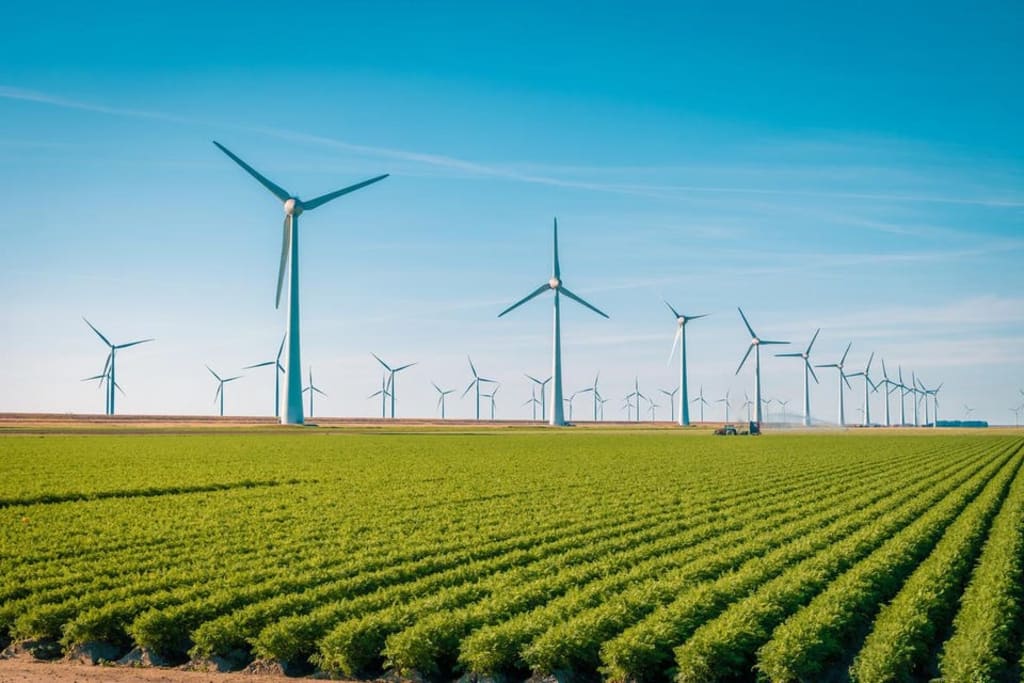
EBay at its very core pioneered the circular economy — of finding new homes for treasures that might otherwise have ended up at the dump. “Avoiding items going into a landfill is very important to our customers,” says Steve Priest, CFO of eBay. “Driving the circular economy is part of everything we do.” But finding new shelves for Beanie Babies is just a small component in eBay’s sustainability efforts, which prioritize slashing greenhouse gas emissions. In eBay’s case, these are mostly tied to electricity used to power vast data centers. Since 2017 eBay has cut its carbon emissions by 29% to 88,000 tons per year. The e-commerce giant became carbon neutral this year and is aiming to achieve a 100% renewable electricity supply for all its offices and data centers by 2025.
This goal might be attainable in the next few years as eBay’s biggest clean energy projects are yet to come online. The White Mesa Wind Project in Texas (a joint venture with Apple, Sprint and Samsung) began operating this year, producing 75 peak megawatts for the four companies, enough to power 20,000 homes. Meanwhile, the Ventress Solar Project in Louisiana, a virtual purchase power agreement between eBay, McDonald's, and BP’s Lightsource division, will generate 345 MW. “We collaborate with our tech peers when some sustainability issues come up, where banding together makes more sense,” says eBay's chief sustainability officer Renee Morin.
Such efforts have earned eBay the no. 11 spot on our inaugural Forbes Green Growth 50 list. Using emissions data from Sustainalytics and financial data from FactSet Research Systems, we honed in on U.S. companies with market caps greater than $5 billion, that started with more than 100,000 tons of carbon dioxide equivalent emissions in 2017, and have since successfully reduced their emissions while simultaneously growing profitability (as measured by an absolute increase in net income or operating income from 2017-2020). Going in, we figured these criteria would produce a list of more than 100 companies. But green growth is harder than it looks — both Weyerhaeuser and Edison International, ranking no. 21 and no. 10 on our list, grew earning less than 2% since 2017.
Is there a connection between cutting carbon emissions and boosting earnings? eBay’s Priest thinks we’ve reached the point where companies that don’t care about green will find it nearly impossible to deliver growth. “Customers want to be associated with corporations that take their environmental responsibilities very seriously. Those that do will continue to drive loyalty from their customer base.”
This is a strategic emphasis echoed by Stephan Tanda, CEO of Aptar, which took the no. 1 spot on the Green Growth 50. Aptar makes myriad drug delivery systems and dispensing products for consumer goods, especially foods and cosmetics. “We look at everything we do through a sustainability lens.” Most of Aptar’s facilities in Europe are already certified landfill free. By the end of the year, Aptar is looking to achieve “80% disposal avoidance.” It’s a business that involves reconciling contradictions — most of their products are plastic, which he says actually has a pretty low carbon footprint relative to alternative containers. A new Aptar product is a “mono-material” lotion pump with no metal parts, entirely recyclable.
Consumer demand for such new products is arguably more impactful than the kind of government policy circus on display at the recent COP26 meetings in Glasgow, Scotland.
“Governments don’t impact what we do that much. Consumers and patients and customers demand what we do,” says Tanda. They will pay for the carbon transition because it is what they want. Listening to the consumers is how Tanda aims to “future proof our business.”
That approach has worked for electricity giant AES, which landed no. 15 on the Green Growth 50 list after reducing emissions by 22%, replacing coal-fired power plants with wind, solar and batteries — “a winning combination that can decarbonize 90% of the grid,” says Chris Shelton, president of AES Next. Because the costs of renewables kept going down, they were able to shift customers over under a “green, blend and extend” program.
About the Creator
Keep reading
More stories from Marinescu Eduard and writers in Earth and other communities.
The Reality of the Illusion of Time
Recently, as I strolled along the short stretch to my strength training session, I aimlessly took in the row of tatty shops and shabby buildings along the route and passed an off-street, in which one of my sisters used to live, around thirteen years ago.
By Chantal Christie Weiss3 days ago in Earth
Why Putin Went Quiet When Challenged by Trump Over Venezuela
When U.S. forces captured Venezuelan President Nicolás Maduro in early January 2026, the world was stunned. Venezuela has long been a Russian ally, yet Russian President Vladimir Putin remained almost completely silent when challenged directly by U.S. President Donald Trump. Why would a leader so often outspoken on the world stage hold back in such a dramatic moment? Let’s unpack the story and explore what it means for global politics. A Bold Move That Shocked the World On January 3, U.S. forces executed a daring operation in Venezuela, taking Maduro into custody in New York to face charges including drug trafficking and narco‑terrorism. The operation was framed by the U.S. as a step to enforce justice, but critics saw it as an extraordinary overreach of power. Venezuela is no ordinary country for Russia. Since the days of Hugo Chávez, Moscow has cultivated close ties with Caracas, offering military support, energy deals, and diplomatic backing on the global stage. Past actions included Russian bombers visiting Venezuela and high-profile defense agreements. Given this history, many expected a fiery response from Putin. Yet, the Kremlin remained calm, issuing measured statements rather than sharp threats. Why Silence Was Strategic Experts suggest there are several reasons for Putin’s muted reaction, each revealing the careful calculation behind the Kremlin’s foreign policy. 1. Focus on the War in Ukraine Russia’s primary priority remains Ukraine. Engaged in a high-stakes military and diplomatic battle, Putin cannot afford distractions or new confrontations far from home. Escalating tensions with the United States over Venezuela could jeopardize Moscow’s position in Europe. A New York Times report highlighted that Russia is “subordinating all other interests to the war in Ukraine,” suggesting that even a high-profile ally like Venezuela takes a back seat to Moscow’s strategic goals. 2. Limited Military Options While Russia’s alliance with Venezuela is longstanding, much of the support has been symbolic rather than operational. Defense systems and military cooperation exist on paper, but Russia lacks the immediate ability to counter a U.S. operation thousands of miles away. Putin may have recognized that responding aggressively would be both ineffective and costly, potentially risking military and economic consequences that Moscow cannot afford. 3. Maintaining Diplomatic Channels with Washington With Donald Trump back in the White House since 2025, there has been cautious optimism in Moscow about recalibrating U.S.–Russia relations. Avoiding a dramatic confrontation over Venezuela keeps diplomatic channels open, allowing Russia to negotiate on other high-priority issues like Ukraine and sanctions relief. In other words, silence can be a calculated strategy, signaling restraint rather than weakness. 4. Russia’s Global Influence Is Waning The Maduro episode also highlights a broader geopolitical reality: Russia’s global reach has limits. Since the 2022 invasion of Ukraine, Moscow’s influence in regions like the Middle East and parts of the former Soviet Union has weakened. Venezuela remains one of its few high-profile allies outside Europe, but even there, Russia’s power is largely symbolic. By not escalating, Putin is acknowledging a practical truth: Russia cannot be everywhere at once, and some battles are not worth fighting. 5. Choosing Battles Wisely Some analysts emphasize that Putin’s quiet response is more about strategic prioritization than capitulation. In a world dominated by nuclear powers and volatile global politics, direct confrontation with the United States over Venezuela could spiral into a far larger crisis. By staying silent, the Kremlin may be signaling that it picks its battles carefully, focusing resources on Ukraine, where the stakes are highest. What This Means for the World Putin’s silence sends several messages: Russia is currently stretched, economically and militarily. Moscow is prioritizing Ukraine over symbolic allies. Strategic restraint is sometimes more powerful than public confrontation. The limits of Russian influence are becoming more visible to the world. This episode reflects a new reality in geopolitics: power is as much about choosing when not to act as when to assert force. The Bigger Picture The capture of Maduro is a defining moment not just for Venezuela, but for global politics. It shows the United States asserting power in a way not seen for decades, while Russia’s quiet reaction underscores its current limits and priorities. For observers, Putin’s silence is a lesson in modern geopolitics: even the most assertive leaders exercise restraint when stakes are high and risks are global. In the end, the Maduro affair reminds us that in today’s world, the loudest response is not always the most effective one — sometimes, quiet calculation speaks volumes. Sources and Further Reading The US capture of Maduro reveals Russia’s weakness – Atlantic Council ‘It sends a horrible signal’: US politicians react to capture of Nicolás Maduro – The Guardian Russia slams 'neocolonial threats' against Venezuela – Reuters
By Muhammad Hassan6 days ago in Earth



Comments
There are no comments for this story
Be the first to respond and start the conversation.