
global warming
The moral responsibility of leaving a livable planet for future generations.
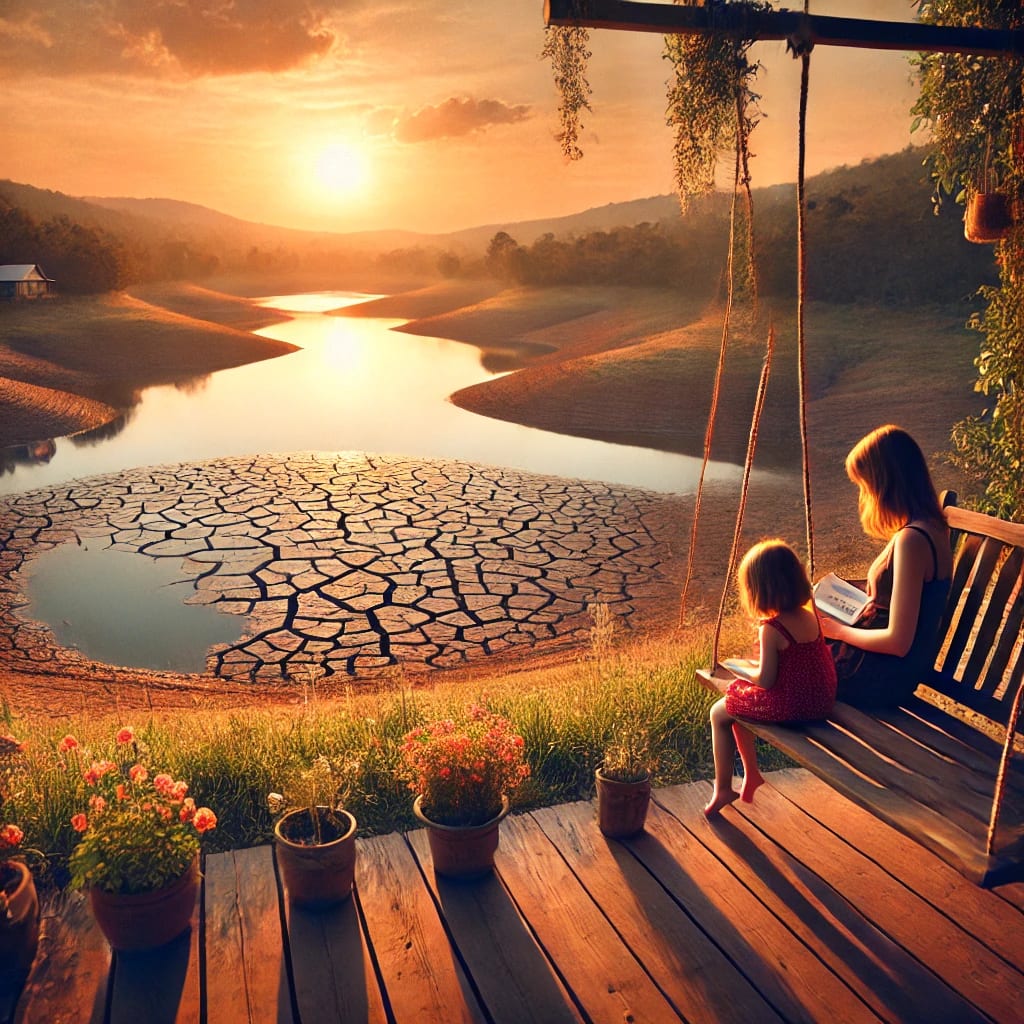
The Weight of Tomorrow
The sun dipped below the horizon, casting a golden hue over the small lakeside town where Emma and her eight-year-old daughter, Lily, lived. The gentle ripples of the water glimmered, reflecting the setting sun, as if nature herself was offering one last breathtaking display before the world continued its downward spiral.
Emma sat on the wooden porch swing, her fingers nervously tracing the edges of a tattered notebook. Inside were sketches and ideas, remnants of the plans she once had for the future. Lily, with her sun-streaked hair and boundless curiosity, was crouched near the edge of the yard, collecting tiny wildflowers that had somehow survived the unrelenting summer heat.
"Mommy," Lily called, holding up a small daisy. "Do you think flowers will always grow like this?"
Emma’s chest tightened. She knew what Lily didn’t: the summers were growing hotter every year, the rain more unpredictable, the soil less forgiving. "I hope so, sweetheart," she replied, forcing a smile. "Flowers are very strong. They always find a way to bloom."
But Emma wasn’t sure anymore.
A World Unraveling
Years ago, Emma had been an environmental scientist. She had worked tirelessly with a team of researchers, warning policymakers about the impending climate crisis. She had written papers, attended conferences, and even stood in front of crowds pleading for change. But the urgency of their warnings had been met with apathy or outright denial. And now, she was watching the world unravel in real time.
Their small town had been spared the worst of the disasters so far, but the signs were everywhere. The lake that had once been a hub of life for the community was shrinking, its edges receding each year like a slow, painful gasp. The winters, once blanketed in snow, now brought icy rains that froze the streets but left the fields dry. Birds that used to herald the seasons with their migrations were fewer and quieter now.
But what haunted Emma most was the question: what kind of world was she leaving for Lily?
The School Play
The next evening, Emma and Lily attended a school play. The children had put together a performance called "The Planet We Love." Lily, wearing a cardboard costume shaped like a tree, was beaming with pride. She had practiced her lines for weeks.
“Trees give you air to breathe,
They shade you from the sun,
Protect them, care for them,
So life can still be fun!”
The audience clapped politely, but Emma noticed some parents exchanging weary glances. She overheard snippets of conversation: “What’s the point of teaching them this when the world’s already burning?” one man muttered.
Emma clenched her fists. The defeat in his voice mirrored the sentiments she had heard so many times before. Was it too late? Was she naïve for still holding onto hope?
That night, after Lily had fallen asleep clutching her little paper tree, Emma found herself staring at the ceiling, tears slipping silently down her cheeks.
A Promise to Lily
The next morning, Lily bounded into the kitchen with a determined look. "Mommy," she said, plopping a crayon drawing onto the table, "when I grow up, I want to save the trees. And the animals. And the water, too."
Emma studied the picture. It was a colorful scene of a lush forest, with a smiling sun shining down and animals frolicking happily. In the middle stood a stick-figure version of Lily, arms outstretched as if she were protecting it all.
"That’s beautiful, Lily," Emma said, her voice trembling.
"But what if the trees are gone by then?" Lily asked, her wide eyes filling with worry.
Emma knelt beside her, holding her tiny hands. "They won’t be," she said firmly, more to herself than to her daughter. "Because we’re going to fight for them. Together."
The Garden of Hope
That weekend, Emma and Lily began transforming their small backyard into a garden. They dug through the dry, cracked soil, planting wildflowers, vegetables, and even a few young saplings. They spent hours learning about composting, water conservation, and pollinators.
At first, it was just the two of them. But soon, neighbors started noticing their efforts. An elderly man down the street donated a pile of mulch he didn’t need. A group of teenagers offered to paint signs encouraging sustainability. Families came together to plant gardens of their own, inspired by the sight of Emma and Lily working side by side.
The garden became a symbol of resilience in the face of despair. It wasn’t a solution to the global crisis, but it was a start. And in the act of nurturing life, Emma found herself rediscovering a sense of purpose she thought she had lost.
Lily’s Questions
One evening, as they watered the garden under the fading light, Lily asked, "Mommy, why didn’t people fix the planet before it got so bad?"
Emma hesitated. How could she explain the complexity of human greed, denial, and short-term thinking to an eight-year-old? Instead, she said, "Sometimes people don’t see how important something is until it’s almost gone. But we can still fix it, Lily. We just have to work very hard."
"Like our garden?" Lily asked.
"Exactly like our garden," Emma said, pulling her daughter into a hug.
The Letter
Months later, Lily came home from school with a project: write a letter to future generations. She showed Emma her draft, written in her uneven, childlike scrawl:
"Dear kids in the future,
I hope you still have trees and animals and flowers. My mommy says we have to take care of them or they might go away. I love nature and I hope you do too. Please keep it safe for the kids after you, just like we’re trying to do for you. Love, Lily."
Emma read the letter, her throat tightening with emotion. It was simple, but it carried the weight of everything she hoped for.
A Legacy Worth Fighting For
As Emma tucked Lily into bed that night, she thought about the world her daughter would inherit. It wasn’t perfect, and the road ahead was daunting. But she also realized that every action, no matter how small, carried a ripple of hope.
Emma couldn’t undo the damage of the past, but she could teach Lily the value of compassion, resilience, and responsibility. She could show her that even in the face of overwhelming odds, it was possible to make a difference.
As Lily drifted off to sleep, Emma whispered, "I promise, I’ll do everything I can to leave you a world worth living in."
And for the first time in years, Emma felt the stirrings of something she thought she had lost: hope.
About the Creator
Keep reading
More stories from writers in Earth and other communities.
China Has Planted So Many Trees Around the Taklamakan Desert That It’s Turned This ‘Biological Void’ Into a Carbon Sink
For generations, the Taklamakan Desert in northwestern China was considered one of the most lifeless places on Earth. Stretching across more than 330,000 square kilometers, this vast sea of sand earned the nickname “biological void” because almost nothing could survive its blistering heat, shifting dunes, and extreme lack of rainfall.
By Sajida Sikandar3 days ago in Earth
Americans Are Losing Hope: What the Latest Gallup Poll Reveals About the Depth of National Gloom
For generations, optimism has been a defining feature of the American identity. The belief that tomorrow will be better than today has powered economic growth, social movements, and personal ambition. But a new Gallup poll suggests that this long-standing sense of hope may be fading — and fading fast. The latest data paints a sobering picture: fewer Americans believe their future will be better than their present. The numbers reveal not just temporary frustration, but a deeper and more widespread sense of uncertainty about where the country — and their own lives — are headed. Let’s take a closer look at what the poll shows and why it matters. Optimism at a Near Record Low Gallup’s survey asks Americans to rate their current lives and where they expect to be five years from now on a scale of 0 to 10. Those who rate their future at 8 or above are considered optimistic about what lies ahead. In 2025, only about 59% of Americans rated their future lives this positively — the lowest level recorded in nearly two decades of tracking. That marks a significant drop compared to earlier years when optimism was considerably stronger. Even more striking is the number of Americans classified as “thriving” — those who rate both their present life positively and expect a strong future. Fewer than half of Americans now meet that standard. In simple terms: many Americans don’t feel confident that the next five years will bring improvement. Future Expectations Are Falling Faster Than Present Satisfaction One of the most revealing aspects of the poll is this: Americans’ satisfaction with their current lives has declined somewhat over time — but expectations for the future have fallen nearly twice as sharply. This suggests that people aren’t only reacting to immediate struggles like inflation, housing costs, or political tension. Instead, they’re losing confidence in long-term progress. It’s one thing to feel frustrated about today. It’s another to believe tomorrow won’t be better. That shift in mindset signals something deeper than economic anxiety. It reflects a broader uncertainty about opportunity, stability, and national direction. Political Divides Deepen the Gloom Political affiliation plays a major role in how Americans view the future. Historically, supporters of the party in power tend to feel more optimistic, while supporters of the opposition feel less hopeful. That pattern continues — but the most recent drop among Democrats following the 2024 election has been particularly sharp. At the same time, Republicans’ optimism has risen slightly with their party holding power, but not enough to offset the overall national decline. In fact, even many Republicans report less optimism compared to previous years. The result? A country where hope is fractured along partisan lines — and where national unity around a shared positive future seems increasingly distant. Economic Anxiety Remains a Key Driver Although unemployment rates and certain economic indicators appear stable on paper, many Americans continue to feel financial pressure. Housing affordability, rising insurance costs, healthcare expenses, and lingering concerns about inflation weigh heavily on households. Even when wages increase, they often struggle to keep pace with living costs. This disconnect between official economic data and everyday experience may be fueling skepticism. When people don’t feel tangible improvement in their daily lives, they are less likely to believe broader economic success stories. Consumer confidence matters because it influences spending, investment, and long-term planning. If Americans feel uncertain, they may delay major decisions — buying homes, starting businesses, or expanding families. Over time, that hesitation can ripple through the broader economy. Younger Americans Are Especially Concerned Younger adults, particularly those under 35, are among the most worried about politics and governance. Many feel burdened by student debt, high housing prices, and an increasingly polarized political climate. For a generation raised during financial crises, a global pandemic, and intense political division, optimism may not come as naturally as it once did for earlier generations. When young people — the group typically most hopeful about the future — begin expressing deep skepticism, it signals a potentially long-term cultural shift. Why Public Optimism Matters It’s easy to dismiss survey data as just numbers. But collective optimism plays a powerful role in shaping national outcomes. Hope influences: Economic behavior – People invest, spend, and innovate when they believe in future growth. Civic engagement – Optimistic citizens are more likely to vote, volunteer, and participate in community life. Mental health – A positive outlook is closely tied to emotional well-being and resilience. Social stability – Societies with higher trust and shared optimism tend to experience less unrest. When optimism declines broadly, the effects can extend far beyond individual moods. Is This Temporary — or Structural? The key question is whether this drop represents a short-term reaction to political and economic cycles, or a deeper structural shift. America has faced moments of pessimism before — during recessions, wars, and periods of social upheaval. In many cases, optimism eventually rebounded. But today’s challenges feel layered: economic pressure, political polarization, institutional distrust, global instability, and rapid technological change all combine to create uncertainty. Unlike previous downturns driven by a single crisis, today’s gloom appears multifaceted. What Could Restore Confidence? Rebuilding optimism likely requires more than improved economic statistics. Americans may need to see tangible progress in areas that affect daily life: Affordable housing and healthcare Stable prices and wages that keep up with costs Reduced political dysfunction Greater institutional trust Clear long-term national direction Leadership, transparency, and practical solutions matter. When people see systems working effectively, confidence tends to rise. A Turning Point for the American Mood The latest Gallup poll doesn’t suggest Americans have given up entirely. A majority still believe in a positive future — but that majority is shrinking. The data reveals something significant: the American belief in steady progress is no longer a given. Whether this period becomes a temporary dip or a lasting transformation depends on how leaders, institutions, and communities respond. Optimism has long been one of America’s greatest strengths. The challenge now is whether it can be renewed in an era defined by uncertainty. If history offers any lesson, it’s this: public mood can change — but it rarely changes on its own.
By Ayesha Lashari4 days ago in Earth
Blessed 33
So I woke up on the morning of February 5, 2026 and guess what and you know what I realized? It’s my 33rd birthday. Do you know what that means? Yes, technically I’m getting old, but what I couldn’t have guessed was this would be one of the best days of my life.
By Joe Patterson7 days ago in Confessions



Comments
There are no comments for this story
Be the first to respond and start the conversation.