
China Has Planted So Many Trees Around the Taklamakan Desert That It’s Turned This ‘Biological Void’ Into a Carbon Sink
“How massive reforestation efforts transformed one of the world’s harshest deserts into a powerful tool against climate change.”

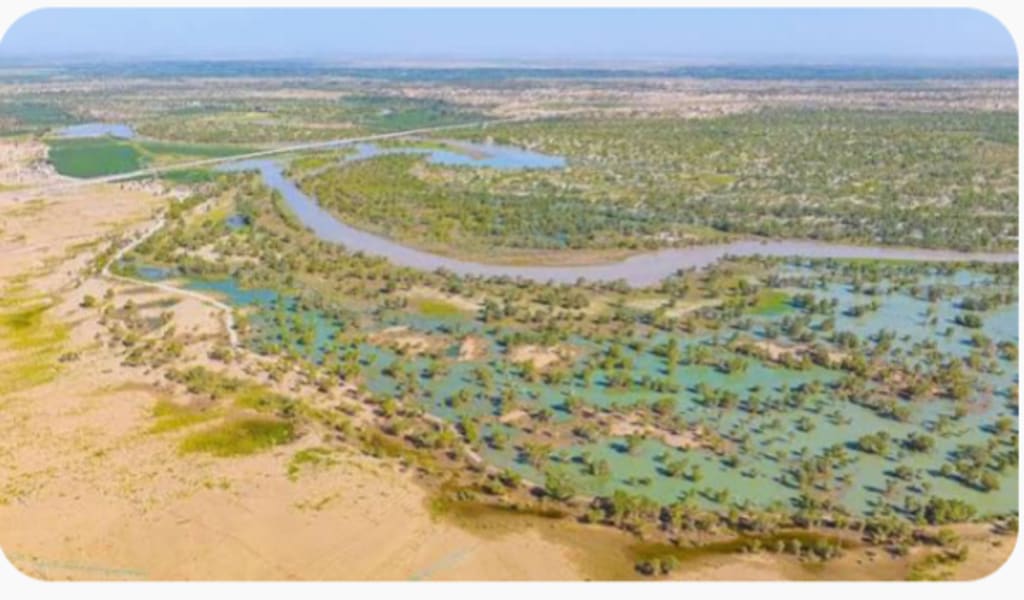
For generations, the Taklamakan Desert in northwestern China was considered one of the most lifeless places on Earth. Stretching across more than 330,000 square kilometers, this vast sea of sand earned the nickname “biological void” because almost nothing could survive its blistering heat, shifting dunes, and extreme lack of rainfall.
But today, something remarkable is happening around its edges.
After decades of massive tree-planting and land restoration projects, scientists now say parts of the Taklamakan Desert have become a carbon sink—an ecosystem that absorbs more carbon dioxide from the atmosphere than it releases. What was once a symbol of desolation is now playing a role in the fight against climate change.
This transformation is not accidental. It is the result of one of the largest environmental engineering projects in human history.
🌱 A Desert Once Thought Impossible to Green
The Taklamakan Desert sits in China’s Xinjiang region and is surrounded by towering mountain ranges that block moist air from reaching it. Rainfall is extremely rare, and temperatures can swing from freezing winters to scorching summers above 40°C (104°F).
For centuries, vegetation barely survived beyond small oasis settlements. Windstorms regularly carried sand into nearby cities and farmland, threatening transportation routes and human health. The desert steadily expanded, swallowing nearby land and pushing communities farther away.
Scientists once believed that large-scale vegetation growth in this region was simply unrealistic.
China decided to challenge that assumption.
🌳 The Great Green Wall Project
In 1978, China launched the Three-North Shelterbelt Program, often called the Great Green Wall of China. The goal was simple but ambitious: stop desertification and protect northern regions from sandstorms by planting trees and shrubs across arid lands.
Over the next four decades, billions of trees were planted across northern China, including a massive effort to surround the Taklamakan Desert with a ring of vegetation.
Rather than planting trees deep inside the shifting dunes, workers focused on stabilizing the desert’s edges—where limited water could support hardy plant species like poplar trees, tamarisk shrubs, and drought-resistant grasses.
This created what scientists now call a “green belt” around the desert.
☁️ From Sand to Carbon Sink
The most surprising outcome of this greening effort is its impact on carbon dioxide.
Recent scientific studies using satellite data and ground measurements discovered that the newly vegetated desert edges are actively absorbing CO₂ from the atmosphere. During wet seasons, plant growth increases dramatically, leading to higher levels of photosynthesis and measurable drops in local carbon concentration.
In simple terms:
Plants that did not exist before are now capturing carbon in a place that once emitted almost none.
This makes the Taklamakan’s outer regions one of the world’s first examples of a human-created carbon sink in a desert environment.
Carbon sinks are critical in slowing climate change. Forests, wetlands, and oceans already absorb about one-third of human-produced carbon emissions each year. Adding new sinks—even in extreme environments—could play a key role in future climate strategies.
🌍 Why This Matters for the Planet
The success around the Taklamakan Desert sends an important message:
Even the harshest ecosystems can be restored if efforts are long-term and carefully managed.
As climate change increases droughts and desertification worldwide, many regions—such as parts of Africa, Central Asia, and the Middle East—face similar challenges. China’s approach demonstrates that:
Large-scale afforestation can reduce erosion
Vegetation can stabilize land and improve air quality
Deserts can contribute to carbon capture
Human action can reverse environmental damage
It also shows that climate solutions do not always have to rely solely on technology. Sometimes, planting trees—done correctly and persistently—can reshape entire landscapes.
⚠️ Challenges and Criticism
Despite the success, the project is not without controversy.
Some scientists warn that planting too many trees in arid regions can strain water resources. Deserts naturally evolved with little vegetation, and introducing forests must be balanced with the local climate and soil conditions.
Another concern is biodiversity. Many of the planted areas use only a few species of trees, which can make the ecosystem vulnerable to pests and disease. True environmental restoration requires diverse plant life, not just mass planting.
Additionally, while the green belt has reduced erosion locally, sandstorms still affect northern Chinese cities. Tree planting alone cannot solve every environmental problem.
Long-term survival of the planted forests will depend on careful management, sustainable water use, and adapting to rising global temperatures.
🌿 A New Identity for the Taklamakan
The Taklamakan Desert will never become a rainforest—and it shouldn’t. Deserts are valuable ecosystems in their own right. But what has changed is the way humans interact with this landscape.
Instead of retreating from it, China has learned how to work with its limits, creating a buffer zone of life where none existed before. This shift has given the desert a new role: not just as a harsh environment, but as a contributor to climate stability.
What was once labeled a “biological void” is now part of the global effort to absorb carbon and protect nearby communities from environmental harm.
🌏 Final Thoughts
China’s decades-long project around the Taklamakan Desert is a powerful example of patience, scale, and commitment. It reminds us that environmental restoration does not happen overnight—it requires years of effort and continuous learning.
The transformation from barren sand to carbon-absorbing greenery shows what is possible when science, policy, and persistence come together.
In a world struggling with climate change, this desert story offers something rare:
proof that damaged landscapes can be healed—and that even the most unlikely places can help protect our future
About the Creator
Sajida Sikandar
Hi, I’m Sajida Sikandar, a passionate blogger with 3 years of experience in crafting engaging and insightful content. Join me as I share my thoughts, stories, and ideas on a variety of topics that matter to you.
Keep reading
More stories from Sajida Sikandar and writers in Earth and other communities.
“It has ventilation systems, food storage, nurseries, toilets and highways” – 11 animals that build villages, towns and even cities
Nature’s architects don’t wear hard hats or use blueprints, yet their constructions rival human engineering in complexity and purpose. Across forests, deserts, oceans, and underground worlds, animals build elaborate homes complete with ventilation systems, food storage rooms, nurseries, waste disposal areas, and even transportation routes that function like highways.
By Sajida Sikandarabout 4 hours ago in Earth
The Northern Lights: Nature’s Mesmerizing Nighttime Spectacle
The Northern Lights, or Aurora Borealis, have fascinated humans for centuries. Their mysterious, shimmering waves of green, purple, and pink light dance across the Arctic skies, inspiring myths, legends, and scientific curiosity. But what causes this spectacular display, and why does it keep appearing, year after year, even today?
By Ayesha Lashari4 days ago in Earth
Scrapping of Jersey Solar Farm Plans Welcomed
The decision to scrap the proposed solar farm plans in Jersey has been widely welcomed by residents, environmental groups, and agricultural stakeholders, marking a significant moment in the island’s ongoing debate over sustainable development. While renewable energy remains a vital priority in the fight against climate change, the shelving of this particular project has highlighted the importance of balancing green ambitions with land preservation, food security, and community consent.
By Ayesha Lashari3 days ago in Earth



Comments
There are no comments for this story
Be the first to respond and start the conversation.