
Global Warming and the Coming Water Crisis
How a warming planet threatens our rivers, our crops, and the future of humanity


The Thirsting Earth: A Story of Global Warming and the Coming Water Crisis
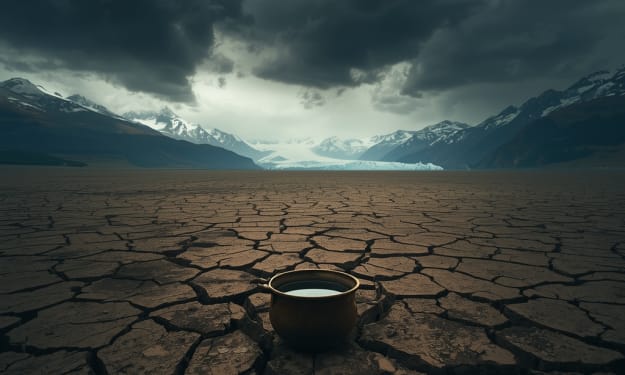
Global warming is no longer a distant threat—it is already reshaping our planet in silent but devastating ways. Among its most dangerous consequences is the growing global water crisis. What once seemed impossible—that the world could run out of fresh water—is now becoming reality. Rivers are shrinking, glaciers are melting, and communities are fighting over access to something more precious than gold: clean drinking water.
Rising global temperatures have caused dramatic changes in rainfall patterns. Some regions now experience long, harsh droughts where rain does not fall for months, drying up lakes and rivers. Other regions face the opposite problem, with sudden floods washing away soil, crops, and homes. The balance that nature had maintained for thousands of years is breaking apart. The cycle of water that once sustained life is becoming unpredictable and unstable.
One of the most alarming effects of global warming is the rapid melting of glaciers. Glaciers act as natural water tanks, releasing fresh water slowly into rivers, feeding millions of people. But now, these giant ice bodies are melting too quickly. In the short term, rivers swell dangerously, causing floods. But in the long term, these glaciers will disappear completely, leaving rivers dry. Countries that depend on glacier water—such as Pakistan, India, Nepal, and many parts of Central Asia—face a future where water scarcity could threaten agriculture, health, and survival itself.
Agriculture is one of the first victims of the water crisis. Crops depend on consistent rainfall, but with climate change, rains often come at the wrong time or not at all. Drought kills plants before they grow, and floods destroy them before they can be harvested. Farmers in many regions report losing entire seasons of crops. As food production decreases, the prices of basic items rise, and hunger spreads across communities. The water crisis is directly connected to food insecurity and poverty, creating a chain reaction that affects millions.

Groundwater, once considered a reliable backup, is also vanishing. As rivers dry and rainfall becomes rare, people pump more water from underground. But these underground reservoirs are not infinite; many are depleting faster than they can be refilled. In some regions, wells that once provided clean water for generations have now become dry holes. Villages that previously relied on groundwater are forced to walk miles for water or depend on expensive tanker services.
Urban areas face their own challenges. Growing populations demand more water for drinking, sanitation, and industry. Cities expand, but their water systems remain outdated. Leaks, wastage, and pollution worsen the crisis. As temperatures rise, people require more water for cooling and daily use, putting extra pressure on limited supplies. Without sustainable planning, many major cities—including Cape Town, Delhi, Mexico City, Karachi, and São Paulo—have already come close to “Day Zero,” the day when all taps run dry.
Pollution adds another layer of danger. Factories, chemicals, pesticides, sewage, and plastic waste contaminate rivers and lakes. Even when water is available, it is often unsafe to drink. Millions of children fall ill each year due to polluted water. Global warming worsens this problem by increasing the growth of harmful bacteria and reducing natural water purification processes.
Climate change also triggers conflicts. When water becomes scarce, communities, farmers, and nations begin to compete. Disputes arise over rivers, dams, and irrigation systems. Tensions grow, and violence becomes more likely. Water, once a symbol of life and peace, now threatens to become a source of conflict and instability.
Yet, despite this grim picture, the crisis is not beyond our control. Solutions exist, but they require cooperation, responsibility, and urgent action. We can reduce water waste by improving irrigation systems, fixing leaks, recycling wastewater, and shifting to crops that require less water. We can protect forests and plant new ones, as trees regulate rainfall and maintain groundwater levels. Governments need to plan sustainable cities, invest in water purification, and enforce strict controls on pollution.
Most importantly, the world must reduce global warming itself. This means lowering greenhouse gas emissions, shifting to renewable energy, and protecting natural ecosystems. Every individual can contribute by saving water at home, avoiding pollution, and supporting climate-friendly practices.
The story of our planet is at a turning point. If we act now, we can preserve water for future generations. If we delay, the thirsting Earth may run dry. Water is not just a resource; it is life itself. Protecting it is the greatest responsibility of our time.
About the Creator
Wings of Time
I'm Wings of Time—a storyteller from Swat, Pakistan. I write immersive, researched tales of war, aviation, and history that bring the past roaring back to life
Keep reading
More stories from Wings of Time and writers in Earth and other communities.
The Thirsting Earth
The Thirsting Earth The world once believed water was endless. Rivers flowed like veins across the planet, glaciers sat tall and unshaken, and rain fell with predictable grace. But humans forgot a simple truth—every resource can be exhausted. Today, global warming has turned the Earth into a thirsty planet, silently draining the water we once took for granted. What used to be a distant fear is now a living reality touching every corner of life.
By Wings of Time 3 months ago in Earth
The Universe That Dreams Us
For centuries, humanity believed the universe was expanding. Galaxies drifting farther apart. Space stretching endlessly like an invisible fabric. The theory had been supported by decades of observations, especially from the famous Hubble Space Telescope, which showed distant galaxies moving away from Earth in every direction.
By Abubakar2207 days ago in Earth



Comments
There are no comments for this story
Be the first to respond and start the conversation.