

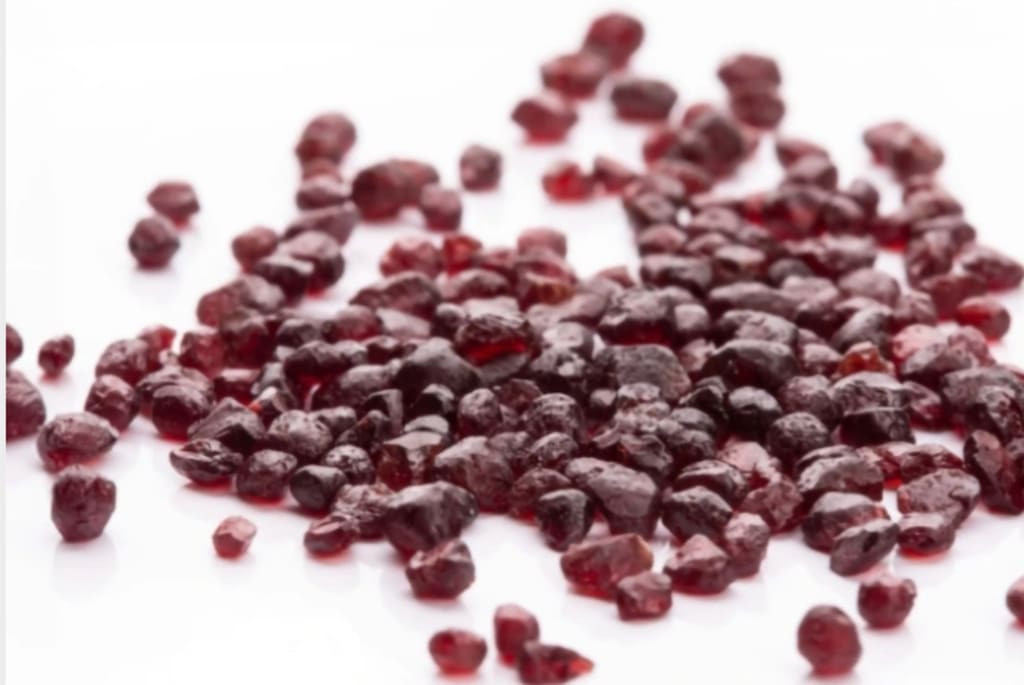
Czech garnet
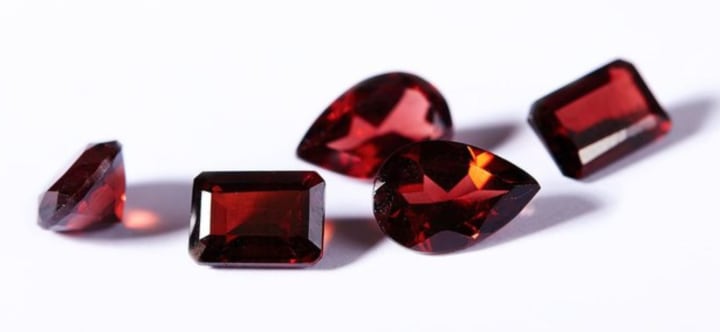
Czech garnet, or Bohemian garnet, is a unique, deep red pyrope garnet found in the Czech Republic, prized for centuries in intricate jewelry, known for its fiery "pigeon blood" color, small size, and cultural significance as the national stone, often set in clusters or elaborate designs. It's distinct from other garnets due to its specific mineral composition, yielding a pure red hue without purplish tones, and remains a beloved Czech tradition.
Key Characteristics
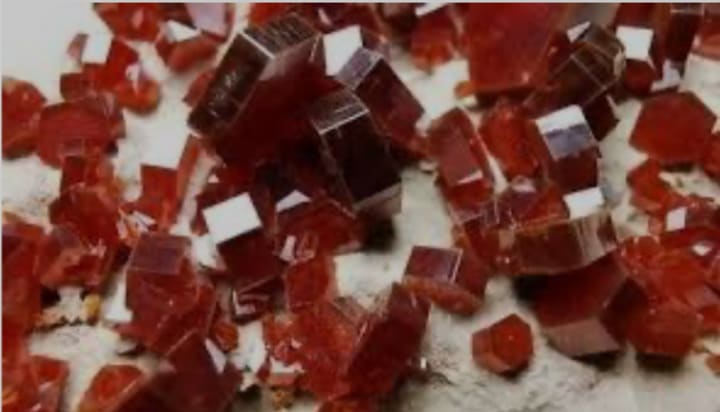
Color: Intense, fiery, deep blood-red (pigeon blood red).
Type: A variety of pyrope garnet, colored by iron and chromium.
Size: Typically very small, often under 3 millimeters, allowing for dense clustering.
Clarity & Luster: High clarity and a bright, sparkling vitreous luster.
Hardness: Around 7-7.5 on the Mohs scale, making it durable enough for jewelry.
History & Significance
National Treasure: The national stone and symbol of Bohemia, historically exchanged as tokens of love and commitment.
Traditional Craft: Heavily used by Czech goldsmiths since the Middle Ages, forming intricate, clustered jewelry.
Mining: Mined in the Czech Republic (Bohemia) for centuries, with deposits in regions like Meronitz.
Buying Czech Garnet
Authenticity: Look for guaranteed origin, often from producers like Granát Turnov.
Fakes: Be aware of fakes, as the small, precious stones are valuable.
Designs: Common settings include intricate cluster rings, necklaces, and brooches, often in silver or gold.
When we say garnet, we most likely think of that particular type of Czech garnet, a deep red gemstone that is famous all over the world. But the word garnet is actually more of a name for a large group of minerals that have the same atomic and crystal structure, but which differ in their chemical composition. There may therefore be large differences in color and properties between the various types of garnets. And lesser known garnets such as rhodolites or tsavorites are becoming more and more popular in jewelry making.
When we say garnet, we most likely think of that particular type of Czech garnet, a deep red gemstone that is famous all over the world. But the word garnet is actually more of a name for a large group of minerals that have the same atomic and crystal structure, but which differ in their chemical composition. There may therefore be large differences in color and properties between the various types of garnets. And lesser known garnets such as rhodolites or tsavorites are becoming more and more popular in jewelry making.
The history of garnets in a nutshell
The name “garnet” comes from the Latin name for the pomegranate, which is granatum malum and those with an eagle eye won’t miss the fact that some pieces of garnet really do resemble the seeds of this fruit. Archaeological finds from the Scythian period (the 6th-4th century BCE) prove that garnets have been known to humanity since ancient times. The beauty of garnets was already appreciated in ancient Egypt, ancient Greece as well as in other ancient cultures. One of the oldest examples of this is a green cylindrical spessartine seal originating from the Mesopotamian city of Ur. It dates back to the 21st century BCE and was meant to demonstrate the power of the last Sumerian king, Ibbi-Sin. In the times of the Roman philosopher Pliny the Elder, red garnets were called carbuncul and this name applied to all red stones since it means “hot little coal”.
A symbol of love and passion
The garnet is the birthstone for those born in January and is usually also given as a gift for a second wedding anniversary. In ancient times, garnets were attributed with magical powers. Due to their deep red color, they are associated with love, passion and life energy. They were supposed to increase the vitality of their wearers, protect them from their enemies and encourage the imagination. They were also supposed to have a positive effect on the functioning of the heart and on blood circulation while the Middle Ages gave garnets an interesting association since during those times, it was believed that the eyes of dragons were made of garnets.
Garnets and geology
If garnets were a topic in a chemistry class, you would see the formula X3Z2 [SiO4] 3 on the board. The formula contains several variables and when these are substituted for the relevant specifics, then we get individual varieties of garnet. Instead of X we can substitute calcium (Ca), manganese (Mn), iron (Fe2 +) or magnesium (Mg) and instead of Z, it is also possible to substitute aluminum (Al), iron (Fe3 +), chromium (Cr), vanadium (V3 +), zirconium (Zr) or titanium (Ti) in the formula. The varieties are genuinely huge, but we essentially distinguish garnets into six basic groups: almandine, pyrope, grosular, andradite and spessartine. Many of the varieties of garnets can be understood as a transitional type of the mineral which sit in between two other forms of it.
Garnets are a type of mineral that crystallizes in the cubic system and they are usually found in the form of rhodododecahedric and hexaoctoedric crystals. Less frequently, they form granular and compact aggregates. They range between 6.5 - 7.5 on the Mohs scale of hardness and their other characteristics are fragility, a very indistinct cleavage and an uneven fracture which is conchoidal and splintery. They have a white streak with a touch of color in it and their luster is vitreous to resinous. With the exception of andradites, acids don’t dissolve garnets and they melt easily except those which contain chromium such as knorringites and uvarovites. Garnets are a group with so much variety, that it is possible to find them in all colors except clear blue. One great advantage of garnets is that they usually don’t contain visible inclusions. Fans of natural stones will also appreciate that they do not normally undergo any modifications. Now let's look at some types of garnets in more detail.
Almandine
This deep red garnet with a purplish tinge is one of the most common types of garnets. It was named in 1546 by the German scholar and father of mineralogy, Georgius Agricola and refers to the ancient site of Alabanda in Turkey where gemstones were cut and polished. In general, the darker it is, the more valuable it is. Almandine deposits are found all over the world and are also present in the Czech Republic. However, most of the pieces on the market come from India and are often mistaken for Czech garnets, which are rarer and more valuable than the Indian ones.
Rhodolite
The gemstone variety of almandine is called rhodolite and it has the chemical formula Mg3Al2 (SiO4) 3. It is sometimes classified as pyrope because it is 70% pyropic and 30% almandine. It is found both under pyropes and under almandines in various publications. As you can see, classifying garnets is a bit of a mystery.
The name is derived from the Greek words rhodon (a rose) and lithos (a stone) though other sources claim that it is named after rhododendron flowers, since the color of the flowers is strikingly reminiscent of the color of the crystals. It was discovered in North Carolina, USA in the 17th century. Today however, it is imported mainly from East Africa.
Rhodolites are considered to be the noblest of red garnets. This is because they have a beautiful color which can range from dark purple-red all the way to a light pink. The rarest are rhodolites with a raspberry red color which even surpass any sapphires or rubies with their luster.
Czech garnet
Czech garnets could even be considered a national treasure. Jewelry made from them is passed down in families from generation to generation and tourists like to bring it home as a souvenir. Garnets were already known to the Celts that earlier inhabited the Czech lands and Czech goldsmiths worked extensively with garnets in the Middle Ages. Proof of this fact lies in the coronation cross of the Czech king Přemysl Otakar II which was decorated with garnets. Their fame reached its peak during the reign of emperor Rudolf II. During this period, this geographically specific type of garnet also acquired its name of "Czech garnet", which is a successful sales “brand” to this day.
From a mineral point of view, Czech garnets belong to the mineral group known as pyropes. The name pyrop comes from Greek and means “fiery eye”. Pyropes are also found elsewhere in the world and are actually not that rare. However the Czech ones stand out with their crimson red color which is also referred to as the color of pigeon blood. Czech garnets are found in smaller sized stones that don’t exceed 0.24 inches. Almandines on the other hand are usually larger in size, so if you see a garnet of about 0.4 inches in size in a piece of jewelry, it will most likely not be a Czech garnet. You can also distinguish these two types of garnets from each other by their color. While a Czech garnet is pure red in color, an almandine will show some purple tones. The center of the Czech garnet industry is in Turnov, close to the center of the glass industry and the crystal valley, Jablonec, where we go every year to buy beads.
Tsavorite
The most typical color for garnets is red, but other colors also feature. Tsavorite, a beautiful green stone . Its chemical composition means that it belongs to the grossular calcium garnet group species. Behind its attractive light to deep green color is the addition of vanadium and chromium, as a result of which it is often compared to emerald. It is also possible to see yellowish or bluish shades of color in it and its crystals are translucent or transparent dodecahedrons.
Tsavorite was first discovered in 1967 by British geologist Campbell Bridges in northern Tanzania. However due to the political situation at the time, it eventually got its name from the Tsavo National Park which lies in the basin of the Tsavo river in Kenya. Tiffany & Co discovered the potential of tsavorite to make its name in the world of jewelry. Today, there are only a couple places where it is mined under very difficult conditions.
How to best care for garnet jewelry
Garnets are not one of those gemstones that are bothered by high temperatures and they maintain their color fastness, so it is not necessary to shield them from the sun. However garnets don’t like heat shocks which you could cause by cleaning them with very hot water or steam for example. Wipe them with a soft cloth instead. In terms of hardness, garnets are fine even if they don’t match the hardness of diamonds. However you should continue to be careful when wearing garnets, as they are relatively fragile.
And finally, if you give love and care to your garnet jewelry, it will dazzle you with its beauty for eternity.
About the Creator
Guy lynn
born and raised in Southern Rhodesia, a British colony in Southern CentralAfrica.I lived in South Africa during the 1970’s, on the south coast,Natal .Emigrated to the U.S.A. In 1980, specifically The San Francisco Bay Area, California.
Things you don't know about Africa
Africa: What You Probably Didn’t Know Article No. 1671 Tuesday, 25 February 2020 By Wardah Baloch In terms of land area, Africa is the second-largest continent in the world. It covers nearly 22 percent of the world’s total landmass and about 6 percent of the Earth’s total surface area. Only Asia is larger than Africa in size.
By Sudais Zakwan4 days ago in Earth
USA vs Iran: A Military Mismatch in 2026
Comparing the U.S. and Iranian militaries is not about who would win a fair fight. It's about understanding two completely different ways of thinking about war. By 2026, the gap between their traditional strength will be wider than ever. The U.S. is a global superpower built to fight and win anywhere. Iran is a regional survivor, built to make an invasion so painful that no one would ever try.
By LegacyWordsa day ago in Earth




Comments
There are no comments for this story
Be the first to respond and start the conversation.