
The secret life of the redwood tree.
It’s a world of its own.


I love Redwood trees. I’m not a tree hugger, I leave that to my California hippie wife, Jme, but having been married to her for 45 years some of her philosophies have rubbed off on me. I’m a conservative born and raised in Africa. For years my fashion choice was camouflage clothing. But now I wear tie dye t-shirts, sandals, wear my long hair in a ponytail. I sell beads for a living. But being around redwood trees make me feel good. I’m in awe of these trees. If I wanted to hug a tree, a redwood tree would be the tree of choice.
So let me tell you about the secret life of the redwood forest and the redwood tree. It’s truly amazing.
Sequoioideae, commonly referred to as redwoods, is a subfamily of coniferous trees within the family Cupressaceae, that range in the northern hemisphere. It includes the largest and tallest trees in the world. The trees in the subfamily are amongst the most notable trees in the world and are common ornamental trees. The subfamily reached its peak of diversity during the early Cenozoic.
Description
The three redwood subfamily genera are Sequoia from coastal California and Oregon, Sequoiadendron from California's Sierra Nevada, and Metasequoia in China. The redwood subfamily contains the largest and tallest trees in the world. These trees can live for thousands of years. Threats include logging, fire suppression,and burl poaching.
Only two of the genera, Sequoia and Sequoiadendron, are known for massive trees. Trees of Metasequoia, from the single living species Metasequoia glyptostroboides, are deciduous, grow much smaller (although are still large compared to most other trees) and can live in colder climates. Visiting redwood forests in Humboldt county and Marin country, in Northern California, or Yosemite National park, where you are surrounded by these tall trees, you enter a magical world of these magical, majestic trees. The temperature drops, from the blazing, searing heat of summer to the cool, comfortable temperature of the redwood forest and the hidden world in it.
In 2024, it was estimated that there were about 500,000 redwoods in Britain, mostly brought as seeds and seedlings from the US in the Victorian era. The entire subfamily is endangered. The IUCN Red List Category & Criteria assesses Sequoia sempervirens as Endangered . Sequoiadendron giganteum as Endangered and Metasequoia glyptostroboides as Endangered .In 2024 it was reported that over a period of two years about one-fifth of all giant sequoias were destroyed in extreme wildfires in California
Protecting Wildlife - Sempervirens FundRedwood forests host diverse wildlife, from canopy dwellers like the Northern Spotted Owl, Marbled Murrelet, and Wandering Salamander (which lives its whole life there) to larger mammals like Roosevelt Elk, Black-tailed Deer, Black Bears, Bobcats, and Mountain Lions, plus smaller creatures like Douglas Squirrels, Banana Slugs, Fishers, and Chipmunks, utilizing the trees for shelter, food, and nesting.
In the Canopy & Upper Reaches:
Birds: Northern Spotted Owls, Marbled Murrelets, Winter Wrens, Varied Thrushes, Anna's Hummingbirds, Wilson's Warblers.
Amphibians:
Wandering Salamanders
live their entire lives in the canopy, breathing through their skin
.
Mammals: Douglas Squirrels, Chipmunks, and Bats (using hollows).
On Trunks & Forest Floor:
Invertebrates: Banana Slugs, Yellow-spotted Millipedes (releasing cyanide when threatened).
Amphibians/Reptiles: Pacific Giant Salamanders, Red-bellied Newts.
Mammals: Black Bears, Bobcats, Mountain Lions, Gray Foxes (excellent climbers), Fishers, Mink, Raccoons, Skunks, Deer, Elk, River Otters.
Key Features & Uses:
Thick Bark: Provides protection from fire and insects for animals like owls.
Fog: Redwoods "drink" fog, creating moisture for amphibians.
Root Systems: Support streams for fish like Coho Salmon.
Hollows: Allow Owls and Bats to live and nest.
Known for their iconic trees that reach up into the atmosphere, redwood forests are important for a whole host of reasons, including some we’re only beginning to understand. Although many people are familiar with the diversity of life a redwood forest floor has to offer, not many realize there are separate ecosystems thriving hundreds of feet above their heads in the upper branches. Recent explorations by tree-climbing scientists have revealed a host of organisms that populate the tops of redwood trees.
The tallest and largest trees in the world are species of redwood trees
Although they have the potential to grow into forests with enormous trees, their cones are among the smallest
Redwood forests rely on their ability to delicately harvest moisture from the coastal fogs that regularly roll over them
Among the most beloved forest types in the U.S., they have inspired impassioned protests to ensure their protection, like those led by Julia “Butterfly” Hill, and have appeared in many movies, such as Star Wars
Redwood lumber since it is unusually resistant to rotting
ABOUT REDWOOD FOREST HABITAT
Redwood forests stretch along a thin belt on the Pacific coast of northern California and southern Oregon, occupying the southern end of the temperate rainforest zone of the Pacific Northwest. Despite being in a rainforest zone, seasonal dryness has forced these forests to adapt, using a shallow root system to sop up moisture dripping from its needles as summer coastal fog blankets their canopy.
A variety of wildlife species call the redwoods their home. These include banana slugs, Pacific giant salamanders, and red-bellied newts, along with raccoons, bobcats, Pacific fishers, pine martens, black-tailed deer, Roosevelt elk, marbled murrelets, and northern spotted owls. Streams passing through redwood forests often contain coho salmon, steelhead, and trout.
The stately and awe-inspiring nature of the redwoods are an economic driver thanks to the millions of tourists who flock to visit the numerous redwood parks in California. Yet redwood forests also produce timber that is among the most valuable on the market, owing largely to its durability and warm hues, as well as the ability of redwoods to regrow rapidly. As a result, many redwood forests have been cut over at least once, if not twice, in the past century. In fact, less than five percent of the original old-growth redwood forest remains from pre-settlement times.
WHY CONSERVE THIS HABITAT?
Redwoods are one of California’s many unique and defining characteristics that are universally beloved. However, because redwood forests are found in a very restricted range, their vulnerability to warming temperatures and changing precipitation patterns brought on by climate change is felt not just by those who live among them, but by any who have stepped under their lofty, lush canopy.
Despite this vulnerability, redwood forests can also help to stem the severity of climate change. Their ability to rapidly sequester carbon dioxide from the atmosphere and store it for extremely long periods of time—whether in large, old trees or in durable wood products—make them an effective tool for minimizing the negative impacts of the increasing concentrations of greenhouse gases in our atmosphere.
A World Heritage of Ecological Diversity
Redwood National and State Parks are globally recognized for their rich ecological diversity, earning a designation as a World Heritage Site.
Visitors to Redwood National and State Parks have a great chance of seeing California sea lions, giant green sea anemones, bald eagles, Roosevelt elk, salamanders, and, of course, a banana slug. The ambitious visitor (and sometimes just the lucky one) may see many of these all in one day. The parks are also home to hundreds of insect species—perhaps you’ll catch a glimpse of the striking common green darner.
Birds of the Coniferous Forest
Old-growth and second growth conifer forest, dominated by coastal redwoods, cover the majority of the parks' area. A variety of flycatchers, warblers, swifts, thrushes, jays, woodpeckers, ruffed grouse, and owls can be found here. If you are in the parks in the summertime, before the sun comes up you may even hear or see the elusive, endangered marbled murrelet (Brachyramphus marmoratus). Any of the many forest trails as well as Bald Hills Road, Newton Drury Parkway, Cal Barrel Road, Howland Hill Road, Walker Road and US Highway 199 will take you deep in this habitat type. Learn more about the marbled murrelet
Birds of the Oak Woodlands and Prairies
In the far southeastern portion of the parks is dominated by extensive Oregon oak woodlands and grasslands. Open country birds and oak specialists are best seen here. Common species include: red-tailed hawk (Buteo jamaicensis), white-tailed kite (Elanus leucurus), acorn wodpecker (Melanerpes formicivorus), california quail (Callipepla californica), western scrub jay (Aphelocoma californica), western bluebird (Sialia mexican), black-throated gray warbler (Setophaga nigrescens) , merlin (Falco columbarius) and western meadowlark (Sturnella neglecta). Access to the area is via the Bald Hills Road and the Dolason and Lyon's Ranch Trails.
Birds of the Oak Woodlands and Prairies
In the far southeastern portion of the parks is dominated by extensive Oregon oak woodlands and grasslands. Open country birds and oak specialists are best seen here. Common species include: red-tailed hawk (Buteo jamaicensis), white-tailed kite (Elanus leucurus), acorn wodpecker (Melanerpes formicivorus), california quail (Callipepla californica), western scrub jay (Aphelocoma californica), western bluebird (Sialia mexican), black-throated gray warbler (Setophaga nigrescens) , merlin (Falco columbarius) and western meadowlark (Sturnella neglecta). Access to the area is via the Bald Hills Road and the Dolason and Lyon's Ranch Trails.
the Canopy & Upper Reaches:
Birds: Northern Spotted Owls, Marbled Murrelets, Winter Wrens, Varied Thrushes, Anna's Hummingbirds, Wilson's Warblers.
Amphibians:
Wandering Salamanders
live their entire lives in the canopy, breathing through their skin
.
Mammals: Douglas Squirrels, Chipmunks, and Bats (using hollows).
On Trunks & Forest Floor:
Invertebrates: Banana Slugs, Yellow-spotted Millipedes (releasing cyanide when threatened).
Amphibians/Reptiles: Pacific Giant Salamanders, Red-bellied Newts.
Mammals: Black Bears, Bobcats, Mountain Lions, Gray Foxes (excellent climbers), Fishers, Mink, Raccoons, Skunks, Deer, Elk, River Otters.
Key Features & Uses:
Thick Bark: Provides protection from fire and insects for animals like owls.
Fog: Redwoods "drink" fog, creating moisture for amphibians.
Root Systems: Support streams for fish like Coho Salmon.
Hollows: Allow Owls and Bats to live and nest.
Coast redwood forests and giant sequoia groves are famous for their iconic beauty, but lesser known are the peculiar wonders they harbor. Here are a handful.
Far-out animals
the fantastic, yellow-spotted millipede, Harpaphe haydeniana, roams freely through the coast redwood forest. Often found crawling in the duff on the forest floor, H. Haydeniana is multilegged invertebrate that demands respect. When it senses danger, this millepede curls up in a ball and releases the sweet almond scent of hydrogen cyanide. It’s a deadly chemical deterrent and is one to watch out for, especially if you are a beetle hoping to catch a quick meal. For people, the threat is pretty low.
The wandering salamander, Aneides vagrans, has no lungs and breathes through its skin. An individual wandering salamander may live its entire life in a single tree! The creature’s skin is camouflaged to blend in perfectly with the lichen-covered bark of redwood trees, helping it hunt the small insects that also inhabit the forest canopy.
Did you know that the coast redwood forest is home to the largest slug in North America and the second largest slug worldwide? Yep, our very own banana slug, Ariolimax columbianus, grows up to 8 inches long and can live for seven years. Perhaps the most fascinating aspect of the banana slug is their mating behavior. These slugs are hermaphrodites and can fight before mating (the slug equivalent of biting). It isn’t uncommon for one of the slugs to chew the penis of its mate and render it unable to fertilize other slug eggs.
In the shady mixed conifer and hardwood forests of the Pacific Northwest are red and white flowers are called “mycotrophs” (“myco” meaning “fungus” and “troph” relating to nutrition). Mycotrophs depend on fungi for food, unlike green plants, which make their food from sunlight, water, and carbon dioxide. Learn more about these unusual plants on the US Forest Service mycotroph page.
Mycotrophs get sugars from green plants through an intricate network of fungi that grow between the roots of the flowers and the trees. Connected by fungi and the sharing of food, these flowers wouldn’t exist without their fungal and tree partners.
Mycotrophs are rare because they only occur in places where the partner tree species and fungus are living.
Aerial fern mats in Prairie Creek Redwoods State Park.
You already know that the coast redwood forest is a wondrous environment unlike any other on earth, but you may not know that in addition to the ecosystem on forest floor is a totally unique ecosystem high in the canopy with an entirely different collection of plants and animals.
There is a whole group of plants that live way up in the canopy of coast redwoods called epiphytes. And one of our favorites is the evergreen leather leaf fern (Polypodium scouleri). Leather leaf ferns disperse through the canopy by wind-borne spores and once established, grow extensive mats of succulent rhizomes and fibrous roots. These fern mats can absorb and retain a tremendous amount of water during the year, helping hold more than 5,000 gallons of water per acre in the canopy. Redwoods benefit from this bonus water and can grow aerial roots into the rhizome mats of leather leaf fern to share in the moisture and recycled nutrients.
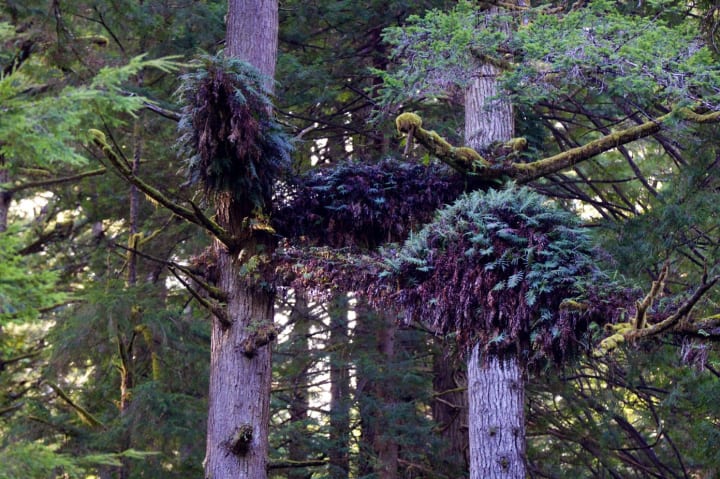
Over time leaves and bark fall off the tree and collect on these platforms, and into the crotches and limbs in redwood canopies. When this organic matter settles and becomes stable to the point that it decomposes no further, it is referred to as humus. This humus breaks down into a kind of organic soil for other plants to root in. If conditions do not change, the matter might remain as it is for centuries, or millennia. An entire food web forms with insects and salamanders.
Wandering salamanders—a species endemic to coastal Northern California—seems to love it up there in the canopy. It feeds on microscopic bugs in the humus mats and finds refuge in complex tunnels out of the way of predators. Researchers have found good evidence that many of these wandering salamanders live their entire lives high in the canopy, never touching the ground.
I have about 20 redwood trees on my property I live on here in Northern California. Mostly young trees, the tallest are about 40/50 feet, and they are my most treasured trees on the property. Walking amongst them calms me, makes me feel good. And yes, every once in awhile I hug them and talk to them. They are a big part of my life.
About the Creator
Guy lynn
born and raised in Southern Rhodesia, a British colony in Southern CentralAfrica.I lived in South Africa during the 1970’s, on the south coast,Natal .Emigrated to the U.S.A. In 1980, specifically The San Francisco Bay Area, California.
The Mysterious Giant: Exploring the Rare and Remarkable Rafflesia hasseltii
Introduction: Nature’s Enigmatic Marvel In the dense, humid rainforests of Southeast Asia, a botanical wonder exists that captures the imagination of scientists, travelers, and nature enthusiasts alike. Rafflesia hasseltii, one of the most intriguing plants on Earth, defies conventional understanding of flora. Unlike typical plants, it lacks stems, leaves, or even roots and relies entirely on a host plant to survive. Its enormous flowers, pungent odor, and unique parasitic lifestyle make it one of the rarest and most fascinating species in the plant kingdom.
By Ahmed aldeabella3 days ago in Earth
White Mushroom Market Size and Forecast 2025–2033
Introduction White mushrooms—scientifically known as Agaricus bisporus—are no longer confined to salads, pizzas, and soups. Once considered a humble kitchen staple, they are now emerging as a strategic crop in the global agrifood ecosystem. Driven by sustainability trends, plant-based eating, and rising health consciousness, white mushrooms have carved out a powerful position in both consumer markets and foodservice industries.
By jaiklin Fanandisha day ago in Earth


Comments (1)
I have yet to visit the west coast and meet some redwoods in person, but I look forward to it. Cedar and cypress, river birch and live oak, magnolia and dogwood. I love them all.