
Galactic Collision: A Window into Our Future
NASA/ESA’s Hubble Space Telescope Captures Spectacular Image of Colliding Galaxies: A Glimpse into the Future.

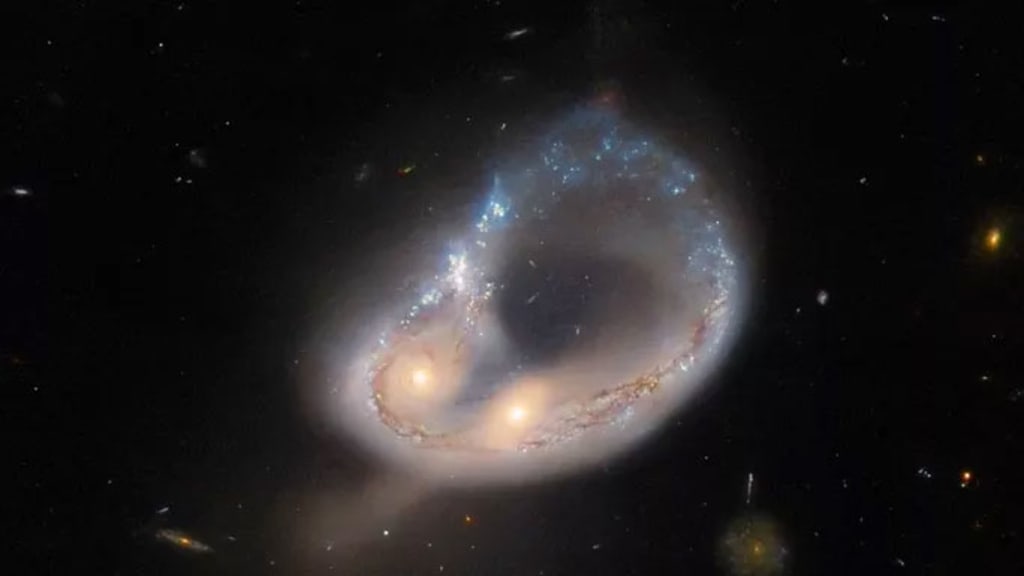
NASA and ESA's Hubble Space Telescope has captured a breathtaking cosmic spectacle—a colossal ring of light formed by two merging galaxies. The image appears like a circular window carved into the vastness of space, possibly offering humanity a glimpse into its own distant future.
The remarkable image reveals a phenomenon known as an "intertwined galaxy," officially cataloged as Arp-Madore 417-391. Situated approximately 670 million light-years from Earth in the constellation Eridanus, this galactic duo is in the throes of a dramatic collision and merger. As gravitational forces distort and twist the two galaxies, their structures are stretched into an intricate, otherworldly shape, while their dense cores inch ever closer to one another.
Unlike many galactic mergers where a dominant galaxy engulfs a smaller one, these two appear to be evenly matched in size and mass, resulting in an intense cosmic tug-of-war rather than a simple act of assimilation. The image suggests a prolonged struggle, as each galaxy bends and deforms under the gravitational pull of the other, their luminous arms stretching outward to form a near-perfect ring of glowing matter.
Unearthing a Cosmic Spectacle
The discovery of this celestial phenomenon comes from Hubble’s vast archive of observations, a treasure trove of data collected by the powerful telescope. The specific region of space where these galaxies reside was meticulously documented through more than 6,000 images captured by Hubble’s advanced instruments, offering astronomers an unprecedented look at the intricate dance of galactic interactions.
ESA, which co-manages the Hubble mission alongside NASA, emphasized the significance of this finding in a recently published report. The image, enhanced by Hubble’s high-resolution capabilities, showcases how these two galaxies have become gravitationally entangled, forming a mesmerizing loop reminiscent of a portal to the distant universe. This ethereal ring structure offers scientists invaluable insights into the mechanics of galactic evolution and the eventual fate of our own Milky Way.
A Mirror to Our Future
This stunning galactic collision could be more than just a scientific curiosity—it may also serve as a preview of what awaits our own galaxy in the distant future. While the Milky Way has absorbed numerous smaller galaxies throughout its history—approximately 16 major mergers—most of those interactions have been one-sided, with our massive galaxy effortlessly consuming its smaller counterparts. However, a far more dramatic encounter looms on the horizon.
In approximately two billion years, the Milky Way is expected to collide with its formidable neighbor, the Andromeda Galaxy (M31). Unlike the previous mergers, this impending cosmic event will not be a mere act of consumption; it will be a battle between two equal titans. Much like the galaxies captured in Hubble’s latest image, the Milky Way and Andromeda will become gravitationally intertwined, distorting each other’s structures and ultimately coalescing into a single, larger galaxy.
Scientists predict that this merger will unleash a spectacular reshaping of both galaxies, stretching their spirals, creating immense rings of glowing matter, and sparking a frenzy of new star formation. Yet, for Earth and our solar system, the consequences remain uncertain. One possible scenario suggests that the collision could eject our solar system from its current location, potentially displacing Earth from the Sun’s habitable zone, leading to drastic changes in our planet’s climate and conditions for life.
The Cosmic Dance of Galaxies
The universe is in a constant state of flux, with galaxies continuously interacting, colliding, and merging over billions of years. While these cosmic events unfold on timescales far beyond human lifetimes, they are instrumental in shaping the structure of the universe as we know it.
Astronomers study such mergers not only to understand the past and future of our galaxy but also to gain insights into the formation of new star systems and the redistribution of cosmic materials. The Hubble Space Telescope, with its unparalleled ability to capture the cosmos in exquisite detail, continues to offer humanity glimpses into these grand celestial interactions.
Although the fate of our own galaxy remains billions of years away, the image of Arp-Madore 417-391 serves as a striking reminder of the dynamic and ever-changing nature of the universe. As technology advances, upcoming observatories like the James Webb Space Telescope will further expand our ability to peer into these distant cosmic collisions, bringing us even closer to unlocking the mysteries of galactic evolution.
For now, Hubble’s latest image offers us a moment to marvel at the grandeur of the universe—a cosmic spectacle that is not just a distant phenomenon, but a preview of what may one day unfold in our own cosmic backyard.
About the Creator
Eleanor Grace
"Dream big.Start small.Act now."
Keep reading
More stories from Eleanor Grace and writers in Earth and other communities.
Laika: The Stray Dog Who Became a Space Legend
From a stray dog on the streets of Moscow to the first living being to embark on a "suicidal" mission beyond Earth, Laika's journey into space aboard Sputnik 2 in 1957 remains one of the most poignant stories in space exploration history.
By Eleanor Grace10 months ago in Earth
Without Democracy, Donald Trump’s Venezuelan Oil Quest Will Fail
Donald Trump’s renewed interest in Venezuelan oil may seem, on the surface, like a hard-nosed geopolitical calculation. Venezuela holds the world’s largest proven oil reserves, and amid global energy uncertainty, access to those resources is undeniably tempting. But history, economics, and politics all point to the same conclusion: without democratic reform in Venezuela, any attempt by a Trump-led US administration to secure reliable Venezuelan oil will ultimately fail.
By Aarif Lashari7 days ago in Earth
Trump’s Message to Norway: A Controversial Diplomatic Signa
**Trump’s Message to Norway: A Controversial Diplomatic Signal** In January 2026, a written message sent by former U.S. President Donald Trump to Norway’s Prime Minister Jonas Gahr Støre sparked widespread political debate and media attention. The message quickly became a topic of discussion across the United States and Europe, not because it announced a formal policy change, but because of its tone and implications. It reflected Trump’s personal view of international recognition, his frustration over the Nobel Peace Prize, and his broader vision for American power and security in a changing world.
By America today a day ago in Earth
So You Decided To Become a Nurse Practitioner:
So you decided to become an "Advanced Practice" nurse. Congratulations!... is what I would say if this was a good idea. Grad school? In this economy? What were you thinking? Likely it was something along the lines of either 1) “I've seen these other chucklefucks do it— Why can't I?” or even 2) “I've got a nice career, I should shake it up. I miss feeling like I have no clue what I'm doing.”
By Sandor Szabo4 days ago in Fiction


Comments
There are no comments for this story
Be the first to respond and start the conversation.