
Trump’s Message to Norway: A Controversial Diplomatic Signa
Trump’s Message to Norway:

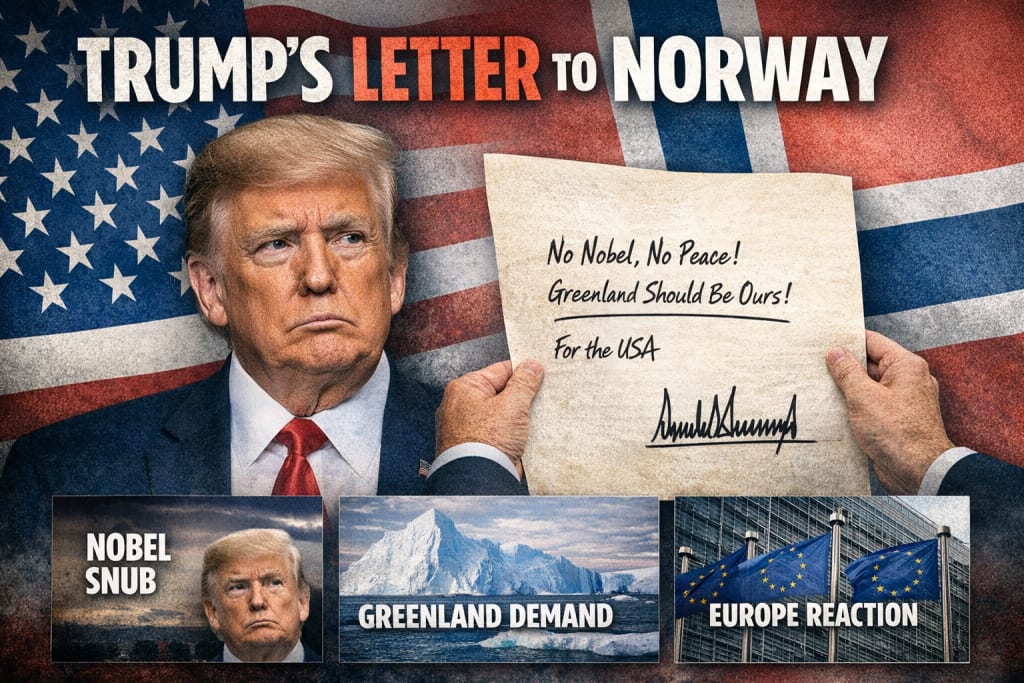
**Trump’s Message to Norway: A Controversial Diplomatic Signal**
In January 2026, a written message sent by former U.S. President Donald Trump to Norway’s Prime Minister Jonas Gahr Støre sparked widespread political debate and media attention. The message quickly became a topic of discussion across the United States and Europe, not because it announced a formal policy change, but because of its tone and implications. It reflected Trump’s personal view of international recognition, his frustration over the Nobel Peace Prize, and his broader vision for American power and security in a changing world.
The message came at a time of growing tension in global politics, especially in the Arctic region, where strategic competition between major powers has intensified. Norway, as a close U.S. ally and a NATO member, found itself unexpectedly drawn into a controversy that highlighted deeper questions about diplomacy, alliances, and leadership style.
**What Was the Core Message Trump Sent to Norway?**
At the heart of Trump’s message was his assertion that he no longer felt an obligation to think “purely of peace” in shaping U.S. policy. He linked this statement to what he described as a lack of recognition for his efforts to reduce or prevent conflicts during his time in office. In particular, he referenced his disappointment at not receiving the Nobel Peace Prize, which is awarded by a committee based in Norway.
Trump framed his argument around the idea that international honors matter in global politics, not just as symbolic gestures, but as acknowledgments of leadership. He suggested that the absence of such recognition freed him to pursue a more forceful and interest-driven approach to foreign policy, centered on what he viewed as the best interests of the United States.
**Why Did Trump Mention the Nobel Peace Prize?**
The Nobel Peace Prize has long carried symbolic weight in international relations. Trump has repeatedly argued that his diplomatic actions deserved recognition comparable to past recipients. In his message to Norway’s prime minister, Trump appeared to conflate the independent Nobel Committee with the Norwegian state, expressing frustration that the prize had not been awarded to him.
This aspect of the letter drew criticism, as the Nobel Peace Prize is not controlled by the Norwegian government. Nevertheless, Trump’s focus on the prize revealed how deeply personal validation and public recognition factor into his worldview. For supporters, it reinforced the belief that Trump’s achievements were overlooked. For critics, it raised concerns about personal grievance influencing foreign policy rhetoric.
**How Did Greenland Become Part of the Message?**
One of the most striking elements of Trump’s message was his reference to Greenland. He questioned the legitimacy of Denmark’s control over the island and suggested that U.S. authority over Greenland would be necessary for global security. Trump framed the issue in terms of strategic defense, pointing to the Arctic’s growing importance amid competition with Russia and China.
Greenland’s vast natural resources and strategic location have long attracted interest from major powers. By raising the issue in a message to Norway, Trump signaled that Arctic geopolitics remain a priority in his thinking. However, the language used was seen as confrontational and dismissive of established international norms regarding sovereignty.
**Why Did the Letter Alarm European Leaders?**
European leaders reacted with concern because the message touched on sensitive issues of sovereignty, alliance trust, and diplomatic conduct. Norway and Denmark are both long-standing allies of the United States, and statements questioning territorial ownership can strain even the strongest partnerships.
The tone of the message also mattered. Rather than emphasizing cooperation or shared security goals, Trump’s words suggested pressure and unilateral decision-making. For many in Europe, this reinforced fears that U.S. leadership could become unpredictable, driven more by personal perspectives than by coordinated alliance strategy.
**What Does This Reveal About Trump’s Foreign Policy Style?**
Trump’s message to Norway reflects a consistent pattern in his approach to foreign policy: a blend of personal conviction, transactional thinking, and direct communication. He often challenges diplomatic conventions, preferring blunt statements over carefully worded agreements.
Supporters argue that this style projects strength and honesty, forcing allies and rivals alike to confront uncomfortable realities. Critics contend that it undermines trust, weakens alliances, and blurs the line between personal opinion and official policy. The letter to Norway became a clear example of how Trump’s personality shapes his diplomatic messaging.
**How Could This Affect U.S.–European Relations Going Forward?**
While a single message does not define an entire relationship, it can influence perceptions and expectations. Trump’s communication with Norway added to existing concerns in Europe about long-term U.S. commitment to multilateral cooperation. It also highlighted differences in how American and European leaders view diplomacy, recognition, and the role of international institutions.
In the broader picture, the message underscored growing uncertainty in global politics. As strategic competition intensifies and alliances face new pressures, the way leaders communicate matters as much as the policies they pursue. Trump’s message to Norway served as a reminder that words, especially when delivered directly and publicly, can reshape diplomatic landscapes.
Ultimately, the controversy surrounding Trump’s letter was not just about Norway, the Nobel Peace Prize, or Greenland. It was about power, recognition, and the evolving nature of leadership in international affairs.
About the Creator
America today
Breaking news, political insights, real-time analysis, U.S. politics, global politics, elections, government policies, international relations, diplomacy, political debates, trending political stories, expert commentary, factual reporting,.
Keep reading
More stories from America today and writers in Earth and other communities.
TODAY’S WEATHER NEWS ACROSS THE UNITED STATES WHAT AMERICANS SHOULD EXPECT RIGHT NOW
TODAY’S WEATHER NEWS ACROSS THE UNITED STATES WHAT AMERICANS SHOULD EXPECT RIGHT NOW Weather conditions continue to be one of the most discussed daily topics across the United States, especially as seasonal transitions bring noticeable changes in temperature, storms, and regional weather patterns. Today’s weather reflects a mix of warming trends, lingering cold pockets, and active systems affecting different parts of the country. From the West Coast to the East Coast, Americans are paying close attention to how temperatures will feel, whether rain or snow is expected, and how conditions may impact daily routines.
By America today 2 months ago in Earth
Hemp as a sustainable material
The ecological properties of hemp makes it one of the types of insulation used in construction with the lowest carbon emissions footprint. In the future, hemp could play a paramount role in the race towards reducing the global carbon emissions footprint to fight climate change, and a more sustainable construction industry.
By Susan Fourtané 3 days ago in Earth


Comments (1)
TACO King TALKS