
Future Perfect: How AI Could Save Us in Climate Fiction
Reimagining survival with underwater cities, smart ecosystems, and the science behind sci-fi.


Climate change is no longer a distant threat—it’s here, reshaping our world. Amidst warnings about environmental collapse, some storytellers imagine a different future—one where technology, especially AI, helps us adapt and thrive.
“The future isn’t something we enter. The future is something we create.” — Leonard I. Sweet
AI isn't just a survival tool; it's a creative force that could redefine our existence in a rapidly changing climate. This intersection of AI and climate fiction (“cli-fi”) offers visions of underwater cities, intelligent weather systems, and synthetic ecosystems.
Let's explore how these futuristic technologies are woven into some of today’s most exciting (and hopeful) sci-fi narratives.
1. Cities Built Underwater
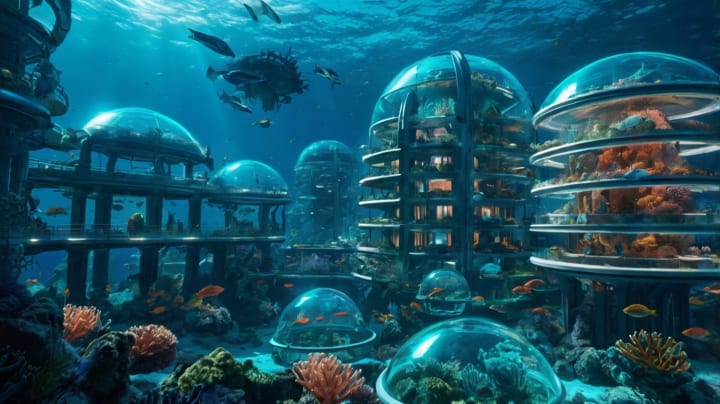
As sea levels rise, AI designs entire underwater metropolises: self-sustaining, pressure-regulated, and resistant to collapse. These cities simulate daylight, recycle resources, and deploy aquatic drones to maintain coral farms and underwater forests.
Walking through these vast underwater boulevards, one might see glowing kelp farms and bioluminescent creatures gliding by, while AI systems manage the pressure, temperature, and oxygen levels. Massive windows offer glimpses of the surrounding marine life, making the city feel like a living organism in harmony with its environment.
This concept is vividly illustrated in the "Neo Coral City" project by designer Yongwook Seong. In this AI-generated vision, an underwater AI design/build practice named Amphitrite 3.0 is commissioned to revitalize parts of the Great Reef area devastated by rising ocean temperatures and acidification. The project envisions 3D-printed marine structures that accelerate coral reef restoration, blending sustainable architecture with marine conservation efforts .


2. Weather-Controlled Domes Powered by AI
AI predicts and manipulates weather to protect human settlements. Inside these vast glassy megadomes, storms are deflected, seasons are scheduled, and crops thrive year-round. Imagine a dome stretching over a barren desert, where the air is crisp and cool inside, with lush, green gardens growing in perfect harmony. Outside, a sandstorm rages, but within the dome, crops flourish under controlled weather conditions, while AI ensures that the rain falls precisely when needed, and the temperature remains optimal for growth.
Real-world parallels exist in AI-driven climate engineering research. Projects like Solar Radiation Management (SRM) and Cloud Brightening explore weather control through AI, though these methods remain in experimental stages. Researchers at institutions such as the University of Oxford are investigating how AI could optimize solar radiation management, essentially using AI to balance climate variables and reduce the impact of climate change.
While these projects are controversial, they show how AI could help manipulate weather patterns to protect vulnerable populations.

3. Rebuilding Ecosystems with Synthetic Biodiversity
AI resurrects extinct species digitally—then prints them biologically using synthetic DNA. Entire food chains are rebuilt, monitored by sentient systems that learn, adapt, and protect life. Imagine ecosystems blooming from synthetic DNA, with AI-pollinated flowers dotting the land and robotic drones planting trees. Beneath the soil, tiny AI-managed networks of bacteria and fungi recreate the microbial symbiosis that once flourished, revitalizing the earth in ways we thought impossible.
In the real world, efforts to rebuild ecosystems using AI and synthetic biology are underway. Companies like Colossal Biosciences are working on de-extincting species like the woolly mammoth using gene-editing technologies. Meanwhile, AI models are helping scientists predict ecosystem shifts and guide biodiversity restoration.
The AI for Earth program by Microsoft is one such initiative that leverages AI to monitor and restore ecosystems, making the dream of synthetic biodiversity a tangible goal.


Reality Check: The AI Fear Factor
It’s no surprise that many people are wary of futuristic innovations—especially AI. Decades of thriller movies, dystopian novels, and media paranoia have trained us to expect the worst. The result? A knee-jerk fear of anything that feels too powerful or unfamiliar. But here’s the truth: not every invention is meant to destroy.
AI, like any tool, reflects the hands that wield it. We are the creators. It’s our intention that determines its impact. If your goals are selfish or destructive, any tool—yes, even AI—can become a weapon. But if your purpose is to heal, build, and imagine better futures, that same tool can be magic.
Due to the flood of thriller-style portrayals and the paranoia they inspire, society often leans toward the negative when imagining AI. But we have to remember: just because something is powerful doesn't mean it's dangerous by default. It becomes dangerous only when used with harmful intent. The responsibility is ours—because it's always in human hands whether a tool becomes a bridge or a blade.
In the end, that’s the terrifying beauty of it—and the hopeful part too.
Conclusion
In the hands of storytellers, AI isn’t just code—it’s a worldbuilder. Climate fiction offers a canvas where artificial intelligence doesn’t doom us... it dreams us forward. With real-world AI applications already beginning to make strides in environmental sustainability, the future of AI and climate action is one worth imagining—and embracing.
Let's write futures that aren't ruled by fear, but by our courage to imagine, build, and do better - with AI as our partner, not our villain.

About the Creator
Dishmi M
I’m Dishmi, a Dubai-based designer, writer & AI artist. I talk about mental health, tech, and how we survive modern life.
Subscribe for healing advice, human stories & future thoughts!
Reader insights
Outstanding
Excellent work. Looking forward to reading more!
Top insights
Compelling and original writing
Creative use of language & vocab
Easy to read and follow
Well-structured & engaging content
Masterful proofreading
Zero grammar & spelling mistakes
Tea of Silence
The snow had covered the hills for days, turning the land into a quiet white world where sound seemed afraid to exist. On the highest of these hills, beneath a dry, leafless tree, a young man sat alone. The tree had long ago lost its strength, its branches thin and broken, but it still stood, as if refusing to disappear. The young man chose this place often, not because it was comfortable, but because it was honest.
By Bilal Mohammadi4 days ago in Earth
Europe Draws a Red Line on Greenland After a Year of Trying to Pacify Trump
For nearly a year, European leaders walked a diplomatic tightrope. They tried calm language, quiet reassurance, and strategic patience as former U.S. President Donald Trump repeatedly revived his controversial interest in Greenland. What began as provocative rhetoric gradually evolved into something Europe could no longer ignore. Now, after months of behind-the-scenes diplomacy, Europe has drawn a clear red line on Greenland — signaling that compromise has its limits when sovereignty and regional security are at stake. This shift marks more than a response to one leader’s remarks. It reflects Europe’s growing determination to defend territorial integrity, manage Arctic competition, and assert strategic autonomy in an increasingly unpredictable geopolitical environment. How Greenland Became a Flashpoint Again Greenland, an autonomous territory within the Kingdom of Denmark, has long held strategic importance. Rich in rare earth minerals, located along key Arctic routes, and home to critical U.S. military infrastructure, the island sits at the crossroads of security, climate change, and great-power rivalry. Donald Trump’s original proposal in 2019 to “buy” Greenland was widely mocked in Europe. But as his political influence resurged, so did concerns that his renewed interest was not just symbolic. Over the past year, Trump’s rhetoric — framed around U.S. security, resource access, and countering China and Russia in the Arctic — became more persistent. European capitals initially chose restraint. Officials hoped that de-escalation, quiet diplomacy, and alliance solidarity would prevent the issue from spiraling into a transatlantic rift. A Year of European Pacification For much of the past year, Europe adopted a strategy of pacification rather than confrontation. Denmark emphasized its close defense cooperation with Washington. EU leaders reiterated NATO unity and the importance of Arctic stability. Diplomats avoided public criticism, choosing private channels instead. The goal was clear: prevent Trump’s Greenland narrative from becoming official U.S. policy while preserving transatlantic relations. However, this approach had limits. As Trump’s language grew sharper — hinting at leverage, pressure, or “strategic necessity” — European patience began to erode. What once sounded like political theater increasingly resembled a challenge to European sovereignty norms. Why Europe Finally Drew the Line Europe’s tougher stance did not emerge overnight. It was driven by several converging realities. 1. Sovereignty Is Non-Negotiable At the heart of Europe’s response is a firm principle: territorial sovereignty cannot be bargained away. Greenland is not a commodity, and its future cannot be dictated by external powers — regardless of alliance ties. European leaders made it clear that any attempt to apply pressure on Denmark or Greenland would cross a red line, undermining international law and democratic self-determination. 2. Arctic Competition Is Intensifying The Arctic is no longer a frozen backwater. Melting ice has opened new shipping routes and intensified competition over resources. Russia has militarized large parts of its Arctic territory, while China has declared itself a “near-Arctic state.” Against this backdrop, Europe fears that normalizing aggressive rhetoric over Greenland could set a dangerous precedent, encouraging other powers to challenge borders under the guise of security or economic necessity. 3. Europe’s Strategic Confidence Has Grown Compared to 2019, Europe today is less willing to absorb geopolitical shocks quietly. The war in Ukraine accelerated Europe’s defense integration and sharpened its sense of strategic responsibility. Standing firm on Greenland is part of a broader shift: Europe is signaling that being a U.S. ally does not mean surrendering political agency. Greenland’s Own Voice Matters One crucial difference between past debates and today is the prominence of Greenlandic leaders themselves. Officials in Nuuk have repeatedly emphasized that Greenland’s future will be decided by its people, not by foreign capitals. Calls for respect, partnership, and economic development — rather than transactional geopolitics — have resonated strongly in Europe. By drawing a red line, European leaders are also amplifying Greenland’s right to self-determination, reinforcing the idea that Arctic communities are stakeholders, not strategic prizes. What This Means for Transatlantic Relations Europe’s firmer stance does not signal a break with the United States. NATO cooperation in the Arctic remains strong, and U.S. military presence in Greenland continues with Danish consent. However, the message is unmistakable: allies must respect boundaries. European officials are increasingly willing to publicly disagree with Washington when core principles are threatened. This reflects a maturing alliance — one where unity does not require silence. In the long run, this clarity may actually strengthen transatlantic relations, reducing ambiguity and preventing future misunderstandings. A Signal Beyond Greenland Europe’s red line on Greenland sends a message far beyond the Arctic. It signals to Russia and China that Europe will defend its territorial order, even under pressure from powerful actors. It reassures smaller states that sovereignty remains a foundational norm. And it underscores that Europe is learning to balance diplomacy with firmness in an era of great-power competition. Conclusion: From Pacification to Principle After a year of cautious diplomacy, Europe has chosen principle over placation. The red line drawn around Greenland is not an act of hostility — it is an assertion of values. In a world where power politics are returning, Europe is making one thing clear: sovereignty is not negotiable, alliances are not blank checks, and Arctic stability requires respect — not rhetoric. Greenland may be vast and sparsely populated, but the message Europe is sending from its icy shores is unmistakably global.
By Muhammad Hassan7 days ago in Earth



Comments (1)
I really love your artwork!