
Frogs That Freeze to Survive – Nature’s Real Ice Cubes🐸
A tiny frog that turns into ice during winter — and thaws back to life in spring. Nature’s real cryogenic miracle.

When winter hits hard, most animals either flee to warmer places, hibernate underground, or simply… die. But not the wood frog.
Instead of escaping the cold, this little creature does something unbelievable — it lets itself freeze solid, like an ice cube. Its heart stops, its lungs go quiet, its blood turns to slush… and yet, when spring returns, it wakes up and hops away like nothing happened.
It sounds like magic, but it’s pure science.
1. Meet the Wood Frog – The Ultimate Winter Survivor
The wood frog (Lithobates sylvaticus) lives in the forests of North America, especially in Alaska and Canada where winters can be brutally cold — dropping below -10°C.
Instead of migrating or burrowing deep underground like other frogs, the wood frog chooses to freeze itself during winter.
2. Yes, It Literally Freezes
As the temperature drops:
- Its breathing slows down
- Its heart stops beating
- Blood flow halts
- The frog becomes completely stiff — frozen solid
At this point, about 60–70% of the water in its body turns to ice. From the outside, it looks absolutely dead.
But this is where nature gets amazing.
3. How Does It Not Die?
Before freezing, the wood frog’s body floods its cells with glucose — natural sugar that works like antifreeze.
This sugar:
- Prevents ice crystals from forming inside the cells, which would otherwise tear them apart
- Helps keep organs safe by pulling water out of the cells
- Maintains enough chemical balance for the frog to "pause" life temporarily
Once spring arrives and temperatures rise, the frog begins to:
- Thaw out slowly
- Resume breathing
- Restart its heartbeat
- Regain full function within hours
Yes — it comes back to life.
4. Why Scientists Are So Obsessed with It
This amazing process is more than just a cool party trick. It has massive potential in science and medicine.
Researchers study the wood frog to learn about:
- Preserving human organs for transplant
- Advancing cryogenics and suspended animation
- Understanding how cells survive freezing without damage
Even space agencies like NASA have taken interest, imagining how such survival mechanisms could help future astronauts on long deep-space missions.
5. Bonus Fun Facts About the Wood Frog
- It doesn’t hibernate underwater — it simply hides under leaves or logs
- Up to 70% of its body water turns to ice during freezing
- It wakes up with no brain damage, no frostbite, and total awareness
- It’s one of the only vertebrates that can freeze and recover naturally
- Wood frogs return to breeding ponds within days of thawing
6. Frozen and Thawed – Year After Year
What’s even more amazing?
The wood frog doesn’t just freeze once in its lifetime. It does this every single year — freezing solid in winter, thawing in spring, and repeating the cycle for up to 6–7 years of its life.
This means:
- Its body withstands extreme stress over and over
- It remembers where to breed and when to wake up
- It maintains healthy reproduction, mobility, and behavior despite multiple freezes
Imagine a human being frozen like a popsicle every year and waking up with zero health issues — that’s the kind of biological resilience we’re talking about.
It’s no wonder scientists are fascinated.
Final Thought
The wood frog may be small, but it’s living proof that life can survive the impossible.
Its story is one of patience, resilience, and wild biological engineering — reminding us that sometimes, the best way to survive is to stop everything, stay still, and wait for the storm to pass.
In a world that moves fast, maybe being a frozen frog isn’t such a bad idea after all.
About the Creator
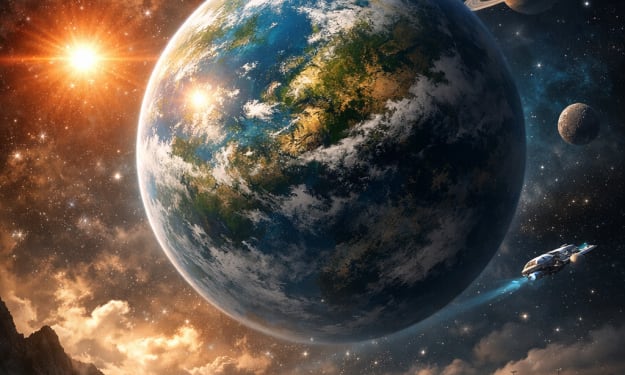
A Planet the Size of Earth with an Atmosphere Like Our Own
For centuries, humans have looked up at the night sky and wondered whether Earth is the only world capable of supporting life. Advances in modern astronomy have brought us closer than ever to answering that question. Recently, astronomers announced the discovery of a planet roughly the size of Earth with an atmosphere that appears surprisingly similar to our own. This finding has sparked excitement among scientists and renewed hope that life might exist elsewhere in the universe.
By Irshad Abbasi 7 days ago in Earth



Comments
There are no comments for this story
Be the first to respond and start the conversation.