
Frenemies of the Sea: When Oceans Refuse to Mix"
Explore the fierce boundary lines where great oceans meet and the forces that keep them apart
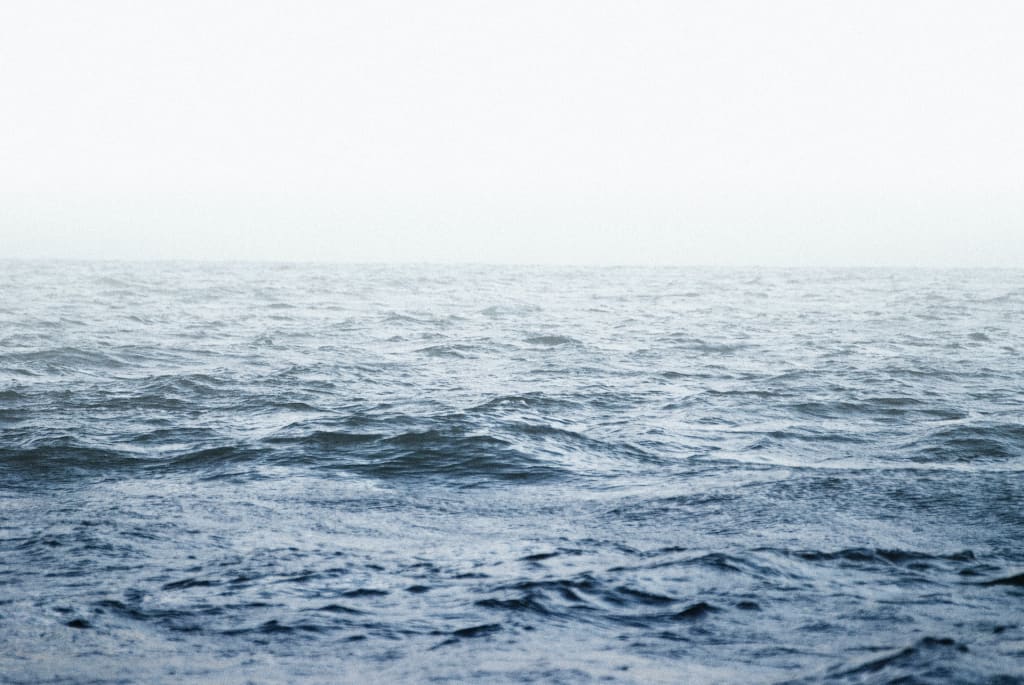
As you look at a map of the world, you might think that the oceans seamlessly blend into each other, as if they are just different shades of the same color. But there's a hidden truth beneath the surface. The border between the Atlantic and Pacific oceans is like a curtain of invisible force that separates them like two different worlds. It's as if they've made a pact not to mix their waters, despite being made up of the same H2O molecules. But why?
Well, it all comes down to the fact that not all water is created equal. The Atlantic and Pacific oceans have different densities, levels of salinity, and chemical compositions. Just like oil and water, they don't mix. The boundary between them is known as an "ocean cline," and the most impressive of them all are "haloclines" - the borders between waters with different salinity.
Haloclines occur when one body of water is at least five times saltier than the other. When Jacques Cousteau explored the Strait of Gibraltar, he discovered layers of water with varying salinity, each with its unique flora and fauna. It was like looking through a transparent film that separated them.
But why don't the denser water sink to the bottom, and the less dense water stay on top? It's all about inertia, my friend. The difference in density between the two oceans isn't significant enough for them to switch places. However, another force is at play - the Coriolis force.
The Coriolis force causes objects in motion on the Earth's surface to deviate from their course, depending on their location in the Northern or Southern hemisphere. This force also affects the direction of flows in the Atlantic and Pacific oceans, making them move in opposite directions and preventing them from mixing.
In addition to the Coriolis force, the surface tensile strength of the water molecules in the two oceans is also vastly different, which means they don't hold onto each other as tightly. And even if they did start to mix, the opposite directions of the ocean flows would prevent it from happening.
But the Atlantic and Pacific oceans aren't the only places where water bodies refuse to mix. There are countless places on our planet where the phenomenon occurs. One such location is the Black Sea, where a thick layer of stagnant, oxygen-depleted water separates the saltier and denser Mediterranean water from the fresher and less dense river water. Another example is the Baltic Sea, which is divided into two regions: the salty, dense water in the deep basin and the fresher, less dense water on top.
The Red Sea is yet another example, where the waters of the Gulf of Aden and the Indian Ocean mix at the Bab el Mandeb strait, but the salinity of the Red Sea is so high that it forms a distinct layer on top of the inflowing water. Similarly, in the Gulf of Alaska, the Pacific Ocean and the freshwater from the Copper River do not mix due to differences in temperature and salinity.
In the South China Sea, the boundary between the warm, shallow waters and the cooler, deeper waters is marked by a thermocline, which acts as a barrier preventing the mixing of the two. Finally, in the Arctic Ocean, the fresh water from the melting ice caps forms a layer on top of the saltwater, and the two layers do not mix.
So the next time you look at the ocean on a map, remember that there's more to the story than meets the eye. The world's oceans are vast, complex, and ever-changing ecosystems that never cease to amaze. And the invisible barriers that separate them are a reminder that even in the seemingly endless expanse of the oceans, there is still so much left to discover.
About the Creator
Keep reading
More stories from Marc Anton Boehringer and writers in Earth and other communities.
When The Niagara Falls Stopped Flowing
The Niagara Falls are known as one of the world's most magnificent waterfalls, with millions of gallons of water cascading down every second. But in 1969, the unthinkable happened. The falls ran dry, leaving behind nothing but bare rocks and stunned tourists.
By Marc Anton Boehringer3 years ago in Earth
Major Scientific Milestones of 2017
The year 2017 was an extraordinary period for scientific progress. Researchers across the world achieved remarkable breakthroughs in space exploration, medicine, technology, and environmental science. These discoveries not only expanded human knowledge but also opened new possibilities for the future. From observing gravitational waves to advances in gene editing and artificial intelligence, 2017 demonstrated the powerful role science plays in shaping modern society.
By Irshad Abbasi 7 days ago in Earth
TUS NUA - ch 53
TUS NUA – ch 53 New Beginnings – Mia and Midnight (*)(*)(*) Finola knew Ali’s brother-in-law needed to put his mind at rest. She fed her arm through his and led him outside. “We’ll sit here. If you like, I can put a block around us so our conversation will be private.”
By Margaret Brennan6 days ago in Fiction


Comments
There are no comments for this story
Be the first to respond and start the conversation.