

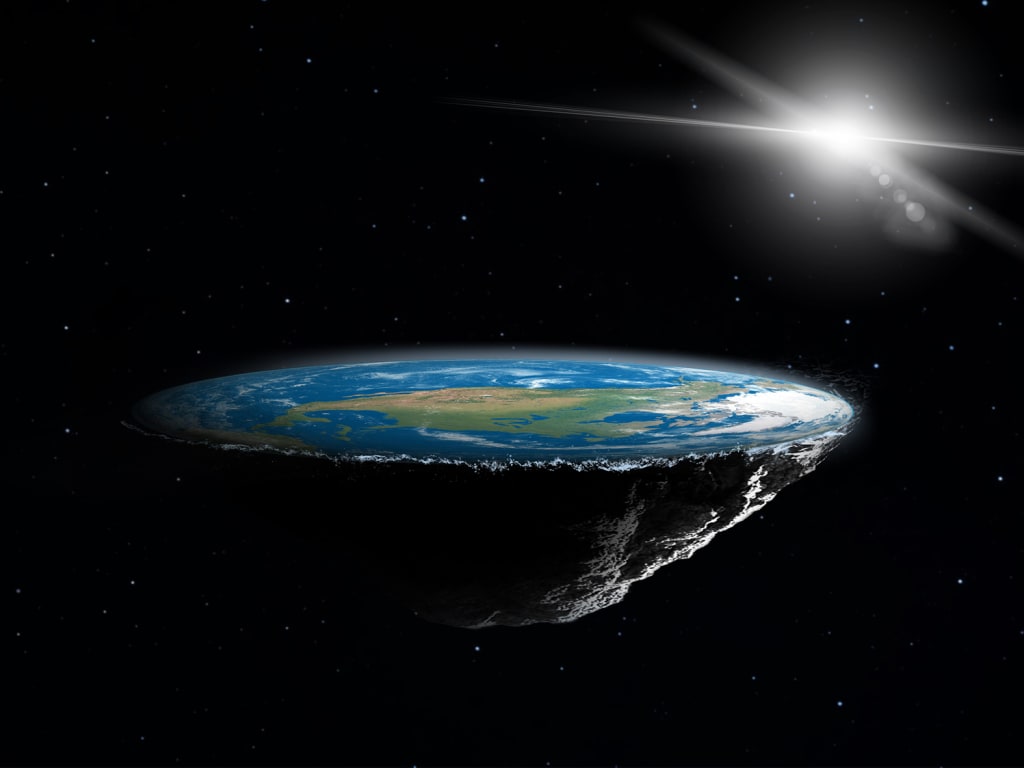
INTRODUCTION:
Flat Earth theories propose that the Earth is not a spherical planet but a flat, disc-shaped object. These theories often challenge mainstream scientific consensus. Some common arguments put forth by flat Earth proponents include
FLAT EARTH PROPONENTS:
Flat Horizon: They claim that the horizon appears flat, and objects that are far away should not be visible due to the Earth's curvature.
Lack of Curvature: Flat Earthers argue that there is a lack of observable curvature when looking at large bodies of water or the horizon.
No Tangential Motion: They assert that if the Earth were truly moving through space, we should feel a constant sense of motion.
Flight Paths: Some suggest that flight paths don't align with what would be expected on a globe, and that long-distance flights seem unnecessarily complex.
Water Level: Flat Earth proponents believe that water naturally seeks a level, and the surface of water bodies should remain flat on a flat Earth.
Lunar Eclipses: Some flat Earthers propose that the shadow cast on the moon during a lunar eclipse is not consistent with the Earth's round shadow.
Gravity Dispute: Some reject the concept of gravity as understood by mainstream science, offering alternative explanations.
Space Exploration Skepticism: Skepticism about space exploration and satellite images is a common aspect of flat Earth theories.
ARGUMENTS OF FLAT EARTHERS:
The perception of a flat horizon is a common argument made by some flat Earth proponents. They suggest that when looking out at a large expanse of land or water, the horizon appears flat and level, which they believe contradicts the idea of Earth being a curved sphere.
However, the appearance of a flat horizon is actually an effect of the immense size of the Earth relative to our everyday observations. The Earth is quite large in comparison to the distances we typically cover, so the curvature is not immediately noticeable in our day-to-day experiences
To help illustrate this, consider standing on a beach and looking out at the ocean. As you look further away, the curvature of the Earth becomes more pronounced, and objects on the horizon appear to sink below it. This effect is especially evident when watching ships as they appear to "sink" bottom-first as they move away due to the curvature of the Earth.
In reality, the curvature of the Earth is quite subtle over small distances, and this can lead to the illusion of a flat horizon in our immediate surroundings. However, when considering larger distances and broader observations, such as the way constellations change as you travel north or south, or the way the Earth casts a round shadow on the moon during a lunar eclipse, the evidence for the Earth's curvature becomes more apparent.
flat Earth proponents as evidence against the Earth being a spherical object. They point out that over certain distances, such as across large bodies of water or when observing distant objects, the curvature of the Earth is not readily apparent.
However, the lack of observable curvature over short distances is due to the Earth's immense size relative to our everyday experiences. Think about standing on a vast beach or looking out at the ocean. The curvature of the Earth is gradual, and over short distances, the curve is not immediately noticeable.
To illustrate this, imagine standing on a basketball. If the basketball were much larger, say the size of the Earth, the curve would be so subtle that you might not notice it when standing on a small section of the surface.
Nevertheless, evidence of Earth's curvature becomes apparent over longer distances. For example, as ships sail away from shore, they gradually disappear hull-first, and their masts are the last to vanish due to the curvature of the Earth. The way constellations change as you move north or south, and the way the Earth's shadow casts a round shape on the moon during a lunar eclipse, are also evidence of the Earth's spherical shape.
Flat Earth proponents sometimes challenge the conventional explanation for lunar eclipses. In a lunar eclipse, the Earth passes between the Sun and the Moon, casting a shadow on the Moon. The curved shape of the Earth's shadow during a lunar eclipse is considered strong evidence for the Earth's spherical nature.
Flat Earth theorists may propose alternative explanations for lunar eclipses, such as suggesting that a mysterious celestial body called the "anti-Moon" or "shadow object" causes the eclipse. They might also question the accuracy of mainstream scientific measurements or dismiss the evidence presented.
However, the curved shape of the Earth's shadow on the Moon during a lunar eclipse is consistent with the behavior of light and shadow on a spherical object. The gradual change in the shape of the Earth's shadow as it passes across the Moon's surface is not easily explained by a flat Earth model.
Mainstream science, supported by centuries of observation and measurements, provides a comprehensive explanation for lunar eclipses that aligns with the spherical nature of the Earth and the interactions of light and shadow. It's important to critically evaluate all viewpoints and consider the weight of evidence when exploring scientific concepts.
GRAVITY DISPUTES:
While the concept of gravity is well-established in scientific understanding, some flat Earth theorists propose alternative explanations for the phenomena associated with gravitational forces.
A few common arguments or disputes related to gravity in the context of flat Earth theories include:
Universal Acceleration: Some flat Earth proponents suggest that objects are accelerated upwards at a constant rate, which creates the sensation of gravity. They propose that this acceleration is what keeps objects on the Earth's surface.
Density and Buoyancy: Flat Earthers may argue that differences in density and buoyancy are responsible for the observed effects that we attribute to gravity, rather than a fundamental force of attraction between masses.
Disputing Mass and Inertia: Some flat Earth arguments challenge the accepted principles of mass and inertia that underlie our understanding of gravitational forces.
Cavendish Experiment Critique: Critics of the Cavendish experiment, which was used to measure the gravitational constant, might question its validity or interpretation.
It's important to note that mainstream science, supported by extensive experimentation and observation, has provided a well-established understanding of gravity as a fundamental force of attraction between masses. The explanations provided by flat Earth theories for gravity-related phenomena often lack the depth of evidence and explanatory power that the accepted scientific model offers.
When considering scientific concepts, it's crucial to weigh the body of evidence, the consistency of explanations, and the broader framework of knowledge that supports a particular understanding.
"ANTARCTICA ICE WALL" AS PART OF THEIR THEORY:

Flat Earth proponents often mention the concept of an "Antarctica ice wall" as part of their theory. They suggest that Antarctica is not a continent surrounding the South Pole, but rather a massive ice wall encircling the flat Earth. This ice wall, they claim, prevents people from falling off the edge of the Earth.
It's important to clarify that the mainstream scientific understanding and evidence contradict this notion. Antarctica is indeed a continent, not an ice wall, and it surrounds the South Pole. The existence of the Southern Ocean and the numerous scientific expeditions to Antarctica provide evidence of its true nature.
Satellite imagery and exploration have revealed the actual topography of Antarctica, showing a landmass with varied landscapes, mountain ranges, and scientific research stations. The notion of an ice wall encircling a flat Earth is not supported by the observable evidence, and it doesn't account for the extensive research, exploration, and understanding of Earth's geography.
In summary, the idea of an "Antarctica ice wall" is a central component of some flat Earth theories, but it doesn't align with the established scientific understanding of the Earth's geography and shape.
SPACE EXPLORATION SKEPTICISM:
Space exploration skepticism and flat Earth beliefs sometimes intersect when flat Earth proponents question the authenticity of space missions as evidence of Earth's spherical shape. Some flat Earthers use skepticism regarding space exploration to support their contention that the information provided by space agencies is unreliable or fabricated.
For example, flat Earthers may use space exploration skepticism to argue that:
Moon Landings: They might claim that the Apollo moon landings were staged as part of a conspiracy to maintain the illusion of a round Earth.
Space Imagery: Flat Earthers could argue that space agencies manipulate images and videos to deceive the public about the Earth's shape.
Space Missions: They may question the feasibility of various space missions, casting doubt on the technology's capability to travel through space.
Satellites: Some flat Earth proponents assert that satellites are not actually orbiting Earth, challenging the established concept of communication and navigation satellite networks.
It's important to note that space exploration skepticism, while present in some circles, doesn't necessarily validate the flat Earth hypothesis. The evidence supporting the Earth's spherical nature comes from a wide range of sources, including not only space missions but also observations of celestial bodies, satellite images, and scientific principles.
The majority of the scientific community maintains that the Earth is an oblate spheroid, and space exploration has contributed significantly to our understanding of the cosmos. When encountering claims related to space exploration skepticism within the context of flat Earth beliefs, it's essential to critically evaluate the evidence, consult reputable sources, and consider the broader body of scientific knowledge.
About the Creator
Asia’s Second-Best Island in DestinAsian Ranking
Vietnam’s largest island, Phu Quoc, has achieved a remarkable milestone in global tourism by being ranked the second-best island in Asia in the prestigious DestinAsian Readers’ Choice Awards 2026, surpassing the world-famous Maldives. The recognition marks a major moment for Vietnam’s tourism industry and highlights the island’s rapid rise as one of the most desirable tropical destinations in the world. 
By Irshad Abbasi a day ago in Earth




Comments
There are no comments for this story
Be the first to respond and start the conversation.