

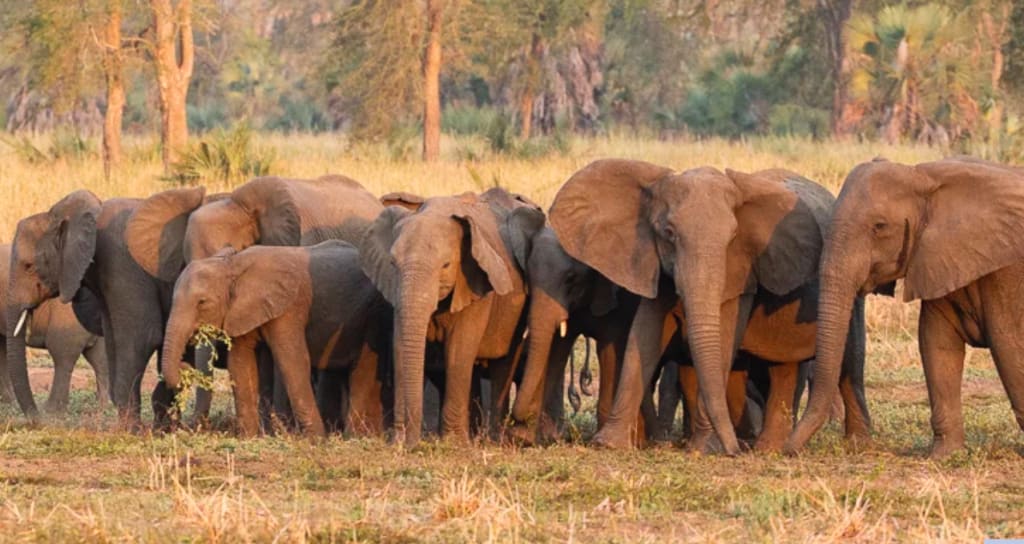
when Europeans started exploring Africa in the 1500’s, they came across and hunted thousands of elephants with huge tusks. Fast forward to the present, and most elephants have no tusks, or very small ones. Wonder why? Have all the Tuskers been hunted out? No, elepants have evolved into tuskless elephants.

A hefty set of tusks is usually an advantage for elephants, allowing them to dig for water, strip bark for food and joust with other elephants. But during episodes of intense ivory poaching, those big incisors become a liability.
Now researchers have pinpointed how years of civil war and poaching in Mozambique have led to a greater proportion of elephants that will never develop tusks.

During the conflict from 1977 to 1992, fighters on both sides slaughtered elephants for ivory to finance war efforts. In the region that's now Gorongosa National Park, around 90% of the elephants were killed.
The survivors were likely to share a key characteristic: half the females were naturally tuskless — they simply never developed tusks — while before the war, less than a fifth lacked tusks.
The tesearchers in Mozambique observed the national park 's roughly 800 elephants over several years to create a catalogue of mothers and offspring.
They noted that most babies were born tuskless because there were no male tuskers to breed with the females.
Evolutionary changes aren't necessarily slow
The researchers genetic analysis revealed two key parts of the elephants' DNA that they think play a role in passing on the trait of tusklessness. The same genes are associated with the development of teeth in other mammals.
The researchers work helps scientists and the public understand how our society and the insatiable demand for ivory can have a major influence on the evolution of other life forms."
Most people think of evolution as something that proceeds slowly, but humans can hit the accelerator.
And it’s not just in Mozambique that it’s happening, but all over Africa.
And humans are causing evolutionsty change in other animals as well. Think about wolves. some of the most aggressive hunting animals in existence, evolved by human contact into domestic dogs. Not all wolves, there are still wolves in the wild, just as there are still elephants with tusks. Just not as many as there used to be.
And humans have evolved themselives, but over millions of years. We have gone from tree living primates, swinging from tree to tree, branch to branch, using our hand and feet, and our tails as a third hand, and if we did walk on the forest floor we walked on all four of our hands and feet. Slowly we came down from the trees, and stayed on the ground, then eventually walked upright on our feet. Our tails disappeared from lack of use. The only evidence of our tails is our tailbone, which is all that is left. The other reminder of our ancient evolutionary past is the webbed hands and feet that sometimes appear on a newborn, which is an ancient echo of when we crawled out of the ocean and became land based mammals millions of years ago. And now we are evolving again. We used to be the most fierce, aggressive animals in the world. But now the general population is sedentary, soft, pudgy, not trained in critical thinking. We are reliant on calculators, computers, artificial intelligence to do our thinking for us. Sure, there are still warriors and critical thinkers out there, but not as many as there used to be when everyone had to fend for themselves. And those warriors and thinkers will not be attracted to those general population softies, so they will not breed with them and produce warrior and critical thinking offspring. They will be attracted to warrior Amazon type women, and breed with them. And the soft general population will breed with other people just like themselves and so continue to carry forward that gene pool of sedentary soft people. How we will eventually evolve I don’t know, but just looking at how we have evolved up to now kind of gives you an idea. We will have an elite class of warrior thinkers ruling, and the general population will be their loyal dogs.
About the Creator
Guy lynn
born and raised in Southern Rhodesia, a British colony in Southern CentralAfrica.I lived in South Africa during the 1970’s, on the south coast,Natal .Emigrated to the U.S.A. In 1980, specifically The San Francisco Bay Area, California.
Man Shot and Killed During Minneapolis Immigration Crackdown Graduated from Preble High School
A man shot and killed during an immigration enforcement operation in Minneapolis has been identified as a graduate of Preble High School, a detail that has added a deeply personal dimension to an already controversial crackdown. As authorities continue to investigate the circumstances surrounding the fatal shooting, community members, former classmates, and civil rights advocates are demanding transparency, accountability, and a broader review of how immigration enforcement actions are being carried out.
By Salaar Jamali7 days ago in Earth
Catherine O’Hara at 71: Celebrating a Comedy Icon as False Death Rumors Circulate
Catherine O’Hara, the beloved actress known worldwide for her unforgettable roles in Schitt’s Creek and Home Alone, has recently been the subject of false online reports claiming she died at the age of 71. These claims are untrue. O’Hara is alive, active, and continues to be celebrated as one of the most influential comedic performers of her generation.
By Aarif Lashariabout 7 hours ago in Earth




Comments
There are no comments for this story
Be the first to respond and start the conversation.