
European Series - The Opener of the "Marine Civilization" in the Mediterranean - the Cretans
The Opener of the "Marine Civilization" in the Mediterranean - the Cretans

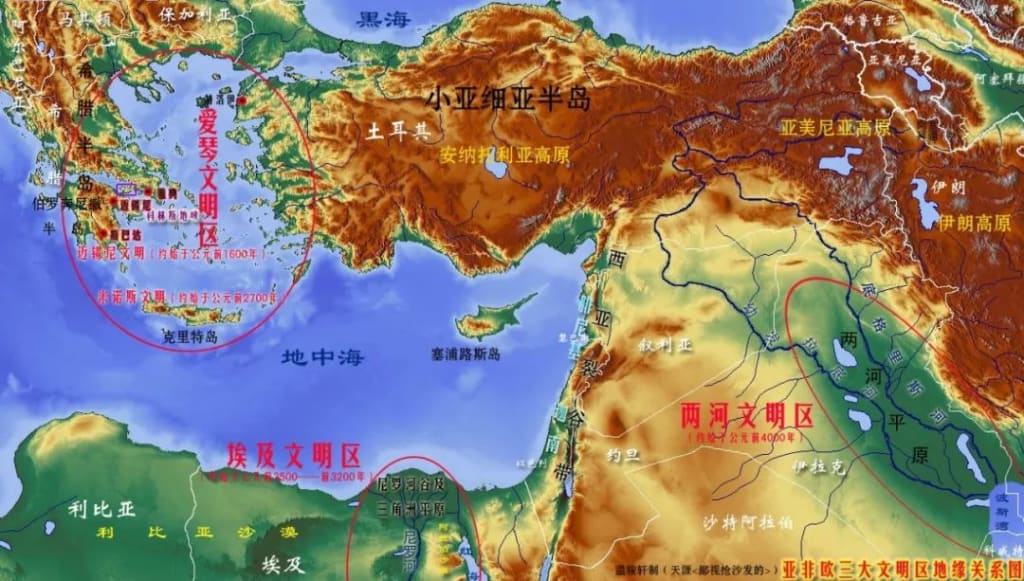
Clearly, no matter what your purpose is to travel between Greece and Egypt, Crete is the perfect springboard. Such a springboard is even more important for ocean pioneers who mainly rely on human-driven ships. If Crete is limited in size, then all it can provide is probably just a trade transit point. However, as the fifth largest island in the Mediterranean Sea (more than 8,000 square kilometers), such a volume was enough to support the existence of a city-state in ancient times.
Today's Crete is part of Greece. And no one doubts that Crete was once an important carrier of Greek civilization. In the ancient Greek mythology, the ruler of Crete was called "Minos", and his greatest "achievement" was to give birth to a son of a tauren, and to confine the monster son, he built a labyrinth. In mythology, King Minos conquered Athens after another son died unexpectedly in Athens. As a result of the war, Athens had to regularly pay tribute to the monstrous sons of Minos in exchange for peace. As for the ending of the story, it was a heroic Greek hero who braved the labyrinth and killed the monster.
Personally, I really don't want to recite these exotic myths in this post. For the plot of this myth, you can go to Baidu information. However, for the ancient times, where there is almost no belief in history, apart from archaeological discoveries, the myths passed on by word of mouth and adding branches and leaves are almost the only evidence that can be used for reference. Extracting useful information from it is what we mean by eliciting this myth.
The above myths can bring us at least two useful information, one is that there was a high degree of civilization in Crete; the other is that the strength of Crete was once able to overwhelm the Greek peninsula. From a geographical point of view, this situation is very likely to exist. As a relay station between the Greek peninsula and the Nile civilization, the tribes that first ruled Crete, in addition to absorbing nutrients from the Nile civilization, can also gain huge benefits from the European-African trade.
Archaeological findings also support the inference that an urban civilization existed in Crete before 2000 BC. For us, the biggest question is, did the original creators of the Cretan civilization come from Europe? If so, then we can regard Cretan civilization (also called "Minoan civilization") as the starting point of European civilization. If not, then the starting point of European civilization should also be attributed to the Peloponnese.
From the perspective of the spread of civilization, the Cretan civilization is more likely to be an extension of the Egyptian civilization. In addition to the earlier civilization in Egypt and the more powerful external expansion, the Nile River was also better equipped to become the origin of Mediterranean navigation. In fact, due to the regular flooding of the Nile, ancient Egypt had no fixed lines of communication on both sides of the Nile for a long time. However, the existence of the Nile River provides a more efficient and convenient transportation method for the communication between residents on both sides of the river, that is, water transportation.
Since the Nile River flows from south to north, ships sailing from the Nile Valley (Upper Egypt) to the estuary delta (Lower Egypt) can go downstream and easily reach the estuary. As for boats sailing in the opposite direction, they can reach their destination with relatively little manpower because of the slow flow of the river. But soon, the Egyptians discovered a more labor-saving way to go upstream, that is, "sails". Because the Mediterranean Sea is in the westerly belt, ships sailing in the Nile are basically subjected to the northwesterly wind. The Egyptians soon discovered that as long as a "sail" was erected on the boat, they could easily go up the river.
The ancient Egyptians were not the only people on this planet who invented the sailboat, but because of the pivotal role of Nile shipping in Egyptian civilization, they were probably the first people in the world to discover this technology. According to historical records and archaeological discoveries, the Egyptians had mastered sailing technology at least as early as 2700 BC. They even formed their own "navy" to strengthen the management of the tribes on both sides of the Nile. This time point also coincides with the rise of the Cretan civilization.
The "navy" of the ancient Egyptians was more responsible for internal management, with the God-given agricultural foundation (the Nile River), and because they were isolated by the desert and had little land threat, they had no desire for external expansion. In terms of not taking the initiative to expand, it is somewhat similar to the Chinese civilization. In fact, Dahe civilization has such characteristics. Since I have occupied the most prosperous land in my world, why should I bother to occupy those barbarian lands?
The rulers of ancient Egypt did not have the desire to expand, which did not mean that no one would spread its culture to the outside world and use it as a trade terminal to develop trade relations with overseas. Crete was the first overseas plate to benefit. As far as the way of transmission is concerned, the tribes that based on Crete and expanded the Mediterranean trade should come from Egypt. That is to say, due to the independence of Crete itself, coupled with the agricultural-oriented ancient Egypt, there is no desire to expand into a maritime trade power. After continuously drawing civilization factors from Egyptian civilization, Crete finally formed its own unique civilization.
The uniqueness of Cretan civilization lies in its maritime attributes. Unlike agriculture, which played a central role in the great river civilization, trade was the cornerstone of Crete's existence. Today, when we go to investigate the ruins of the Cretan civilization, we will find that the cities and palaces on the island basically have no fortifications. In fact, for a maritime country, land defense is not important, a strong navy is its line of defense.
Since the Egyptians, who possessed great material wealth, had no desire to expand their maritime interests (they were more worried about the invasion of nomadic tribes in desert areas), the only challenge to Crete civilization was its east and north coastlines. In fact, the Egyptians' breakthrough in navigation technology did not only awaken the sea consciousness of Crete. Those explorers who set out from the mouth of the Nile, in addition to discovering Crete northwards, also sailed eastward along the coastline. In this direction, they had the opportunity to approach another center of civilization, Mesopotamia (Two Rivers), by sea.
About the Creator
Keep reading
More stories from guanjianwenti001 and writers in Earth and other communities.
Europe Series - The Geographical Relations of Three Civilizations in the Mediterranean
It is a recognized fact that European civilization originated in Greece. Of course, the debate about the authenticity of ancient Greek civilization has also been a hot topic on the Internet in recent years. However, the evidence that is indisputable will not affect the following content. Because according to the consistent perspective of this post, the geography itself is the focus of our attention.
By guanjianwenti0013 years ago in Earth
Trump Administration Moves to End Deportation Protection for Somalis
The Trump administration has moved to end long-standing deportation protections for Somali nationals living in the United States, a decision that could place tens of thousands of people at risk of removal. The move has sparked alarm among immigrant communities, human rights organizations, and legal experts, who warn that returning Somalis to a country still grappling with instability could have severe humanitarian consequences. As the policy change unfolds, it has reignited debate over immigration enforcement, executive authority, and America’s obligations to people fleeing conflict.
By Aarif Lashari6 days ago in Earth
Biochar-Based Carbon Removal Market Outlook for 2026
Biochar carbon removal is transitioning from a niche climate intervention into a structured, investable market. By 2026, the sector is expected to exhibit accelerated growth driven by tightening climate commitments, maturation of crediting methodologies, and increasing buyer sophistication. Market dynamics are shifting from pilot-scale experimentation toward scalable deployment, with pricing, supply constraints, and verification rigor emerging as defining variables.
By Wayne Shen7 days ago in Earth



Comments
There are no comments for this story
Be the first to respond and start the conversation.