
Environmental Injustice
bear the brunt of environmental degradation and climate change impacts

In the heart of the Mississippi Delta, where blues notes dance on cotton fields and history's ghosts linger like specters in the humid air, a small community called Belle Haven stood resilient. For generations, its predominantly African American residents had woven their lives into the fabric of the land. But beneath the towering magnolias and amidst the rustling reeds, a darker truth had taken root - the shadows of environmental injustice.
It was a hot August morning when a storm, heavy with the promise of rain, gathered on the horizon. The town of Belle Haven was no stranger to floods. The Mississippi River had both blessed and cursed their lives, nourishing their crops while threatening to steal their homes. But the storms had grown fiercer, the floods more destructive, and the resilience of Belle Haven was wearing thin.
Nina Johnson, a wise elder in the community, remembered the days when her ancestors had first settled in these parts. Their connection to the land ran deep, much like the river's meandering course. She often recounted the stories of how they had tilled the soil, sown the seeds, and nurtured the crops that put food on their tables. Those same fields now faced an existential threat.
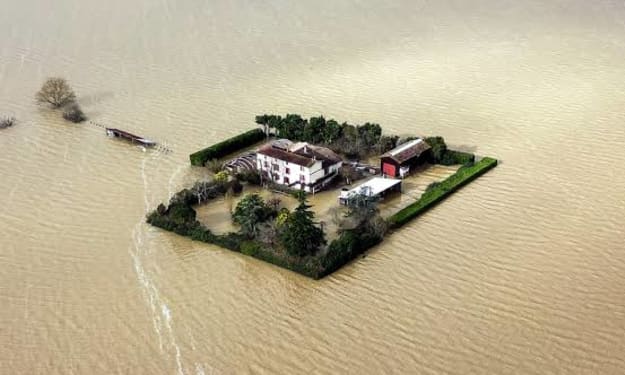
The clouds loomed ominously, and as the rain began to fall, the river's water level steadily rose. With it came fear and frustration, for the Belle Haven community knew that they bore the brunt of environmental degradation and climate change impacts. The levees, originally built to protect the more affluent communities upstream, diverted floodwaters towards them, like a shield that repelled danger but directed it elsewhere.
Nina's grandson, Jamal, stood at the edge of their property, gazing out at the deluge. His thoughts raced like the raindrops cascading from the sky. He had just graduated from the local high school with dreams of becoming an environmental scientist. But as he watched the water creep closer to their doorstep, those dreams seemed ever more distant.
The river had not always been an enemy. Jamal remembered the stories his grandmother had told him about how they used to fish, swim, and gather on its banks. But now, the river was an unpredictable beast, emboldened by climate change. It roared with fury, drowning fields and homes, leaving the scars of erosion in its wake.
The injustice cut deep. Belle Haven had been carved into a silent, submerged prison. As the waters rose, the predominantly white communities upstream remained largely untouched. They had the resources to fortify their homes, the political clout to secure government funding for infrastructure, and the privilege to distance themselves from the rising tide. Belle Haven had none of these.
As the rain continued to pour, Nina and Jamal joined their neighbors in a makeshift shelter on higher ground. The despair in the room was palpable, but so was the resilience that had sustained their community for generations. They knew they could not let Belle Haven drown in sorrow.
Jamal decided to take action. He would fight not only for his family but for all the marginalized communities suffering from environmental injustice. He started by documenting the flooding, collecting data, and reaching out to organizations that could help. He also joined a grassroots movement that aimed to address the disproportionate impacts of climate change on vulnerable communities.
Months turned into years, and Jamal's passion led to a partnership with environmental activists from across the country. Together, they pressured the government to invest in stronger levees and better flood management strategies for Belle Haven and similar communities.
Change was slow, but it was happening. The river no longer held the community captive in the same way it once did. Jamal's dream of becoming an environmental scientist was rekindled. He had witnessed the power of collective action and the resilience of his people.
In time, Belle Haven began to thrive anew. The land that had once been a symbol of suffering became a testament to their strength. Nina Johnson, with pride in her eyes, looked at her grandson and said, "Jamal, you've shown us that even when the shadows of environmental injustice fall upon us, we have the power to cast our own light and carve our own path."
As the years went by, the storm clouds continued to gather on the horizon, but Belle Haven stood tall, its roots deep in the earth, its people united against injustice. They had learned that the river could be tamed, and justice, like the Mississippi Delta's blues, could be sung into existence by those who refused to be silenced.
About the Creator
Keep reading
More stories from writers in Earth and other communities.
Under Water, in Denial: Is Europe Drowning Out the Climate Crisis?
Europe is facing an escalating climate crisis, yet public discourse and policy responses often appear misaligned with the scale and urgency of the challenge. Extreme weather events, flooding, and record temperatures have repeatedly tested the continent’s infrastructure and resilience, but some analysts argue that political hesitation, economic priorities, and media framing are contributing to a subtle form of denial about the severity of climate threats. Extreme Weather on the Rise Over the past decade, Europe has witnessed a notable increase in extreme weather events. From unprecedented heatwaves in southern Spain and Italy to devastating floods in Germany and Belgium, the frequency and intensity of such incidents are rising in ways scientists attribute to climate change. According to recent data from the European Environment Agency (EEA), floods and heatwaves alone have caused tens of billions of euros in damage since 2015. Despite the evidence, many European governments have struggled to translate these warnings into consistent, robust climate action. While countries like Germany and Denmark have invested heavily in renewable energy, others continue to rely on fossil fuels or fail to implement comprehensive mitigation strategies. Political Hesitation and Economic Constraints A recurring theme in European climate policy is the tension between immediate economic concerns and long-term environmental imperatives. Policymakers face pressure to maintain economic growth, protect jobs, and avoid unpopular energy price hikes. This often results in incremental measures rather than bold reforms. “The problem is not ignorance—it’s political inertia,” said a climate policy analyst in Brussels. “Even when governments acknowledge the science, short-term economic and electoral pressures dilute the urgency of their actions.” Recent debates over natural gas reliance illustrate this dynamic. While Europe has pledged to reduce carbon emissions in line with the Paris Agreement, geopolitical events and energy security concerns have led some countries to temporarily increase fossil fuel consumption, undermining broader climate objectives. Media Coverage and Public Perception Media framing also plays a critical role in shaping public awareness of climate risk. Studies show that while extreme events receive coverage, they are often presented episodically rather than as part of a systemic crisis. Headlines may highlight isolated floods or wildfires without connecting them to long-term climate trends, fostering a perception that these events are temporary or exceptional. This framing can feed a subtle denial among the public, even as scientific reports warn of accelerating environmental risks. Surveys indicate that while Europeans generally recognize climate change, there is less consensus on the urgency or the transformative actions required, suggesting a gap between knowledge and engagement. Regional Disparities and Vulnerable Communities The impact of climate change is uneven across Europe. Coastal regions, river valleys, and low-lying urban centers are particularly vulnerable to flooding, while southern areas face intensifying heatwaves and drought. Vulnerable populations, including low-income residents and migrants, are disproportionately affected, raising concerns about social equity and resilience. Cities like Venice, Rotterdam, and Hamburg have implemented flood defenses and urban adaptation measures, yet experts warn that piecemeal efforts are insufficient. Without coordinated, continent-wide strategies, localized responses may fail to protect broader populations from systemic climate risks. Looking Ahead European leaders face a critical crossroads. The continent has the resources, scientific expertise, and technological capability to lead on climate action, yet political caution, economic pressures, and fragmented communication threaten to undermine progress. Analysts emphasize that acknowledging the crisis, integrating mitigation and adaptation strategies, and fostering public engagement are essential to avoid long-term ecological and economic costs. “The question is whether Europe will confront reality before it’s too late,” said an environmental policy researcher. “We are literally under water—politically and environmentally—if we continue to treat climate change as a distant problem.” Without decisive action, Europe risks not only environmental damage but also economic disruption, social inequality, and political instability. The climate crisis is no longer a future threat—it is an immediate challenge, demanding coordinated, bold, and transparent policies across the continent.
By Fiaz Ahmed 7 days ago in Earth



Comments
There are no comments for this story
Be the first to respond and start the conversation.