
Emergency Crews Deployed as Earthquake Swarm Shakes Santorini, Greece
Authorities take action as over 200 quakes rattle the island, causing panic among residents and tourists

Santorini, one of Greece’s most famous islands, is facing a rising crisis as a swarm of earthquakes has rattled the region, prompting emergency crews to step in. With more than 200 undersea tremors recorded over the past three days, authorities have taken precautionary measures to ensure public safety. Tourists and residents are on edge, with many choosing to leave the island.
Seismic Activity Raises Concerns
The earthquake swarm, with magnitudes reaching up to 4.9, has created a wave of uncertainty among experts and local officials. Although Greek scientists have ruled out any direct link to Santorini’s volcano, the frequency and intensity of the tremors have sparked fears of a stronger earthquake.
Greek Prime Minister Kyriakos Mitsotakis, speaking from Brussels, urged residents to remain calm and follow safety instructions. “We have a very intense geological phenomenon to handle,” he said, emphasizing the importance of listening to the Civil Protection authority’s guidelines.
Precautionary Measures in Place
To minimize risks, authorities have implemented several precautionary steps, including:
- Deploying emergency rescue teams to Santorini
- Shutting down schools on Santorini, Amorgos, Anafi, and Ios until Friday
- Banning access to certain seaside areas, including the island’s old port, due to the risk of rockslides
- Sending mobile alerts to residents and visitors about potential dangers
- Advising people to avoid large indoor gatherings and areas prone to landslides
- Instructing hotels to drain swimming pools to prevent structural damage from quakes
Residents and Tourists React
The ongoing tremors have left residents and tourists anxious, with many scrambling to leave Santorini. Long lines formed at ticket counters as people rushed to buy ferry and flight tickets to escape the island.
“I have never experienced anything like this before—an earthquake every 10 or 20 minutes. Everyone is worried, even if they try not to show it,” said Michalis Gerontakis, the director of the Santorini Philharmonic Orchestra.
Some, however, have decided to stay. Restaurant worker Yiannis Fragiadakis returned to the island despite the quakes. “I wasn’t afraid. People are leaving, but I plan to stay and hopefully, the restaurant will reopen for the holiday season in three weeks,” he said.
Tourists are also divided on their response. While some are leaving as a safety measure, others, like South Korean traveler Soo Jin Kim, are cautiously continuing their vacation. “We felt mild shakes about 10 times during dinner, but at midnight, there was a strong one. We are half-worried, half-observing the situation,” she said.
Emergency Crews Set Up Base
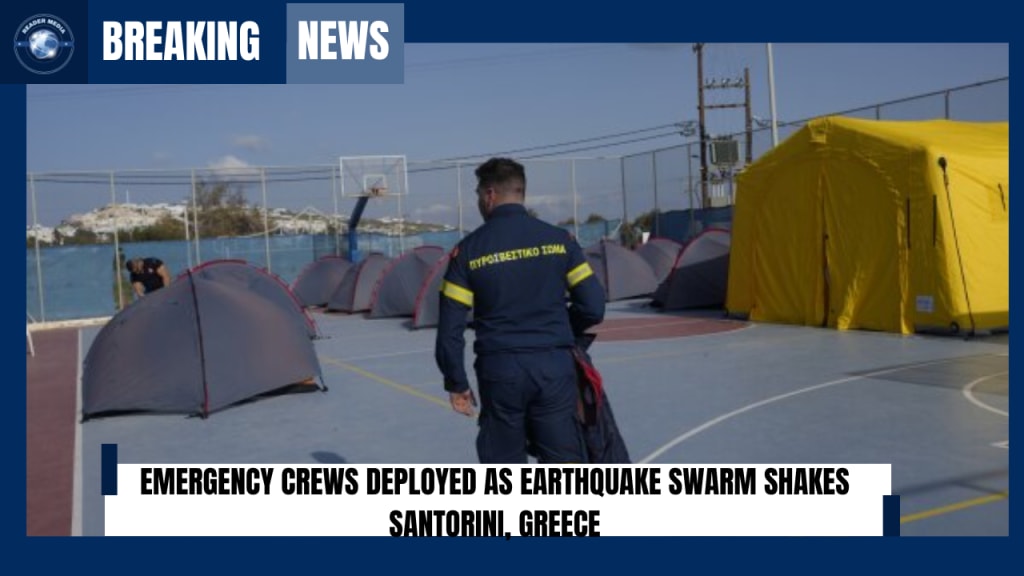
To ensure public safety, emergency teams arrived on Sunday and have set up a staging area with yellow tents at a basketball court near the island’s main hospital.
“We arrived last night with a 26-member team of rescuers and a rescue dog,” said fire brigadier Ioannis Billias. Many families, fearing aftershocks, chose to sleep in their cars instead of staying in their homes.
Experts Warn of Possible Larger Quake
Seismologists are closely monitoring the situation, analyzing the unusual pattern of seismic activity. Prominent Greek seismologist Gerasimos Papadopoulos noted that the earthquakes are tectonic rather than volcanic, but their increasing frequency and shifting epicenters raise concerns about a potentially larger event.
“All scenarios remain open,” he wrote in an online post. “The risk level has escalated.”
A Look at Santorini’s Volcanic Past
Santorini is a top tourist destination, attracting over 3 million visitors annually. Its whitewashed villages, perched on dramatic cliffs, were shaped by a massive volcanic eruption around 1620 B.C. That eruption, one of the largest in history, wiped out a large part of the island and contributed to the decline of the ancient Minoan civilization.
While the Santorini volcano remains active, its last significant eruption was in 1950. The current earthquake swarm, though not volcanic, has put the island’s geological instability back in the spotlight.
Authorities Urge Calm but Stay Prepared
Despite the uncertainty, local authorities stress that the measures being taken are purely precautionary. Mayor Nikos Zorzos reassured residents that planning for potential emergencies does not mean disaster is imminent.
“We are obliged to make preparations. But being prepared for something does not mean it will happen,” he said.
As the situation unfolds, officials are advising people to remain alert, follow safety instructions, and avoid panic. Scientists and emergency teams continue to monitor the seismic activity closely, ready to respond to any developments.
Disclaimer
This content has been created by an AI language model and is intended to provide general information. While we strive to deliver accurate and reliable content, it may not always reflect the latest developments or expert opinions. The content should not be considered as professional or personalized advice. We encourage you to seek professional guidance and verify the information independently before making decisions based on this content.
This information is sourced from AP News
About the Creator
Reader Media News
Welcome to Reader Media – your go-to source for the latest news, expert insights, and in-depth articles across business, tech, health, entertainment, sports, and more. Stay informed and engaged with the world through quality content.
Keep reading
More stories from Reader Media News and writers in Earth and other communities.
Doomsday Clock Moves to 89 Seconds Before Midnight – The Closest Eve
The Doomsday Clock, a symbolic representation of how close humanity is to global catastrophe, has moved forward by one second, now standing at 89 seconds to midnight. This is the closest it has ever been to symbolic destruction, reflecting the increasing threats facing the world today.
By Reader Media Newsabout a year ago in Earth
Hemp as a sustainable material
The ecological properties of hemp makes it one of the types of insulation used in construction with the lowest carbon emissions footprint. In the future, hemp could play a paramount role in the race towards reducing the global carbon emissions footprint to fight climate change, and a more sustainable construction industry.
By Susan Fourtané a day ago in Earth
A System That Isn’t Working Challenge Winners
Systems promise order. They organize behavior, distribute opportunity, and suggest that if everyone follows the rules, things will work. The entries in A System That Isn’t Working look closely at what happens when that promise begins to slip.
By Vocal Curation Team3 days ago in Resources



Comments
There are no comments for this story
Be the first to respond and start the conversation.