
Edge of No Return: Earth's Climate Tipping Points
How Irreversible Changes Are Unfolding—and Why Urgent Action Is Our Only Hope

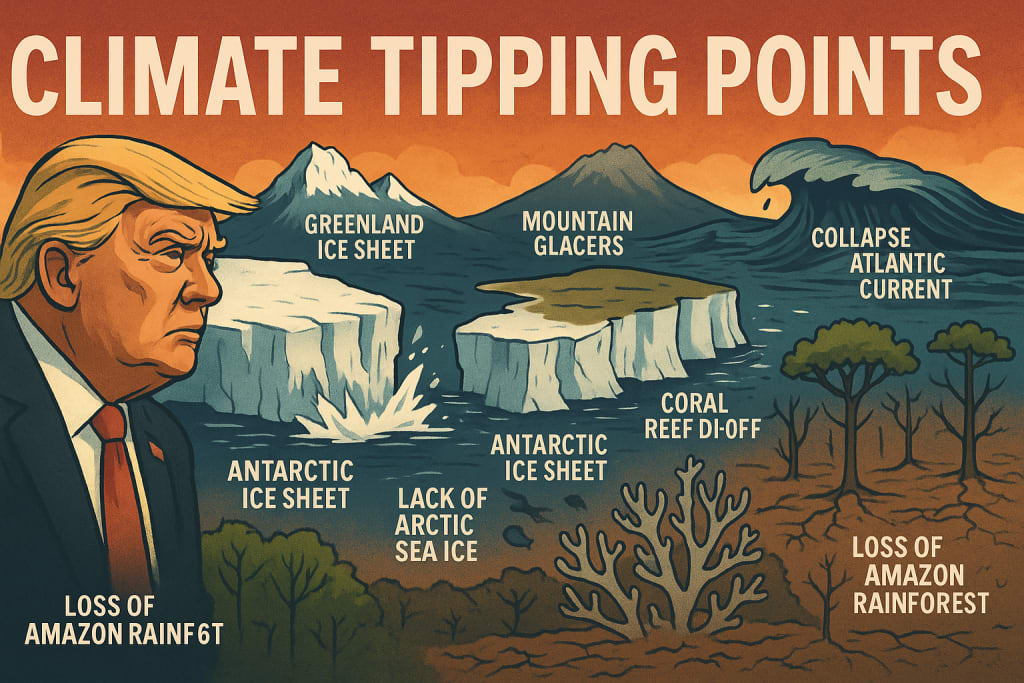
The climate keeps changing, despite the Trump administration's attempt to silence the entire phenomenon.
If policies continue on their current course, the world is on track to trigger several climate "tipping points," according to a new study released on April 23. These points of no return are specific moments when the planet has warmed so much that certain effects become irreversible.
Scientists assessed the risk of “tipping” in 16 different parts of the Earth system – ranging from the collapse of major ice sheets to the "dieback" of tropical coral reefs and vast forests.
“Climate tipping points could have devastating consequences for humanity," said study co-author Tim Lenton, from the University of Exeter's Global Systems Institute in the United Kingdom. "It is clear that we are currently on a dangerous trajectory – with tipping points likely to be triggered unless we change course rapidly."
What is a 'tipping point'?
A "tipping point" is when a minor change causes a system to shift into a new state, resulting in significant, long-term change. According to the study, the debate regarding the climate system's tipping points has grown more heated over the past two decades.
What are some of the tipping points?
The study mentions a number of tipping points, including the collapse of the Greenland and Antarctic ice sheets, coral reef die-offs, the loss of the Amazon rainforest, a lack of winter sea ice in the Arctic, an abrupt thaw of permafrost, the loss of mountain glaciers, and the collapse of a crucial Atlantic current that could change the climate worldwide.
Trump administration takes aim at climate change
The Trump administration is continuing to pursue its pledge to prioritize American energy independence and scale back the federal government's plans to understand and prevent climate change.
The president has withdrawn the United States from the historic Paris climate agreement, among other things. Increased use of fossil fuels produced in the United States, such as coal, oil, and natural gas, which produce the greenhouse gases that contribute to climate change, is a key component of his strategy.
What can we do?
Lenton stated, "To reach a safe and sustainable future, we need urgent global action, including the triggering of "positive tipping points" in our societies and economies." As for actions that individuals can take, Lenton said to "eat less meat .... Choices made regarding one's diet and the associated farming practices are responsible for 25% of all greenhouse gas emissions. It is also better for your health because the majority of consumers in the United States and Europe consume an unhealthy amount of animal protein, which raises the risk of colorectal cancer, heart disease, and diabetes. It is also better for the environment because meat consumption, particularly beef consumption, is the primary factor in the global net loss of nature. This is because beef consumption is an extremely inefficient method of utilizing land for food production. He said individuals can also choose to adopt renewable energy (such as rooftop solar) since the power sector is another quarter of all greenhouse gas emissions.
People can also choose to adopt electric vehicles since road transport is responsible for about 12% of greenhouse gas emissions worldwide, Lenton said.
There is some good news
The study also found that certain tipping points, like the dieback of the Amazon rainforest and the thawing of permafrost, are unlikely to release enough carbon to set off other tipping points. According to study lead author Jakob Deutloff, the emissions from those points are insufficient to set off a "tipping cascade," in which one tipping element sets off the next. According to Deutloff, who is also from the University of Exeter, "The good news from our study is that the power to prevent climate tipping points is still in our hands." "The risk of triggering these tipping points is significantly reduced by moving toward a more sustainable future with lower emissions."
WRITTED BY ME
About the Creator
Mahafuj Alam
🗞️ Mahafuj Alam | News Curator & Independent Media Voice
delivering news quickly, accurately, and bravely, including headline breaking stories and untold local stories. Stay informed. Keep your power.
Keep reading
More stories from Mahafuj Alam and writers in Earth and other communities.
Pope Francis (2013–2025): A Shepherd of the Streets
Pope Francis flashed a wide, easy smile frequently. He thrived on direct, informal encounters: phone calls, penned notes, hugs, audiences with small groups. He broke protocol by busing his own tray at the cafeteria, carrying his own overnight bag, and responding to reporters' questions extemporaneously. He was attentive, determined, testy, mercurial, sometimes deliberate, sometimes in a hurry, hard to read, and hard to pin down. When Francis was elected to the papacy at the age of 76, he brought those characteristics to the position for a period of twelve years—until he passed away on Monday—and over time, they became more refined rather than altered. That seems to have been the most important part of his time as Pope. He brought Roman Catholicism back to the street level and the papacy down to earth through pure personability, similar to what John XXIII had done six decades earlier when he convened the Second Vatican Council. It doesn't seem that long ago that Benedict XVI unexpectedly resigned—the first Pope to do so in six centuries—and Jorge Mario Bergoglio, the Cardinal Archbishop of Buenos Aires, was elected Pope. He remained a man who wasn't defined by his role despite Church scandals involving clerical sexual abuse and Vatican finances and open resistance from doctrinal and liturgical traditionalists. That was March, 2013, and the images from Francis’s first weeks in office are still fresh in mind: returning to the hotel where he’d stayed prior to his election to pay his bill, setting up residence in a plain modern guesthouse rather than the Apostolic Palace, trading the papal Mercedes-Benz for a Fiat. This Pope was new in many respects: the first Jesuit Pope, the first Pope from the Americas, the first to take the name Francis, after the Italian saint known for his embrace of poverty and his care for the natural world.
By Mahafuj Alam10 months ago in Earth
Warships and Fighter Jets: What Is the ‘Massive’ US Armada on Its Way to Iran?
A Show of Force in a Volatile Region The United States has begun deploying what officials and analysts are describing as a “massive” military armada toward the Middle East, amid rising tensions with Iran. The movement includes aircraft carriers, guided-missile destroyers, submarines, and advanced fighter jets, signaling one of the most significant American military postures in the region in recent years.
By Aarif Lashari3 days ago in Earth
Why Earth is round why not plan?
For thousands of years, humans have wondered about the true shape of the world beneath their feet. Early civilizations imagined many possibilities: a flat disc, a giant mountain, or even a floating island. However, careful observation of nature, the sky, and the seas gradually revealed something remarkable — Earth is round. Not perfectly like a ball, but very close to a sphere, slightly flattened at the poles. This shape is called an oblate spheroid. The evidence for this conclusion comes from ancient observations, modern science, and direct images from space.
By USA daily update 6 days ago in Earth


Comments
There are no comments for this story
Be the first to respond and start the conversation.