
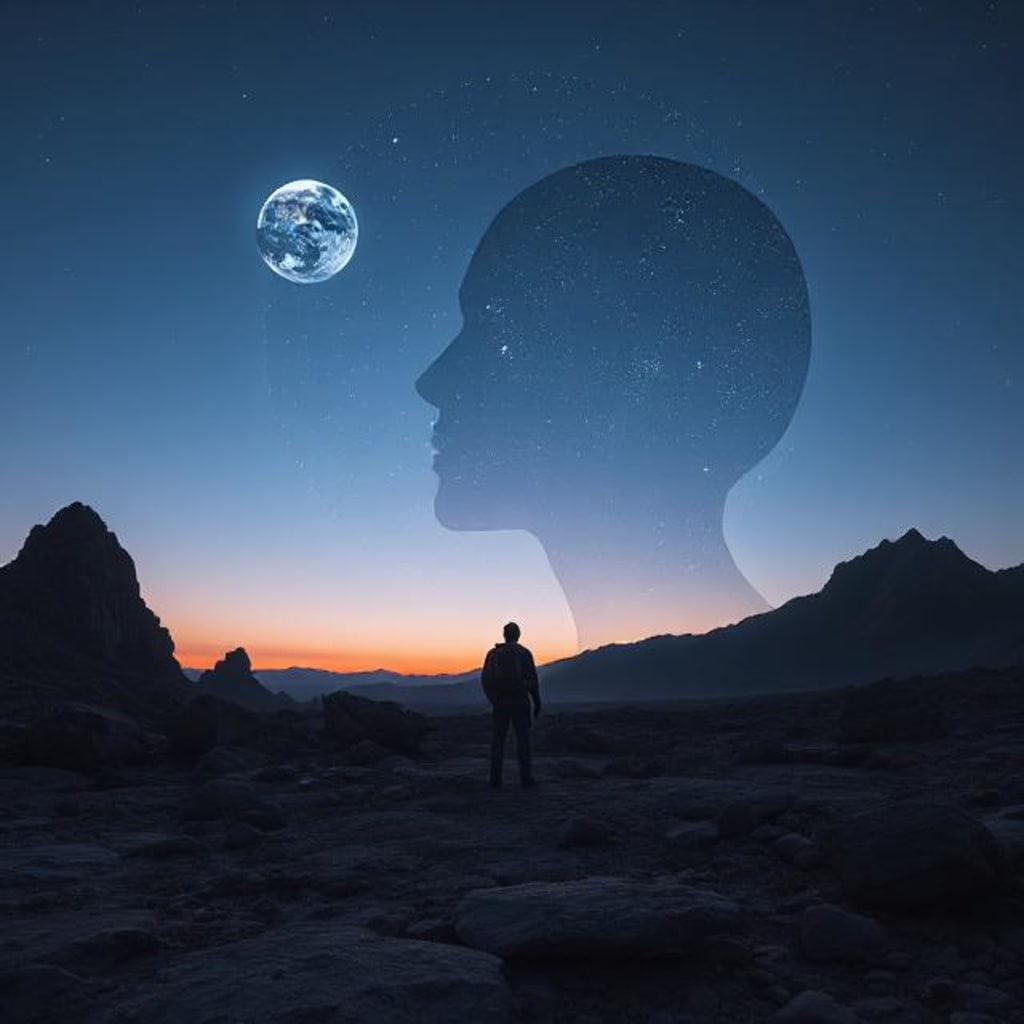
They called it Erelios, the second cradle of humanity. Orbiting a binary sun at the edge of the Omega system, Erelios was the crown jewel of terraforming—a planet shaped by human hands, designed for survival, yet haunted by memory.
Elara Voss had never seen Earth.
Born three generations after the Exodus, she was a child of steel corridors, artificial gravity, and oxygen farms. But she had felt Earth—in her bones, in the lullabies her grandmother sang, and in the dreams that came every night without fail. Dreams she had never shared with anyone.
In the dreams, she stood barefoot on soft green grass, felt wind with the scent of rain, and heard laughter that belonged to voices she didn’t recognize. Cities rose in the distance—towers of light and glass, rivers winding like veins through landscapes impossibly alive. And always, always, the sky above pulsed with blue, not the copper haze of Erelios.
These weren’t dreams. They were memories.
Elara worked as a data archaeologist—an odd profession, given that humanity’s digital history had mostly been lost in the Collapse. She catalogued fragments: broken hard drives from derelict escape ships, corrupted AIs, even message capsules floating in deep space.
That’s how she found Echo Project.
It was buried in a signal drone recovered from the wreck of the Athena V, one of the final ships to leave Earth. Its metadata was scrambled, its core AI dead. But deep in the system cache, under seven layers of encrypted failsafes, Elara uncovered a subroutine simply labeled "REVERIE".
When she ran it through a neural simulation, it bloomed into a sensory archive: sights, sounds, and emotions—millions of them.
Dreams.
Just like hers.
She stayed up for nights decoding the stream. The dreams came from thousands of individuals—some scientists, some artists, some ordinary citizens. The Echo Project had been Earth's final act of preservation. Realizing they could not save the planet, the creators developed a way to store not just data, but experiential memory, embedding fragments of human consciousness into a quantum echo field.
It had been designed to echo through space, tethered to drones like the one Elara discovered, to spread as far and wide as possible. Like messages in bottles cast into a cosmic ocean.
But somehow, impossibly, some of those echoes had been absorbed—into people like her.
She brought her findings to the council.
They dismissed her. Called it corrupted code, a hallucination, “grieftech”—data meant to comfort the dying, not inform the living. One scientist went so far as to suggest that Elara's connection to the dreams was genetic—a form of inherited memory. But none could explain the level of detail, the consistency, or why she had started dreaming long before the data was ever found.
Frustrated and disillusioned, Elara went rogue. She isolated a dream cluster that repeated over hundreds of minds: a memory of a grove of silver-leaved trees, where people gathered to sing a song with no known language. The trees weren’t native to Erelios. Nor were they listed in any Earth archive.
So she set out to find them.
She left the colony behind and trekked across the less-settled southern hemisphere, through mineral storms and abandoned biodomes. Her only companions were an old AI drone named Muse and the dreamscapes playing in her neural interface.
Weeks into the journey, Muse detected a strange electromagnetic frequency beneath a dead valley floor. It matched the Echo Project’s signature.
They unearthed a structure: half-buried, rust-covered, overgrown with Erelios-native flora. Inside, there were no lights, no power. But when Elara entered, the air shimmered.
And she remembered.
The trees. The song. The wind.
All around her, holographic images flickered into life—the grove, the people singing. She reached out, and they reached back, laughing, embracing, knowing her. She was no longer watching a memory.
She was part of it.
Muse’s systems registered a spike in neural resonance. The structure wasn’t just a relic. It was a receiver—one of the few designed to capture and project human emotional residue. Somehow, the grove she saw wasn’t from Earth at all.
It was built on Erelios, by the original settlers, replicating what they remembered… or what they felt through the echoes.
Elara collapsed, overwhelmed. In that moment, the dreams stopped being dreams. They became truth.
When she returned, the council could no longer deny what she had seen.
Echo Project had not just preserved Earth's memory. It had rewired the human soul. The first settlers had been imprinted with fragments of thousands of lives, and those fragments had passed down—not as data, but as intuition, dreams, feelings, even creativity. Earth had not died.
It had echoed forward.
Through Elara, through everyone.
Years later, they would build the Hall of Memory, using the receiver as its core. People came from all over Erelios to walk through projected dreamscapes—some remembered, some newly born—and connect with echoes that stirred something in their blood.
Elara became a myth, a founder of the "Second Awakening." But she never called herself that.
To her, she was just a daughter of Earth, carrying its last breath like a seed, waiting to be planted.
And sometimes, when she stood alone under the Erelios sky, she swore she could hear Earth whispering.
the end
Not in words.
But in echoes.
About the Creator
Reader insights
Nice work
Very well written. Keep up the good work!
Top insight
Expert insights and opinions
Arguments were carefully researched and presented
Keep reading
More stories from farooq shah and writers in Earth and other communities.
What Is Hardiness? Understanding Your Zone and Plant Survival
Hardiness is a plant's ability to survive adverse conditions, most critically cold temperatures. It is quantified through hardiness zones, a system that maps average minimum winter temperatures across regions. Learning to read and apply this system transforms you from a hopeful gambler into an informed gardener who selects plants destined to survive and thrive.
By Emma Wallace4 days ago in Earth



Comments
There are no comments for this story
Be the first to respond and start the conversation.