
Earth Spins Faster on July 22: Second Shortest Day in History Recorded.
On July 22, 2025, scientists observed a remarkable event: Earth spun on its axis faster than almost any other day in recorded history, creating the second shortest day ever measured.


On July 22, 2025, scientists observed a remarkable event: Earth spun on its axis faster than almost any other day in recorded history, creating the second shortest day ever measured. Atomic clock and astronomical observations revealed that the planet completed one full rotation approximately 1.15 milliseconds faster than the standard 24 hours. This tiny but significant change once again highlights the dynamic and sometimes unpredictable nature of our planet’s rotation.
The phenomenon of Earth’s rotation speeding up or slowing down slightly is not new. For centuries, geophysicists have tracked subtle variations in the length of day, known as LOD (Length of Day). Typically, a day is defined as 86,400 seconds, but due to complex interactions between Earth’s core, oceans, atmosphere, and even celestial bodies like the Moon and Sun, that number can fluctuate by a few milliseconds.
July 22, 2025’s event did not break the record for the absolute shortest day ever — that still belongs to July 19, 2020, when Earth completed its rotation about 1.47 milliseconds faster than normal. However, this latest spin-up comes close and has renewed scientific interest in understanding the causes behind these rapid changes.
What Causes Earth’s Rotation to Vary?
The Earth does not rotate at a perfectly steady pace. Instead, its spin is influenced by a variety of natural factors. One major factor is the movement of mass across the planet. For example, winds in the atmosphere and ocean currents can shift mass distribution, slightly altering rotational speed. When air flows toward the poles, it can speed up Earth’s spin, much like a figure skater pulling in their arms during a spin. Conversely, when mass moves toward the equator, the spin slows slightly.
Similarly, movements within Earth’s molten outer core can also play a role. The liquid iron and nickel that generate Earth’s magnetic field are in constant motion, and changes deep underground can subtly impact rotation. Large-scale geological events such as earthquakes have even been known to affect Earth’s rotational speed by redistributing mass in the crust.
Some scientists also point to the ongoing effects of climate change. Melting ice sheets, especially in Greenland and Antarctica, redistribute water mass from land to oceans, changing Earth’s shape and how it spins.
Why Are These Changes Important?
While a few milliseconds might seem inconsequential to everyday life, Earth’s rotational changes do have real-world implications, particularly in the fields of timekeeping and satellite navigation. Modern timekeeping systems rely on highly precise atomic clocks. To keep Coordinated Universal Time (UTC) in sync with Earth’s actual rotation, experts occasionally add or subtract what’s known as a “leap second.”
In the past, leap seconds have always been added to account for Earth’s gradual slowing over long timescales due to tidal friction with the Moon. However, with the recent trend of Earth spinning faster in recent years, scientists are now debating whether a negative leap second — subtracting a second — may soon be necessary to keep atomic time aligned with astronomical time.
This creates challenges for computer systems, telecommunications, and financial networks, which all rely on perfectly synchronized timekeeping. Some engineers worry that a negative leap second could be more disruptive than adding one, as software systems are typically not designed to handle a second simply disappearing.
A Reminder of Earth’s Complexity
The July 22, 2025 observation is also a reminder of just how dynamic and interconnected our planet’s systems truly are. It underscores the importance of continued investment in geophysical research and monitoring. As our understanding of Earth’s interior processes, climate, and oceans grows, so too does our ability to predict and adapt to such subtle changes.
For the general public, though, the idea that our planet can spin slightly faster or slower — even imperceptibly — is a fascinating illustration of Earth’s living nature. Over millennia, Earth’s rotation has been gradually slowing at an average rate of about 1.8 milliseconds per century due to tidal forces. Yet these recent short days remind us that this trend is not linear and that other, shorter-term forces are always at play.
Looking Ahead
Scientists will continue to monitor Earth’s rotation closely in the coming years. If the trend of faster rotations persists, it could mark a significant shift in the planet’s long-term behavior. Future research will focus on whether this is a temporary anomaly or part of a longer-term pattern driven by deep Earth or climatic changes.
For now, though, July 22, 2025 stands as a record-breaking day that showcased our planet’s dynamic nature and left scientists with more questions than answers. Even in an age of incredible technological advancement, Earth continues to surprise and challenge us, spinning faster than our most precise clocks expected, and reminding us just how much more there is to learn about the world beneath our feet.
About the Creator
Hamd Ullah
Sharing real stories and positive message to inspire heart and mind.
Keep reading
More stories from Hamd Ullah and writers in Earth and other communities.
Earth Spinning Faster.The Shortest Day Recorded on 10 July.
How Fast Does the Earth Spin? Normally, the Earth takes 24 hours to complete one full rotation on its axis. This is what gives us day and night. In reality, the Earth takes slightly more than 86,400 seconds (the exact number of seconds in 24 hours) to rotate once. Scientists have been measuring the length of the day very precisely for decades using atomic clocks, which are incredibly accurate.
By Hamd Ullah6 months ago in Earth
BRICS Wargames: Why They Matter — And Why India Chose to Sit Out
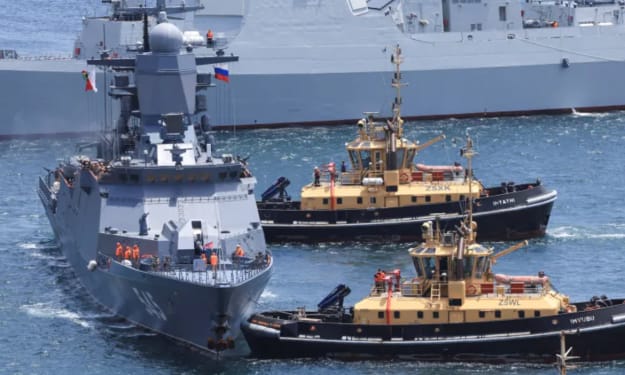
BRICS — the economic and political bloc comprising Brazil, Russia, India, China, and South Africa — has long been seen as a counterweight to Western-dominated global institutions. Over the years, it has expanded its influence in finance, trade, and diplomacy. Yet, in recent times, BRICS has begun exploring another domain that grabs headlines and sparks speculation: military cooperation, including large-scale wargames. These exercises are designed to simulate joint operations, test interoperability, and send a signal of strength. For members like Russia and China, wargames serve as both a show of force and a tool to deepen military collaboration within the bloc. However, India’s decision to opt out of recent BRICS wargames has raised questions: why does this matter, and why is India taking a different path from its BRICS partners? The Rise of BRICS Military Exercises Historically, BRICS has been portrayed as primarily economic, focused on initiatives like the New Development Bank (NDB) and trade agreements aimed at reducing Western dominance. But recent years have seen an evolution. Military drills among BRICS members are increasingly prominent, especially in the context of global tension and regional conflicts. These wargames are about more than just tactical drills. They serve multiple purposes: Strategic signaling: By conducting joint exercises, BRICS countries demonstrate unity and military capability to the rest of the world. Operational readiness: Countries test their ability to coordinate in complex scenarios, from humanitarian missions to potential combat operations. Diplomatic leverage: The exercises send subtle messages to other global powers, indicating that BRICS members can collaborate beyond economic forums. For nations like Russia, recently facing sanctions and international scrutiny, these exercises are particularly important. They showcase the ability to maintain partnerships and project power despite global isolation. For China, it is a way to cement strategic influence in Asia and beyond. Why BRICS Wargames Matter Globally The significance of these exercises extends beyond the bloc itself. Analysts note several key implications: Challenge to NATO and U.S. influence: BRICS wargames signal that alternative power centers exist outside Western-led military alliances. Regional security dynamics: Countries bordering BRICS members, particularly in South Asia, Africa, and Latin America, must monitor these developments carefully. Economic-military linkages: Military coordination among major emerging economies could shape security considerations in trade corridors, energy supply routes, and resource-rich regions. In essence, BRICS wargames are not just about soldiers and tanks, but about the broader geopolitical landscape: signaling, strategy, and shaping perceptions of influence. India’s Calculated Decision to Opt Out While Russia, China, Brazil, and South Africa have shown interest in participating actively, India has strategically chosen to abstain from the most recent wargames. This decision may appear surprising, given India’s economic and political stake in BRICS, but several factors explain it. Geopolitical balancing: India maintains complex relations with both China and Russia. While it has defense and historical ties with Russia, its relationship with China has grown tense due to border disputes and regional competition. Joining a wargame with China could be politically and militarily sensitive. Alignment with Western partnerships: India has strengthened ties with Western-led coalitions, including the Quad (U.S., Japan, Australia, India). Participating in BRICS military drills could conflict with these alliances, potentially sending mixed signals. Strategic autonomy: India has long emphasized a policy of strategic autonomy — making decisions based on national interest rather than bloc pressure. Opting out allows India to maintain flexibility in foreign policy and avoid entanglement in exercises that may not align with its regional objectives. Domestic perception: Indian public opinion and political narratives favor cautious engagement with China and Russia on military matters. Skipping the wargames minimizes domestic criticism of appearing too closely aligned with either of the more assertive BRICS powers. What India Gains by Sitting Out Choosing not to participate does not mean India is disengaged from BRICS. Economically and diplomatically, it remains a key player in the bloc. By skipping the wargames, India can: Maintain regional credibility in South Asia while avoiding the perception of aligning militarily with China. Signal strategic independence, reinforcing its image as a nation that prioritizes national security over bloc politics. Focus on bilateral and multilateral exercises elsewhere, such as those with the U.S., Japan, and Australia, which are more aligned with India’s current security priorities. In short, opting out allows India to navigate the delicate balance between its BRICS commitments and broader global strategic interests. Implications for BRICS and Global Security India’s abstention also reflects broader trends within BRICS: the bloc is not monolithic. While economic cooperation is often strong, military integration faces political and strategic limits. Differing national interests, historical rivalries, and regional tensions prevent uniform alignment. For global observers, this is crucial. It shows that while BRICS wargames are important, they are not necessarily indicative of a fully unified military bloc. The exercises are as much about optics as operations, and India’s absence underscores the challenges of aligning countries with divergent security priorities. Conclusion BRICS wargames matter because they are a window into the bloc’s evolving strategic ambitions. They signal power, test cooperation, and demonstrate emerging global influence. Yet India’s decision to opt out highlights that even within this growing coalition, national interests remain paramount. For India, the choice reflects a calculated approach: engage where it benefits national interest, avoid where risks outweigh gains, and maintain strategic flexibility. For the rest of the world, it is a reminder that BRICS, while increasingly important, is not a military monolith. Ultimately, BRICS wargames are as much about geopolitics and signaling as they are about military maneuvers — and India’s careful stance illustrates how emerging powers navigate this complex global chessboard.Start writing...
By Muhammad Hassan7 days ago in Earth
Tensions in the Sky: North Korea Calls on South Korea to Probe Drone Incidents
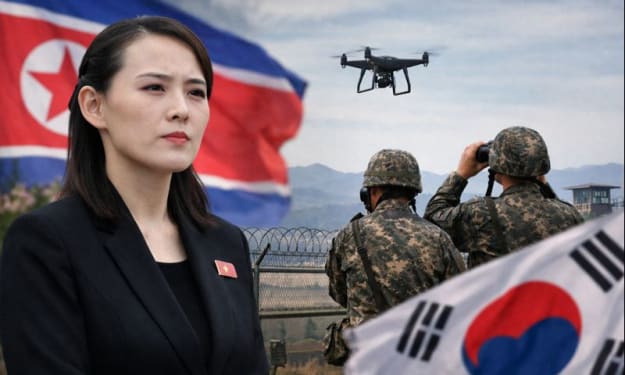
Tensions between North and South Korea have once again made international headlines after North Korea accused its southern neighbor of sending drones into its airspace. At the center of the issue is Kim Yo Jong, the influential sister of North Korean leader Kim Jong Un, who has urged South Korea to investigate the alleged drone incidents and provide a clear explanation. While drones may seem small, the political impact of this dispute is anything but minor.
By dua fatima7 days ago in Earth


Comments
There are no comments for this story
Be the first to respond and start the conversation.