
"Earth Spinning at the Speed of Light"
"A Hypothetical Odyssey Through Catastrophic Changes"
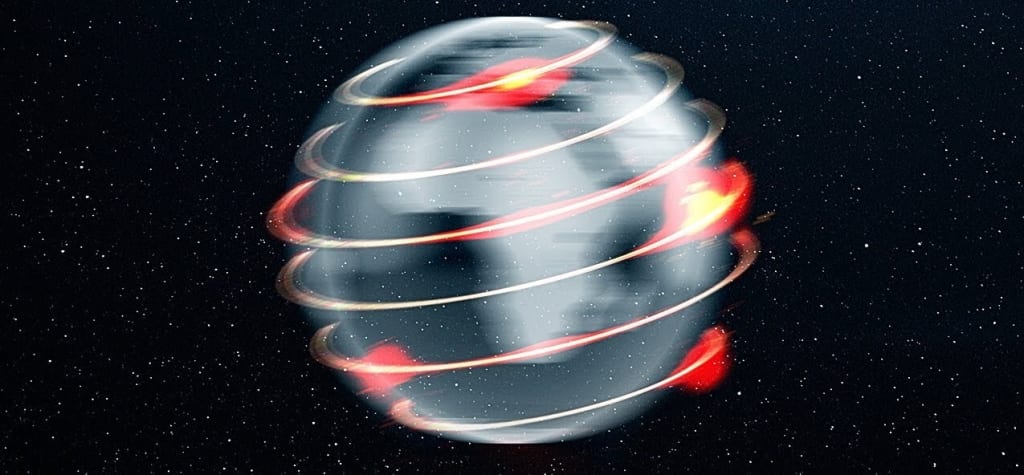
Have you ever taken a moment to contemplate the slow and steady pace at which our planet completes a full rotation in a single day? The 24-hour cycle of day and night may seem unremarkable, but have you ever wondered what would transpire if we were to dramatically alter this fundamental aspect of our existence? What if the Earth were to spin at the astounding speed of light? In this captivating thought experiment, we'll delve into the profound implications of Earth rotating at a velocity that defies imagination.
Currently, the Earth accomplishes one full rotation on its axis in approximately 23 hours, 56 minutes, and 4.1 seconds. However, it's crucial to recognize that this rotational speed is not consistent across the entire planet. At the equator, Earth moves at its most rapid pace, hurtling through space at a remarkable speed of about 460 meters per second. Conversely, near the North and South Poles, the rotational velocity diminishes to the point of nearly imperceptibility, creating an illusion of stillness. This variation in rotational speed is fundamental to life on our planet, orchestrating the diurnal cycle that governs temperature fluctuations, sustains a hospitable environment, and influences numerous natural phenomena, including weather patterns and tidal movements.
Now, let's embark on the journey of imagination and consider the consequences of disrupting this delicate balance by accelerating the Earth's rotation to the speed of light.
We'll commence with a modest increase in rotational speed, a mere 0.45 meters per second faster. This seemingly inconsequential adjustment would lead to slightly shorter days, shortening each day by approximately a minute and a half. Such a minor alteration might go unnoticed in our daily routines. Nevertheless, this minute change would trigger a cascade of repercussions, especially for coastal regions. As the rotational speed increases, sea levels would rise by several centimeters or a few inches due to the migration of water from the polar regions toward the equator.
Now, let's transition to a more audacious scenario: increasing the Earth's rotation to 45 meters per second. In this scenario, a single day would last around 22 hours, inducing a sense of disorientation and jet-lag-like sensations as we grapple with the abrupt alteration in our daily rhythm. Adapting to this new reality would necessitate adding extra days to our calendar year to accommodate the change in rotation. Nevertheless, the most profound impact would manifest in the form of rapidly rising sea levels. Oceans near the equator would experience a surge, elevating water levels by as much as 9 to 20 meters, imperiling coastal areas across the globe. Iconic cities such as New York, Venice, and Mumbai would confront the impending threat of displacement, with millions of inhabitants facing the dire consequences.
But what if we dared to push the boundaries further, doubling the current rotational speed to a staggering 920 meters per second? The repercussions would be nothing short of cataclysmic. Water would inundate nearly everything, sparing only the highest mountain peaks like Kilimanjaro and the towering summits of the Andes. Satellites orbiting the Earth would be thrust into chaos, struggling to maintain their trajectories amidst the frenzy of our rapidly spinning planet.
In this hypothetical scenario of Earth rotating at the speed of light, life as we know it would cease to exist. The world would become an unrecognizable and inhospitable realm, with continents submerged, cities lost to the depths, and the delicate equilibrium that sustains life on Earth irrevocably disrupted.
As we contemplate the far-reaching consequences of this extreme thought experiment, it serves as a poignant reminder of the fragile balance inherent in our planet's natural systems and the paramount importance of preserving the stability of our environment. While the concept of a rapidly spinning Earth may captivate our imagination, it also underscores the imperative of safeguarding the harmonious rhythms that enable life to flourish on this extraordinary planet.
About the Creator
Keep reading
More stories from Μarilena Κont and writers in Earth and other communities.
"Earth's Sudden Halt"
Prepare yourselves for a mind-boggling scenario that defies our everyday understanding of the world we live in. Imagine, for a fleeting five seconds, the Earth's rotation comes to a sudden and unprecedented halt. What cataclysmic events would unfold? How would this affect people across the globe? And if the Earth were to resume its rotation, could we still call it a habitable planet? In this speculative exploration, we will not only delve into the immediate consequences of such an event but also ponder the long-term implications.
By Μarilena Κont2 years ago in Earth
Day Will Turn to Night: Astronomers Officially Confirm the Date of the Longest Solar Eclipse of the Century
For stargazers, astronomers, and casual skywatchers alike, 2026 promises an astronomical event that will be remembered for a lifetime. Scientists have officially confirmed the date of the longest solar eclipse of the 21st century, a celestial phenomenon that will turn day into night for several minutes across parts of the globe. The announcement has sent excitement rippling through the scientific community and among enthusiasts who have long awaited a solar spectacle of this magnitude. The Science Behind the Eclipse A solar eclipse occurs when the Moon passes between the Earth and the Sun, casting a shadow on our planet and temporarily blocking the Sun’s light. While solar eclipses happen somewhere on Earth approximately every 18 months, total eclipses—where the Sun is completely obscured by the Moon—are far less common. What sets the 2026 eclipse apart is its duration. Astronomers predict that the eclipse will last for over six minutes in its longest phase, making it the longest total solar eclipse of the century. The phenomenon is a result of the precise alignment of the Sun, Moon, and Earth, as well as the Moon’s elliptical orbit, which causes slight variations in apparent size. Dr. Elena Morales, an astrophysicist at the European Southern Observatory, explains: "This eclipse is remarkable not just for its length but for its visibility. For several regions, the Sun will disappear completely, creating a surreal twilight in the middle of the day. It's an excellent opportunity to study the Sun’s corona, which is usually obscured by its brightness." Where and When to Watch The path of totality—the narrow band where the eclipse will be fully visible—stretches across several countries, including parts of the Arctic, Greenland, Iceland, and Spain. Millions of people living along this corridor will experience the full majesty of the eclipse, while a partial eclipse will be visible across much of Europe, northern Africa, and North America. Astronomers recommend planning travel in advance, as areas within the path of totality are expected to see a significant influx of visitors. Hotels, camping grounds, and viewing points are already reporting high demand, as enthusiasts from around the world seek to witness the once-in-a-lifetime event. Safety First: Protecting Your Eyes Viewing a solar eclipse can be dangerous if proper precautions are not taken. Staring directly at the Sun without specialized glasses can cause permanent eye damage. Experts emphasize the use of ISO-certified eclipse glasses or solar viewers for safe observation. Pinhole projectors, telescopes equipped with solar filters, and projection methods can also provide safe and magnified views of the eclipse. Many educational institutions and astronomical societies are planning public viewing events, combining safety with expert commentary to enhance the experience for attendees. Cultural and Scientific Significance Throughout history, solar eclipses have held deep cultural significance. Ancient civilizations often interpreted eclipses as omens or messages from the gods. Today, eclipses continue to captivate human imagination, blending scientific intrigue with awe-inspiring natural beauty. From a scientific perspective, total solar eclipses offer rare opportunities to study the Sun’s outer atmosphere, the corona, which is invisible during regular daylight. Researchers can observe solar flares, prominences, and other phenomena, gaining insights that contribute to our understanding of solar physics, space weather, and even the impact of solar activity on Earth’s climate and satellite communications. Preparing for the Experience For those planning to witness the eclipse, preparation is key. Many enthusiasts are setting up travel plans, packing eclipse glasses, cameras, and telescopes, and coordinating with local astronomy clubs for guided viewing. Timing is crucial—the totality phase, though extended in 2026, still lasts just a few minutes, making precise observation essential for both enjoyment and scientific study. Communities along the path of totality are also preparing for the influx of visitors. Local authorities are coordinating traffic management, accommodation, and public safety measures to ensure that the event remains enjoyable and safe for everyone involved. A Rare and Awe-Inspiring Event The 2026 solar eclipse is more than just a scientific event; it is a once-in-a-generation experience that reminds humanity of the vastness and beauty of the cosmos. For a brief moment, day will turn to night, and millions of people across the globe will share in the wonder of the universe’s intricate dance. Whether you are a professional astronomer or a curious skywatcher, this eclipse offers an unforgettable spectacle. It’s a moment to pause, look up, and marvel at the universe—a reminder that even in our modern, digital age, the natural world continues to inspire awe and wonder. Prepare your glasses, mark your calendars, and get ready for the longest solar eclipse of the century. For those lucky enough to witness it, it will be a memory etched in time, a celestial marvel that will be talked about for decades to come.
By Fiazahmedbrohi 5 days ago in Earth
United States Lawn Mowers Market Size and Forecast 2025–2033
The United States Lawn Mowers Market is expected to reach US$ 15.91 billion by 2033, rising from US$ 9.64 billion in 2024, registering a CAGR of 5.73% during 2025–2033. This strong growth trajectory reflects changing lifestyles, increased spending on home improvement, and rapid technological innovation across outdoor equipment. From battery-powered walk-behind models to autonomous robotic mowers guided by GPS and artificial intelligence, the industry is undergoing a structural shift toward efficiency, sustainability, and user convenience.
By Renub Research6 days ago in Earth


Comments
There are no comments for this story
Be the first to respond and start the conversation.