
Earth as a living organism? The development of Gaia's theory, which eventually became the basis of the Earth discipline
The Earth is a living thing


I wonder if you have ever imagined that the Earth as a whole might be a living organism. If this idea is true, then we could explain some things. But to be honest, it's hard to guess. Our habitual thinking governs our thinking, so if we were to imagine the Earth as a living being, you'd wonder how to prove the idea. After all, even the most basic conditions for living, growing and moving around don't exist.
But as far back as the last century, the Earth has taken on a new concept and field of study in the scientific community. It was biogeochemistry, pioneered by Vladimir Ivanovich Wernersky. He tried to understand how holistic cognition was presented through the study of local and specific problems. In addition to geology, physics and chemistry, biology has played a crucial role in the evolution of the Earth. The activities of species have shaped the environment. He says, "An organism not only evolves in an environment to which it can adapt, that environment also has to suit the evolution of that organism." The two are in a mutually reinforcing relationship, rather than one making the other.
However, Wernadsky is referring to the biosphere that exists between the Earth's deep crust and the edge of the atmosphere. Life's activities dramatically alter the transition between energy and matter, and life eventually controls the entire biosphere through slow adaptation. The great oxidation event mentioned in my previous article is in fact an example of biological activity affecting the entire planet. Without this life, the Earth's atmosphere would probably still be dominated by carbon dioxide. And this state has continued. If all the current life were destroyed and the Earth turned upside down, the greenhouse effect would continue to increase.
The balance of all the biosphere is as if the Earth were an organic organism that can regulate itself through various weather and geological changes. This theory was eventually identified as the Gaia theory by James Lovelock and Lynn Margulies. Lovelock-Margret was introduced by her ex-husband Carl Sagan. They initially discussed only the origin of oxygen and microorganisms in the atmosphere. Eventually, they followed Wernersky's ideas and formulated the Gaia theory, which was defined as a planetary life system capable of self-regulation.
The Earth's living environment is in a very delicate balance. Why, for example, is the oxygen content stable at 21%? If the oxygen concentration is high, it is prone to cause global fires during thunder and lightning. Why, for example, can global temperatures be stabilised in a range suitable for life? It is important to know that temperature affects the survival of living things.
In the Gaia theory, Lovelock and Margulies argue that life as a whole generates global negative feedbacks to the Earth. Those feedback mechanisms have kept the Earth in a series of relatively stable states over the course of its long history, thus keeping it in an optimal state for habitable, living drama. In other words, life can survive for itself, making the planet more habitable.
However, this theory and idea was not widely accepted when it was first proposed. Whether the Earth was seen as a living being or life as a whole, scientists could not accept it. The biggest problem was that biological evolution had no purpose, direction or goal. This view has taken hold.
In response to all the denials and criticisms, Lovelock worked with ecologist James Watson to create the Daisy World model, which is still well known today. This model uses a simplified set of equations to describe a planet with only black and white daisies, plus a gradually brightening sun. The feedback mechanism of the black daisies absorbing sunlight and the white daisies reflecting it is clearly represented in the solution. In the end it is shown that the temperature of the planet can be maintained at a constant state all the time.
As the models emerged, public opinion began to reverse and the biospheric feedback mechanism was popularly recognised as an important part of the laws of planetary motion. But Gaia's theory was eventually replaced by a less controversial name, Earth system science.
From life on Earth to the biosphere to Gaia's theory to Earth systems science, much effort and experience has gone into the study of the Earth, from absurd speculation to systematic knowledge. Earth systems science has become the basis for the study of the Earth's interdisciplinary fields. A new generation of scientists is now talking about the 'interactive evolution' of life and planets, which is providing new ideas for astrobiology.
In the future, scientists will continue their research and we will figure out whether it is the Earth or the universe. Scientists are determined to know the truth about the world, and I wish I had known the truth about the world sooner. Although I can't help with the research, I can still contribute to the popularisation of science. I hope more people will care about the nature of the world and the truth!
About the Creator
Paul Weiest
Opening the windows of science to you
Keep reading
More stories from Paul Weiest and writers in Earth and other communities.
Sichuan is on fire! Ya'an's first national Grade II animal brown-backed field hen found, red iris is extremely special
Two days ago, rare animals and plants were found continuously in Zhejiang and other places, triggering concern and discussion among netizens. Many people are speculating that it is now the season of changing seasons, which is the active period for animals.
By Paul Weiest3 years ago in Earth
Do Not Touch the Roses
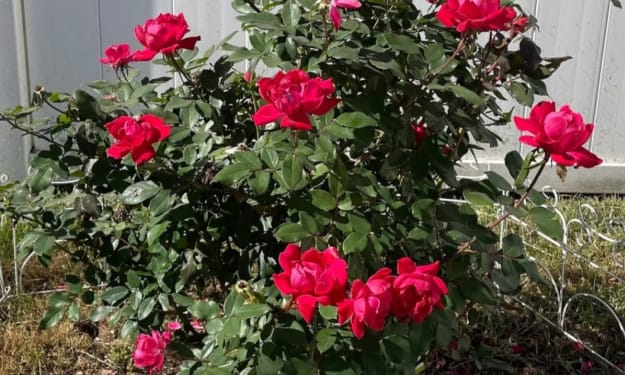
There is a quiet power in the phrase “Do Not Touch the Roses.” It sounds like a warning, but it feels like an invitation — one that asks us to pause, admire, and respect something without claiming it. Roses have long symbolized love, beauty, and passion, yet they are also guarded by thorns. That contradiction makes them the perfect metaphor for many of life’s most meaningful things.
By Aarif Lashariabout 16 hours ago in Earth
Wild Card Weekend Recap: What Happens Now?
I think I figured out why I love Wild Card Weekend so much. It's because it's the first playoff anything of the calendar year. The NFL season starts in the fall, and once upon a time, the champion was crowned either on or slightly before New Year's. The evolution of the NFL schedule has resulted in the playoffs starting just into the New Year, and currently, the final week of the season falls on the first weekend of the New Year, with Wild Card Weekend coming a week after that. So yes, chronologically, the NFL's Wild Card Weekend serves as the first playoff anything of the calendar year.
By Clyde E. Dawkins7 days ago in Unbalanced



Comments
There are no comments for this story
Be the first to respond and start the conversation.