


By 2125, Earth is no longer the planet we once knew—it’s something entirely new. Shaped by climate change, technological evolution, and the shifting values of humanity, the world has transformed in ways both breathtaking and sobering. If we could step into a time machine and walk the Earth a century from now, what would we see?
Let’s take a journey into the future of our planet.
---
Climate and Environment: A Planet Reclaimed
One of the most dramatic changes in 2125 is the environment. After centuries of pollution, deforestation, and rising temperatures, nature has responded in unexpected ways.
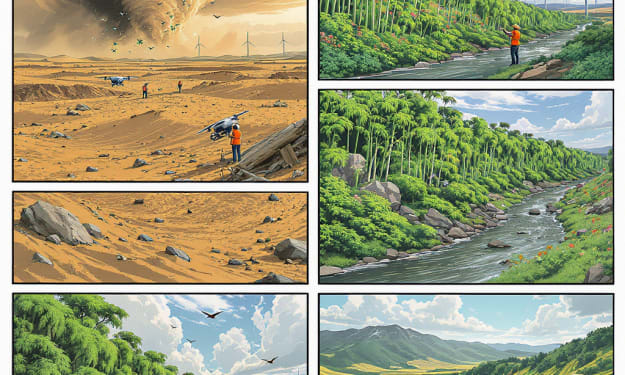
Large portions of Earth’s equator are now uninhabitable due to extreme heat, with temperatures reaching up to 60°C (140°F). These areas, once densely populated, have been abandoned and reclaimed by nature. Forests with genetically modified flora adapted to extreme climates grow in places where cities once stood. Towering solar trees and algae-covered towers clean the air and provide shade in urban spaces.
The polar regions, now partially ice-free, have become hubs of global agriculture. With the melting of ice sheets, vast new territories opened up in Greenland, Canada, and Siberia. Though the rising sea levels swallowed many coastal cities—New York, Venice, Mumbai—new floating and vertical cities now rise above or beyond the old ones.
Rivers and lakes, once drying and shrinking, are now carefully managed by AI-controlled systems. Many ecosystems were rebuilt with synthetic biology: lab-designed coral reefs, cloned endangered species, and bio-domes help preserve what was almost lost.
Nature didn’t die—it adapted. And in some places, it’s fighting back.
---
Cities and Architecture: Living With the Land
Cities in 2125 are no longer just concrete jungles. They breathe, grow, and respond like living organisms. Vertical cities—miles high—stretch into the sky, covered in plant life. Entire neighborhoods are designed to move slightly throughout the day to follow the sun or avoid the wind.
Homes are no longer static structures. Smart walls adjust to temperature, light, and even mood. People live in modular living pods that can detach and reattach elsewhere. Need a change of scenery? Your entire house can be flown to another region.
Underground and underwater cities are also thriving. These environments are shielded from surface climate issues and powered by geothermal energy. Some even feature artificial stars for sunlight simulation.
The idea of “sustainable” has evolved to “symbiotic”—cities no longer just reduce harm, they actively repair and enhance their environments.
---
Technology: The Earth is Always Listening
Technology in 2125 is no longer just in your pocket—it’s in the air, the soil, the trees. Earth's surface is embedded with a planetary-scale Internet of Things (IoT), allowing AI systems to monitor and manage everything from water flow in a forest to the emotional health of a community.
Neural interfaces allow people to connect with machines through thought alone. Physical devices like phones and computers are considered outdated. Communication is now visual, sensory, and immersive—messages are experienced rather than read.
Transportation is largely autonomous. Flying taxis, magnetic trains, and zero-emission vehicles dominate. Personal travel has become more of a leisure activity, since remote presence and holographic projections are widely used for work and social life.
The downside? Privacy is almost non-existent. In exchange for security and efficiency, most people live in a state of voluntary transparency.
---
Human Culture and Society: A Redefined Civilization
Earth’s population has declined slightly—not due to disaster, but by choice. Many have left to live in orbiting space habitats or on Mars colonies. The humans who stayed became deeply connected to Earth’s wellbeing.
Instead of global nations, the world is divided into eco-regions. Governance is handled by hybrid councils of humans and AI, focused not on profit, but planetary health and social harmony.
Education is continuous and experiential. Children learn by doing—exploring forests, building machines, planting crops, and engaging with historical simulations. Empathy is a core subject, alongside science and creativity.
Work is not about survival anymore. AI and robotics handle most labor. Humans focus on problem-solving, storytelling, and innovation. Basic income is universal. Mental health is taken seriously. Time is valued as the most precious currency.
---
The Emotional Landscape: Wonder and Warning
Despite all the advancements, Earth in 2125 carries the emotional weight of its past. Ghost cities still stand beneath the oceans. Forests whisper through genetically engineered leaves that were once burned to the ground. Monuments and museums tell stories of the planet’s near-death and rebirth.
There’s wonder—yes. Earth has become more alive, more interconnected, and more beautiful in strange, futuristic ways.
But there’s also a warning.
The scars of the past remain visible to remind future generations: Earth is not invincible. She is patient, powerful, and fragile all at once. We broke her once. We may not get a second chance if we do it again.
---
Final Thought:
The Earth of 2125 is a planet reimagined—not utopia, not dystopia—but something deeply real. It's a future shaped by both human failure and human resilience.
And the most powerful truth? That future still depends on what we choose today.
About the Creator
Keep reading
More stories from SHADOW-WRITES and writers in Earth and other communities.
"WHY READING IS STILL IMPORTANT IN THE DIGITAL AGE "
In today’s fast-moving world, we have smartphones, videos, voice notes, and even AI tools to answer our questions in seconds. Social media keeps us busy, and we’re always scrolling through something. With so much technology around, some people may ask: “Is reading still important?”
By SHADOW-WRITES10 months ago in BookClub
Chinese Planetary Engineering: The Great Green Wall and the Reclamation of Climate
There are junctures in history where a civilization no longer chooses between comfort and progress, but between adaptation and extinction. At the dawn of the new millennium, China hit one of those silent thresholds where geography ceases to be a backdrop and becomes an adversary. The desert was advancing, not as a metaphor for decay, but as a physical, methodical, and relentless force. Sand was devouring the horizon, winds grew heavy with dust, and the soil lost its fertile memory, taking with it the promise of social stability.
By Laurenceau Porte3 days ago in Earth



Comments
There are no comments for this story
Be the first to respond and start the conversation.