
Dolphins and Orcas Can’t Evolve Back to Land, Scientists Say
Why these marine mammals are unlikely to return to a terrestrial lifestyle, despite their evolutionary history.
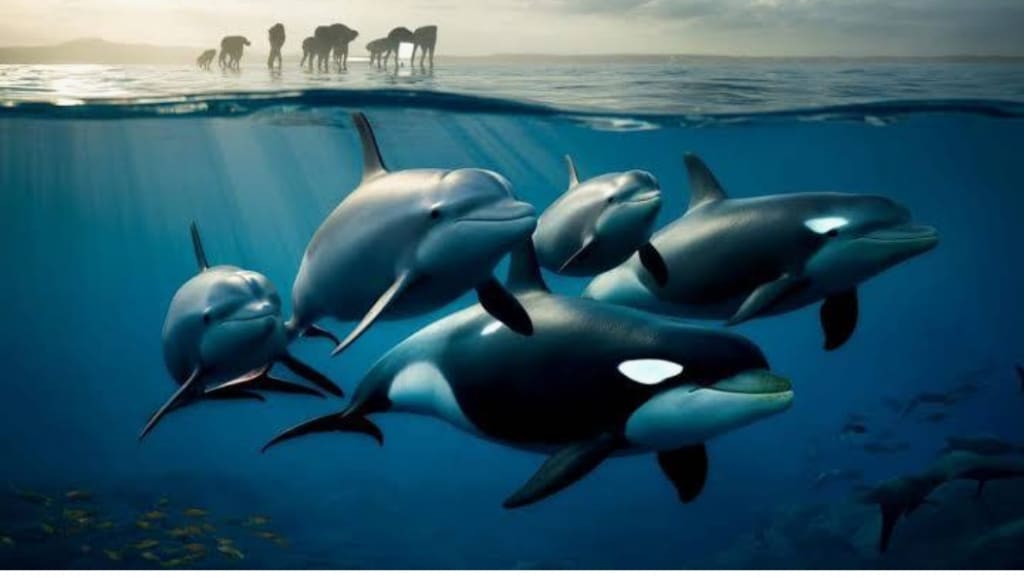
For decades, scientists and enthusiasts have speculated about the possibility of dolphins, orcas, and other cetaceans evolving back onto land. After all, these marine mammals originated from land-dwelling ancestors millions of years ago. However, recent research confirms what many evolutionary biologists suspected: dolphins and orcas cannot evolve back to live on land.
This revelation sheds light on the limits of evolution, the unique adaptations of marine mammals, and why some evolutionary paths are effectively one-way streets.
From Land to Sea: The Cetacean Journey
Cetaceans, which include dolphins, orcas, and whales, didn’t always live in the ocean. Their ancestors were terrestrial mammals that roamed riverbanks and wetlands around 50 million years ago.
Over millions of years, these early ancestors adapted to aquatic life:
Limbs transformed into flippers for swimming.
The spine became flexible to aid propulsion through water.
Nostrils migrated to the top of the head, forming a blowhole for easier breathing at the surface.
The body became streamlined, reducing drag and allowing for efficient movement in water.
These adaptations were essential for survival in aquatic environments. However, they also created irreversible changes that make a return to land impossible.
The Science Behind the Impossibility
Researchers have analyzed the anatomy, physiology, and genetics of modern cetaceans to determine whether a terrestrial comeback is feasible. The findings are clear: dolphins and orcas are highly specialized for aquatic life, and the evolutionary cost of returning to land would be too great.
Skeletal and Muscular Limitations
The skeletal structure of cetaceans has evolved for swimming, not walking. Their limbs are flippers, with no functional joints for supporting body weight on land. Even the most agile dolphins would collapse under gravity if they tried to walk.
Muscles are optimized for horizontal propulsion in water rather than vertical support. Their spines and core muscles are adapted for flexibility and speed in the ocean, not standing or walking on solid ground.
Respiratory and Sensory Constraints
Dolphins and orcas breathe through a blowhole at the top of the head, making land respiration challenging. Unlike terrestrial mammals, they cannot take continuous breaths while moving on land.
Their sensory systems, including echolocation, are finely tuned for underwater environments. On land, these systems would be far less effective, reducing their ability to navigate, hunt, or avoid predators.
Reproductive and Developmental Barriers
Cetaceans give birth in water and rely on buoyancy to support newborns. Terrestrial birth would place extreme stress on mothers and infants, making survival unlikely. Evolution would require radical changes in reproduction and developmental strategies — changes that are virtually impossible within realistic evolutionary timescales.
Why Some Evolutionary Paths Are One-Way
Cetaceans provide a striking example of irreversible evolution. Once a species undergoes extensive specialization, returning to a previous lifestyle can become biologically impractical.
This phenomenon, known as Dollo’s Law, states that complex traits lost during evolution are unlikely to reappear in the same form. For dolphins and orcas, adaptations for aquatic life — streamlined bodies, flippers, and unique respiratory systems — make land evolution effectively impossible.
Other species demonstrate similar one-way paths. For example, penguins evolved for swimming and cannot fly, and elephants’ tusks have evolved in ways that cannot simply revert.
Why This Matters
Understanding the evolutionary constraints of cetaceans has important implications:
Conservation: Dolphins and orcas cannot return to land, so protecting their marine habitats is critical. Rising sea temperatures, pollution, and overfishing directly threaten their survival.
Evolutionary Biology: Studying cetaceans helps scientists understand how environmental pressures drive specialization and why some evolutionary paths are irreversible.
Education and Curiosity: Popular culture often imagines fantastical scenarios of dolphins walking on land. Scientific clarity helps separate fact from fiction while inspiring curiosity about evolution.
The Future of Cetaceans
Although dolphins and orcas won’t be returning to land, their evolution is far from static. Marine mammals continue to adapt to changing ocean conditions, such as:
Shifts in prey availability due to overfishing or climate change.
Increased human interaction in coastal environments.
Emerging diseases and environmental stressors.
These adaptations occur within the aquatic realm, highlighting that evolution works forward, not backward.
Cultural Fascination with Land-Loving Dolphins
Humans have long imagined the possibility of cetaceans walking on land. From folklore to science fiction, the idea of dolphins and whales returning to terrestrial habitats has captured imaginations.
However, science teaches us that evolution is a one-way street. The beauty of dolphins and orcas lies in their mastery of the oceans, not in a hypothetical return to land.
Conclusion: Mastery of the Ocean, Not the Land
Dolphins and orcas are living proof of nature’s ingenuity. Their evolution from land-dwelling mammals to apex marine predators demonstrates the power of adaptation.
While humans may fantasize about seeing dolphins roam beaches or forests, their biology makes that impossible. Instead, these marine mammals thrive in their natural habitat, perfectly attuned to life in water. Protecting the oceans is the key to ensuring that dolphins and orcas continue to thrive, not dreaming of a world where they return to land.
About the Creator
Keep reading
More stories from Aarif Lashari and writers in Earth and other communities.
Hotel Giant Collapses into Administration — 8,300 Employees Affected
In a shocking turn for the European hospitality sector, Revo Hospitality Group, one of the continent’s largest hotel operators, has filed for insolvency, putting about 8,300 jobs at risk. The move comes amid mounting financial pressures, rising costs, and an unstable post-pandemic market for travel and tourism.
By Aarif Lashariabout 20 hours ago in Earth
Trump Slams UK Deal to Hand Over Chagos Islands After Previously Backing It
If you thought politics couldn’t surprise you anymore, Donald Trump just proved otherwise. In a dramatic U-turn, the former U.S. president criticized the United Kingdom’s decision to transfer sovereignty of the Chagos Islands to Mauritius—a deal he had previously backed. What was once considered a solution to a decades-long dispute has now become a hot topic, sparking debates about strategy, diplomacy, and international trust.
By Muhammad Hassanabout 20 hours ago in Earth
Inside Trump's $11 Billion Health Plan to Replace “Neo-Colonial” USAID
In the landscape of global health aid, few proposals have stirred as much debate as former President Donald Trump’s ambitious plan to restructure American assistance abroad. Dubbed an $11 billion health initiative aimed at replacing USAID’s current framework, the plan seeks to pivot away from what Trump and his allies have criticized as the “neo-colonial” approach of U.S. foreign aid. While the plan promises greater efficiency and impact, experts are split on whether it is a practical solution or a politically driven gamble. Trump’s Critique of USAID The United States Agency for International Development (USAID) has long been a central pillar of American foreign assistance, distributing billions in aid annually to address health crises, food insecurity, and development challenges worldwide. However, Trump’s administration and its supporters have often described USAID’s approach as bureaucratic, inefficient, and reflective of a “neo-colonial” mindset. In public statements, Trump argued that the U.S. was spending taxpayer dollars on programs that benefited foreign governments or contractors more than the intended local communities. Critics of the plan say that while USAID has flaws—as any large bureaucracy does—its extensive networks and decades of experience provide an unmatched capacity to deliver aid efficiently and safely. The Core of the $11 Billion Proposal At the heart of Trump’s proposal is an $11 billion fund designed to consolidate, modernize, and streamline U.S. health aid. Unlike the traditional USAID model, which relies heavily on long-term partnerships with governments and NGOs, the new plan emphasizes: Direct Impact Funding: Allocating resources to frontline health workers and local initiatives rather than intermediaries. Data-Driven Investments: Using real-time health data to target outbreaks and crises more efficiently. Private Sector Partnerships: Leveraging U.S. pharmaceutical companies, tech firms, and healthcare startups to deliver vaccines, treatments, and medical infrastructure. Shorter Program Cycles: Moving away from multi-year funding commitments in favor of more flexible, results-oriented programs. Proponents argue that this approach could reduce bureaucratic overhead and ensure U.S. aid reaches communities faster. By “cutting out the middlemen,” Trump supporters claim, America can avoid the pitfalls of slow-moving aid programs that sometimes fail to adapt to crises. Reactions from the Global Health Community Global health experts, however, have expressed concern about both the logistics and philosophy of the plan. Dr. Melissa Ortega, a senior researcher at the Global Health Policy Institute, explained, “The idea of bypassing established structures like USAID may sound appealing on paper, but in practice, it risks undermining decades of institutional knowledge. Health systems are complex, and short-term projects cannot replace long-term capacity building.” Some critics have also questioned the characterization of USAID as “neo-colonial.” While U.S. foreign aid has historically been tied to geopolitical interests, many programs today are designed collaboratively with recipient countries and local organizations. Reducing oversight could unintentionally increase the risk of misuse, corruption, or health inequities. On the other hand, supporters of Trump’s plan point to examples of inefficiency in USAID programs, citing cases where aid was delayed or mismanaged. By introducing more direct funding models, they argue, U.S. taxpayer dollars could achieve a higher “return on health outcomes.” Political Implications Trump’s health aid overhaul proposal is not just about international development—it is also deeply political. Framing USAID as a “neo-colonial” institution resonates with a populist narrative that America should prioritize its own citizens and assert greater control over how taxpayer money is spent abroad. Domestically, the $11 billion plan faces scrutiny from Congress. Lawmakers from both parties have questioned whether dismantling USAID’s systems could destabilize ongoing health programs in countries where the U.S. has long-term commitments. The potential impact on global health security—including the fight against pandemics like COVID-19—adds another layer of concern. Internationally, U.S. allies and partner nations are watching closely. Sudden shifts in aid delivery could disrupt health programs in low- and middle-income countries, many of which rely on predictable funding cycles to maintain vaccination campaigns, maternal health services, and disease surveillance. Possible Benefits and Risks If executed carefully, the Trump-backed model could bring several benefits: Faster Response Times: Direct funding could accelerate delivery of vaccines, treatments, and emergency support. Innovation Boost: By partnering with private sector companies, the plan could accelerate development of new health technologies. Accountability: With performance-based metrics, the plan may better measure the impact of U.S. aid. However, the risks are equally significant: Disruption of Existing Programs: Abrupt changes could destabilize ongoing health projects. Loss of Expertise: USAID’s decades of experience in navigating local governance, supply chains, and community engagement may be hard to replace. Geopolitical Fallout: Allies accustomed to collaborating with USAID might see the move as destabilizing, reducing cooperation on global health initiatives. Looking Ahead As Trump and his allies continue to advocate for this $11 billion overhaul, the debate over the future of U.S. health aid is intensifying. Proponents view it as a necessary modernization of an outdated system, while critics fear it could undercut decades of carefully built infrastructure and global partnerships. Ultimately, the success of this plan will hinge on its ability to balance efficiency with stability, innovation with oversight, and political objectives with humanitarian needs. For now, the proposal remains controversial, representing a dramatic departure from traditional approaches to U.S. foreign aid. Whether it will reshape global health for the better—or simply create more uncertainty—remains to be seen. In the end, the Trump health plan is as much about ideology as it is about dollars. It challenges the conventional wisdom of international development and asks whether a more streamlined, results-focused approach can truly replace a system built over decades. As the world watches, the stakes could not be higher: the future of U.S. global health aid—and the lives it touches—hangs in the balance.
By Muhammad Hassan7 days ago in Earth



Comments
There are no comments for this story
Be the first to respond and start the conversation.