
Does Earth Have Two Moons? NASA’s Asteroid Discovery Sparks Global Fascination
NASA’s discovery of a tiny asteroid orbiting alongside Earth reveals a hidden cosmic companion — a ‘second moon’ that offers new insights into our solar system.

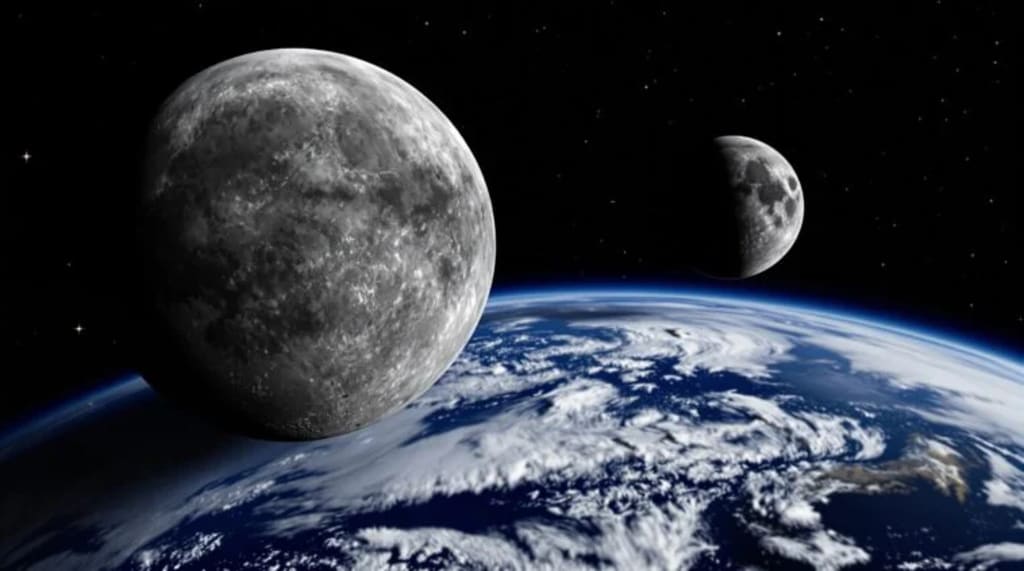
For centuries, people have gazed at the night sky believing Earth has just one natural satellite — the Moon. But recent findings by NASA have reignited global curiosity: could Earth actually have a second “moon”? While the answer isn’t as simple as a clear yes, the story of how an asteroid came to be nicknamed Earth’s second moon reveals fascinating truths about orbital mechanics, space exploration, and the ever-changing nature of our cosmic neighborhood.
A Surprise Companion in Earth’s Orbit
In early 2016, astronomers with NASA’s asteroid tracking program announced the discovery of a small near-Earth object. Officially designated 469219 Kamoʻoalewa, this asteroid was found following a path closely related to Earth’s orbit. Unlike traditional asteroids that orbit the Sun independently, Kamoʻoalewa moves in a peculiar way — almost as if it’s dancing with Earth.
Scientists call such objects “quasi-satellites.” A quasi-satellite is not a true moon, but it follows a path around the Sun that keeps it near Earth for extended periods. Kamoʻoalewa measures about 40 to 100 meters in diameter and orbits the Sun in nearly the same time it takes Earth to do so. From our perspective, it appears to circle Earth in a looping motion, giving the illusion of a second moon.
What Makes Kamoʻoalewa Special
Unlike the Moon, which has been Earth’s steadfast companion for over 4 billion years, Kamoʻoalewa’s relationship with Earth is temporary. Astronomers estimate that it’s been orbiting near Earth for at least a century and may remain for several more centuries before drifting away.
NASA researchers and astronomers at University of Arizona were intrigued not just by its orbit but also by its composition. Observations suggest the asteroid reflects sunlight in a way similar to lunar material. This has led to a stunning hypothesis: Kamoʻoalewa may actually be a fragment chipped off Earth’s Moon after an ancient collision.
While not confirmed, this idea adds an exciting layer to the story. If true, Earth’s second “moon” may, in fact, be a lost piece of the first.
How NASA Detected Earth’s Quasi-Moon
Detecting small celestial bodies is no easy task. NASA’s advanced telescopes and tracking systems scan the sky constantly to detect potentially hazardous asteroids. Kamoʻoalewa was spotted using the Pan-STARRS telescope in Hawaii — one of the world’s most sensitive survey instruments.
Its unusual orbital pattern immediately caught attention. Scientists used radar and optical telescopes to map its trajectory, confirming it was neither heading toward Earth nor drifting away rapidly. Instead, it was in a gravitationally balanced “dance” with our planet.
Why It’s Not a “Real” Second Moon
The term “two moons” can be a bit misleading. A true moon, or natural satellite, orbits Earth directly. Kamoʻoalewa, however, technically orbits the Sun. Earth’s gravity influences its motion but does not fully control it. Think of it as a companion in orbit — close, but independent.
Earth has temporarily captured small asteroids before. For example, in 2020, a tiny object named 2020 CD3 orbited Earth briefly before escaping back into space. But Kamoʻoalewa is different. It’s not just passing through — it’s been in this stable quasi-orbit for a surprisingly long time.
Scientific Importance of This Discovery
NASA’s discovery of a quasi-satellite is more than just a cool fact about “two moons.” It provides scientists with a rare opportunity to study near-Earth objects up close without leaving our cosmic neighborhood. Understanding Kamoʻoalewa’s composition and origin can:
Offer clues about the early history of the Moon and Earth.
Help improve asteroid tracking and planetary defense strategies.
Inform future space missions and resource utilization.
NASA is already considering missions to explore this object more closely. Its small size and proximity make it an ideal candidate for robotic study.
The Future of Earth’s Asteroid Companion
One of the most fascinating aspects of Kamoʻoalewa’s orbit is its stability. Simulations suggest it will continue to follow Earth’s path for centuries before eventually drifting away. By then, we may have visited it, sampled it, or perhaps even used it as a stepping stone for deeper space exploration.
This asteroid also challenges our definitions of moons and satellites. It reminds us that the solar system is dynamic, with new discoveries constantly reshaping what we thought we knew.
A Universe Full of Surprises
NASA’s findings about Earth’s “second moon” have captured the imagination of people worldwide. It’s a story that blends science, mystery, and a touch of poetry. While Kamoʻoalewa may not be a moon in the traditional sense, it stands as a reminder that our planet is part of a vast, evolving system — one filled with unexpected neighbors and cosmic companions.
As technology improves and more telescopes come online, we may discover more quasi-moons sharing Earth’s orbit. Each will offer new insights into the mechanics of our solar system and the forces that shape it.
So, the next time you look up at the night sky, remember: Earth’s story involves more than just one glowing moon. Somewhere out there, a small asteroid is silently keeping us company — a humble, mysterious traveler in our shared cosmic journey.
About the Creator
Sajida Sikandar
Hi, I’m Sajida Sikandar, a passionate blogger with 3 years of experience in crafting engaging and insightful content. Join me as I share my thoughts, stories, and ideas on a variety of topics that matter to you.
Keep reading
More stories from Sajida Sikandar and writers in Earth and other communities.
Snow on the Horizon: What the Met Office Forecast Really Means This Winter
When the Met Office mentions snow in its weather forecast, the nation listens. From commuters anxiously checking road conditions to children hoping for a rare snow day, the word snow carries a unique emotional weight in the UK. But beyond the headlines and social media buzz, snow forecasting is a complex science—one that blends data, probability, and experience to help the public prepare for winter’s most disruptive weather.
By Sajida Sikandar18 days ago in Earth
The Reality of the Illusion of Time
Recently, as I strolled along the short stretch to my strength training session, I aimlessly took in the row of tatty shops and shabby buildings along the route and passed an off-street, in which one of my sisters used to live, around thirteen years ago.
By Chantal Christie Weiss3 days ago in Earth
Why Putin Went Quiet When Challenged by Trump Over Venezuela
When U.S. forces captured Venezuelan President Nicolás Maduro in early January 2026, the world was stunned. Venezuela has long been a Russian ally, yet Russian President Vladimir Putin remained almost completely silent when challenged directly by U.S. President Donald Trump. Why would a leader so often outspoken on the world stage hold back in such a dramatic moment? Let’s unpack the story and explore what it means for global politics. A Bold Move That Shocked the World On January 3, U.S. forces executed a daring operation in Venezuela, taking Maduro into custody in New York to face charges including drug trafficking and narco‑terrorism. The operation was framed by the U.S. as a step to enforce justice, but critics saw it as an extraordinary overreach of power. Venezuela is no ordinary country for Russia. Since the days of Hugo Chávez, Moscow has cultivated close ties with Caracas, offering military support, energy deals, and diplomatic backing on the global stage. Past actions included Russian bombers visiting Venezuela and high-profile defense agreements. Given this history, many expected a fiery response from Putin. Yet, the Kremlin remained calm, issuing measured statements rather than sharp threats. Why Silence Was Strategic Experts suggest there are several reasons for Putin’s muted reaction, each revealing the careful calculation behind the Kremlin’s foreign policy. 1. Focus on the War in Ukraine Russia’s primary priority remains Ukraine. Engaged in a high-stakes military and diplomatic battle, Putin cannot afford distractions or new confrontations far from home. Escalating tensions with the United States over Venezuela could jeopardize Moscow’s position in Europe. A New York Times report highlighted that Russia is “subordinating all other interests to the war in Ukraine,” suggesting that even a high-profile ally like Venezuela takes a back seat to Moscow’s strategic goals. 2. Limited Military Options While Russia’s alliance with Venezuela is longstanding, much of the support has been symbolic rather than operational. Defense systems and military cooperation exist on paper, but Russia lacks the immediate ability to counter a U.S. operation thousands of miles away. Putin may have recognized that responding aggressively would be both ineffective and costly, potentially risking military and economic consequences that Moscow cannot afford. 3. Maintaining Diplomatic Channels with Washington With Donald Trump back in the White House since 2025, there has been cautious optimism in Moscow about recalibrating U.S.–Russia relations. Avoiding a dramatic confrontation over Venezuela keeps diplomatic channels open, allowing Russia to negotiate on other high-priority issues like Ukraine and sanctions relief. In other words, silence can be a calculated strategy, signaling restraint rather than weakness. 4. Russia’s Global Influence Is Waning The Maduro episode also highlights a broader geopolitical reality: Russia’s global reach has limits. Since the 2022 invasion of Ukraine, Moscow’s influence in regions like the Middle East and parts of the former Soviet Union has weakened. Venezuela remains one of its few high-profile allies outside Europe, but even there, Russia’s power is largely symbolic. By not escalating, Putin is acknowledging a practical truth: Russia cannot be everywhere at once, and some battles are not worth fighting. 5. Choosing Battles Wisely Some analysts emphasize that Putin’s quiet response is more about strategic prioritization than capitulation. In a world dominated by nuclear powers and volatile global politics, direct confrontation with the United States over Venezuela could spiral into a far larger crisis. By staying silent, the Kremlin may be signaling that it picks its battles carefully, focusing resources on Ukraine, where the stakes are highest. What This Means for the World Putin’s silence sends several messages: Russia is currently stretched, economically and militarily. Moscow is prioritizing Ukraine over symbolic allies. Strategic restraint is sometimes more powerful than public confrontation. The limits of Russian influence are becoming more visible to the world. This episode reflects a new reality in geopolitics: power is as much about choosing when not to act as when to assert force. The Bigger Picture The capture of Maduro is a defining moment not just for Venezuela, but for global politics. It shows the United States asserting power in a way not seen for decades, while Russia’s quiet reaction underscores its current limits and priorities. For observers, Putin’s silence is a lesson in modern geopolitics: even the most assertive leaders exercise restraint when stakes are high and risks are global. In the end, the Maduro affair reminds us that in today’s world, the loudest response is not always the most effective one — sometimes, quiet calculation speaks volumes. Sources and Further Reading The US capture of Maduro reveals Russia’s weakness – Atlantic Council ‘It sends a horrible signal’: US politicians react to capture of Nicolás Maduro – The Guardian Russia slams 'neocolonial threats' against Venezuela – Reuters
By Muhammad Hassan6 days ago in Earth



Comments
There are no comments for this story
Be the first to respond and start the conversation.