
Do parallel universe really exist?
Exploring the Possibilities of a Parallel Universe - What Could Exist in an Alternate Reality?

WHAT IS A PARALLEL UNIVERSE AND HOW COULD IT IMPACT OUR REALITY?
A parallel universe, also known as a parallel dimension or alternate universe, is a hypothetical universe that exists alongside our own. According to some theories, there could be an infinite number of parallel universes, each with its own unique set of physical laws, properties, and histories.
One popular idea is the Many-Worlds interpretation of quantum mechanics, which suggests that every time a quantum event occurs, the universe splits into multiple parallel universes, each containing a different outcome of that event.
The idea of parallel universes has been explored in science fiction for decades, but there is currently no empirical evidence to support its existence. However, some physicists and cosmologists believe that the existence of parallel universes is a possibility based on certain mathematical models and observations.
If parallel universes do exist, their impact on our reality is uncertain. Some theories suggest that they may have no effect on our universe at all, as they may exist beyond the reach of our observable universe. However, other theories propose that parallel universes could potentially have a significant impact on our reality, such as influencing the outcome of quantum events or providing a way to travel through time and space.
Overall, the concept of parallel universes remains a topic of much debate and speculation in the scientific community. While its existence and impact on our reality remain uncertain, exploring this concept can help us better understand the fundamental nature of the universe and our place within it.
EXPLORING THE THEORIES OF PARALLEL UNIVERSES & HOW THEY COULD CONNECT TO OUR OWN
There are several theories about parallel universes, and they differ in their proposed mechanisms for how they could exist and connect to our own universe. Here are some of the most prominent theories:
Many-Worlds Interpretation: This interpretation of quantum mechanics suggests that every time a quantum event occurs, the universe splits into multiple parallel universes, each containing a different outcome of that event. For example, if you flip a coin, the universe would split into two parallel universes, one where the coin landed heads and one where it landed tails. The Many-Worlds Interpretation suggests that every possible outcome of a quantum event is realized in a parallel universe, leading to an infinite number of parallel universes.
Bubble Universes: According to the theory of cosmic inflation, our universe underwent a rapid expansion in the moments following the Big Bang. This expansion may have created pockets of space-time that inflated at different rates, resulting in multiple "bubble" universes that exist alongside our own.
Brane Theory: This theory suggests that our universe exists on a three-dimensional "brane" within a higher-dimensional space. Other universes could exist on other branes, and in some versions of the theory, these branes could come into contact with each other, resulting in a "collision" that could potentially create a new universe.
Many-Interacting Worlds Theory: This theory proposes that there are an infinite number of parallel universes, each with its own unique properties and histories. However, unlike the Many-Worlds Interpretation, these universes do not split every time a quantum event occurs. Instead, they are all interconnected and interact with each other through a process called "decoherence."
The impact of these theories on our universe is uncertain and subject to much debate. Some theories suggest that parallel universes may be completely separate from our own and have no impact on our reality. However, other theories propose that these universes could potentially interact with our own through gravity or other forces, influencing the behavior of particles and potentially explaining certain observed phenomena, such as dark matter. Additionally, some theories suggest that parallel universes could provide a way to travel through time and space or even offer a potential source of energy. However, much more research is needed to fully understand the implications of these theories on our universe.
THE POSSIBILITIES OF LIFE IN A PARALLEL UNIVERSE - WHAT WOULD IT LOOK LIKE?
The concept of parallel universes, also known as the multiverse, suggests that there could be multiple versions of reality existing alongside our own. The idea has captured the imagination of science fiction writers and physicists alike, and while it remains a topic of speculation, it is an area of active research in the fields of quantum mechanics and cosmology.
If parallel universes exist, the possibilities for what they might look like are virtually endless. Here are a few possibilities:
Different physical laws: In a parallel universe, the laws of physics could be completely different from those in our own. For example, gravity might not exist, or the speed of light could be different.
Different histories: Another possibility is that different decisions or events in history could have led to vastly different outcomes in a parallel universe. For instance, a different person might have won a key battle, leading to a vastly different political landscape.
Different versions of ourselves: It's also possible that there are parallel universes where versions of ourselves exist that have made different choices, leading to different life outcomes. For example, there could be a parallel universe where you decided to pursue a different career path, or never met your significant other.
Different levels of technology: In some parallel universes, technology could be far more advanced than in our own, while in others it could be less developed. There could even be universes where technology never emerged at all.
Different life forms: Another possibility is that there could be parallel universes where life forms that are radically different from our own exist. These could be beings that are microscopic, giant or have entirely different ways of processing information.
HOW TECHNOLOGY & SCIENCE CAN HELP US EXPLORE DIFFERENT REALITIES
Technology and science have been instrumental in helping us explore different realities. Here are some ways in which they can help:
Virtual Reality (VR): Virtual reality technology can create immersive digital environments that can simulate real-world experiences or entirely new ones. By using VR headsets and controllers, users can explore and interact with these environments, creating a sense of presence and engagement. VR can be used for various purposes, such as entertainment, education, therapy, and training.
Augmented Reality (AR): Augmented reality technology overlays digital content onto the real world, enhancing our perception and understanding of the environment around us. AR can be used in various fields, such as entertainment, education, marketing, and healthcare. For example, AR can help doctors visualize and manipulate 3D models of organs during surgery.
Mixed Reality (MR): Mixed reality is a blend of virtual and augmented reality technologies. It combines the immersive experience of VR with the real-world context of AR, creating a new reality that is both virtual and physical. MR can be used for various purposes, such as gaming, education, and training.
Neuroscience: Neuroscience research has helped us understand how the brain perceives and processes reality. By studying brain activity, researchers can identify patterns that correspond to different cognitive processes, such as attention, memory, and perception. This knowledge can be used to improve virtual and augmented reality technologies, creating more realistic and engaging experiences.
Robotics: Robotics technology can help us explore and interact with different realities by creating autonomous agents that can navigate and interact with the physical world. For example, robots can be used to explore space, deep sea, or disaster areas, where human presence may be difficult or dangerous.
Artificial Intelligence (AI): AI can help us create intelligent virtual agents that can interact with us in natural ways, such as chatbots, virtual assistants, or game characters. AI can also be used to analyze and interpret large amounts of data, creating new insights and understanding of the world around us.
Overall, technology and science have provided us with new tools and insights to explore different realities, creating new opportunities for entertainment, education, research, and innovation.
WHAT WE CAN LEARN FROM EXPLORING OTHER REALITIES & UNIVERSES
Exploring other realities and universes, whether it be through science, philosophy, or imagination, can teach us several valuable lessons about ourselves and the world around us. Here are some of the key things we can learn:
Humility: Exploring other realities and universes can remind us that the world we know is just a tiny fragment of what is possible. It can be humbling to realize that there are vast, unexplored realms of knowledge and experience beyond our current understanding.
Creativity: Exploring other realities and universes can inspire creativity by showing us new ways of thinking and being. By imagining what life might be like in a parallel universe, for example, we can stretch our imaginations and come up with new ideas that we might not have thought of otherwise.
Open-mindedness: Exploring other realities and universes can also help us become more open-minded and accepting of different perspectives. When we encounter a universe that operates under different rules than our own, it can challenge our assumptions and help us see things from a different point of view.
Scientific discovery: Exploring other realities and universes can lead to scientific discoveries by revealing new phenomena and laws of nature that we might not have observed in our own universe. For example, studying the behavior of particles in a hypothetical "mirror universe" could provide insights into the nature of dark matter, which is a mystery in our own universe.
Appreciation for what we have: Finally, exploring other realities and universes can help us appreciate the world we live in. By seeing how different things could be in other universes, we can gain a greater appreciation for the beauty and complexity of our own universe, and for the people and experiences that make our lives meaningful.
About the Creator
Keep reading
More stories from writers in Earth and other communities.
Conquering the Annapurna Base Camp Trek: A Himalayan Odyssey
Conquering the Annapurna Base Camp Trek: A Himalayan Odyssey The Annapurna Base Camp (ABC) trek is more than just a trek; it is a spiritual journey into the core of the Himalayas. The towering snow- covered peaks reach for the sky while the rhododendron woods seem to tell the tales of the adventure in their whispers. Located in the Annapurna region of Nepal, the ABC trek is a magnet for thousands of adventurers annually. This trek provides the stunning vistas of some of the biggest Himalayan peaks including Annapurna I (8, 091m) and the uniquely fishtail, shaped Machapuchare mountain (6, 993m). It is a must for all adventurers, regardless of their experience level. The ABC trek is like a melting pot of adventure, culture, and nature that are barely matched anywhere else on this planet.
By Pranjal Pandey3 days ago in Earth
Magnetic Magma earth
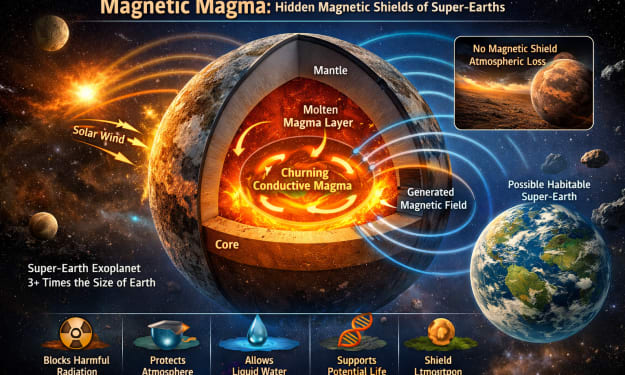
Super-Earths are rocky exoplanets more than three times the size of our planet, with far greater internal pressures and temperatures. For years, scientists assumed that if these worlds had magnetic fields, they would form the same way Earth’s does — through movement in a molten iron core. However, new laboratory experiments suggest something very different may be happening deep inside these massive planets. Under extreme pressure, certain molten rocks become electrically conductive. When these materials churn and circulate between the core and the mantle, they can generate magnetic fields on their own. This means a super-Earth might not rely solely on its core for protection. Instead, a thick, dynamic layer of magma could act as a natural magnetic shield, powered by internal heat and motion.
By USA daily update 3 days ago in Earth



Comments
There are no comments for this story
Be the first to respond and start the conversation.