
Discovering the Wonders of the Milky Way Galaxy
Scientists Detected Mysterious 'Morse Code' in Milky Way's Center
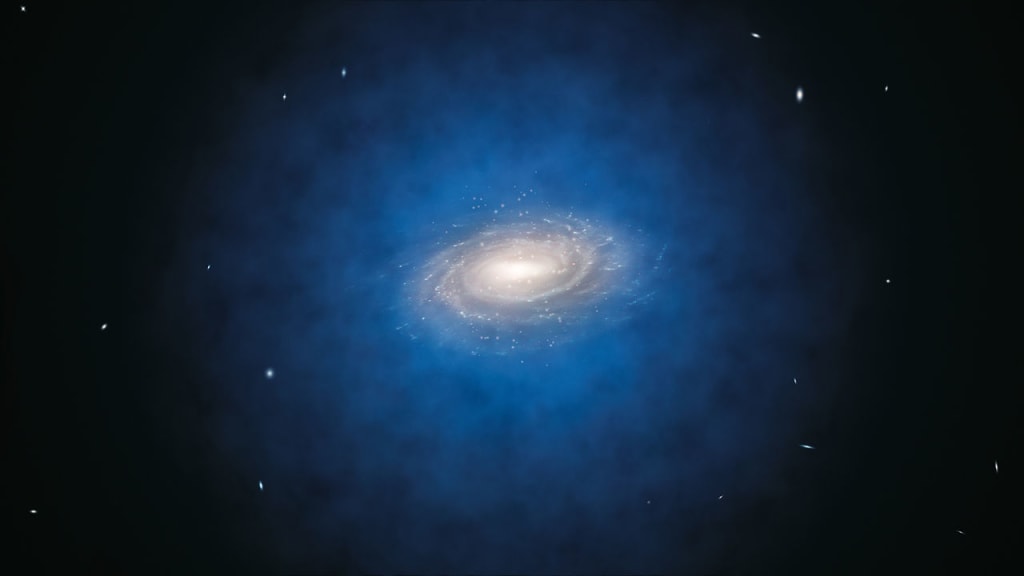
The Milky Way, our celestial home, showcases a breathtaking spectacle resembling an enormous pinwheel gracefully spinning through space. Classified as a spiral galaxy, it came into existence approximately 14 billion years ago and is a thriving habitat filled with an array of celestial marvels. Stars, nebulae (clouds of dust and gas), planets, asteroids, and even beings like ourselves, alongside the quirky neighbors down the street, form a vibrant tapestry that radiates outward from the heart of the Galaxy in its long, spiraling arms – an awe-inspiring view indeed.
Spanning about one hundred thousand light-years across, the Milky Way commands a grand scale, so vast that it takes our Sun and the entire solar system a staggering 250 million years to complete a single orbit around its central core. The sheer magnitude of this journey leaves us in awe as we witness our Sun's colossal lap around the galactic center.
Gazing up at the night sky, the majority of stars we observe belong to just one of the Milky Way's outstretched arms. Centuries ago, before the invention of telescopes, the stars appeared blurred, merging into a single white streak stretching across the dark canvas. This mesmerizing sight gave rise to the poetic name "Milky Way," evoking imagery of a celestial river of milk flowing above.
Beyond the familiar wonders of the Milky Way, exciting recent discoveries have sparked intrigue among the scientific community. An international team of researchers stumbled upon a peculiar phenomenon concealed at the Galaxy's center. Strikingly resembling Morse code, it raised the curious question: is our galaxy trying to communicate with us?
In the early 1980s, astronomers made a groundbreaking discovery – enormous one-dimensional filaments dangling vertically near Sagittarius A*, the supermassive black hole that serves as the Galaxy's central hub. Recently, a new type of filament has come to light. Unlike its predecessors, these filaments are shorter and extend either horizontally or radially, reminiscent of spokes on a cosmic wheel, radiating away from the enigmatic black hole. Though sharing certain similarities, researchers suggest they likely originate from different sources.
Approximately 1,000 vertical filaments, often appearing in pairs and clusters, stretch through the Galaxy, soaring up to an astounding 150 light-years in height. By contrast, the horizontal filaments display a Morse code-like pattern and appear to be around 6 million years old. Though both types are one-dimensional and detectable with radio waves, their unique characteristics set them apart. While vertical filaments are magnetic and contain particles moving at nearly the speed of light, the horizontal ones emit thermal radiation and lack such speedy particles. Moreover, the vertical filaments dwarf their horizontal counterparts in both number and size, spanning an astonishing 150 light-years compared to 5 to 10 light-years at most.
The discovery of these filaments has triggered great excitement among scientists. Extensive research and confirmation revealed that the filaments are not random occurrences but are indeed linked to the outflow of the black hole, providing invaluable insights into the spin of the black hole and the orientation of its accretion disk – a rotating disk of matter swirling under the immense gravitational force.
While these filaments continue to baffle astronomers, they are not the only peculiarities in our solar neighborhood. Australian researchers stumbled upon an extraordinary spinning object within the Milky Way, unlike anything observed before. Emitting massive bursts of radio energy three times every hour, the object's pulsation frequency is unparalleled in the celestial realm. Though other objects, such as pulsars, switch on and off, such rapid pulsation remains unprecedented. Astronomers, captivated by this mysterious occurrence, diligently study its enigmatic origin, situated approximately 4,000 light-years from Earth. The object's extraordinary brightness and powerful magnetic field raise further curiosity, defying traditional scientific explanations.
Theories about the object's identity abound, with some proposing it might be an ultra long-period magnetar or the remnants of a collapsed star, while others entertain the possibility of an entirely new celestial entity yet to be defined. Nonetheless, one fact remains undisputed: the signal observed across a wide range of frequencies indicates a natural origin, ruling out any artificial sources.
Beyond these remarkable discoveries, the Milky Way still harbors numerous mysteries that continue to fascinate astronomers. For instance, the Fermi gamma-ray Space Telescope, launched about 15 years ago, revealed that the Galaxy's center emits substantially more gamma radiation than its outskirts. While this intriguing glow has puzzled scientists for nearly a decade, no definitive explanation has emerged. Speculations of Dark Matter annihilation, leading to gamma-ray emissions, have been debated, but the observed clumpy distribution of light contradicts this theory. An alternative proposition attributes the glow to groups of millisecond pulsars, neutron stars spinning at incredible speeds, providing a compelling case given the clumpy nature of the light. However, the scientific community remains divided, and further investigation is necessary.
The Milky Way, with its allure and mysteries, beckons scientists to explore its enigmatic depths. As researchers continue to unlock its secrets, we eagerly anticipate the unveiling of more astonishing discoveries, bringing us closer to understanding the awe-inspiring wonders of our galactic abode.
About the Creator
Keep reading
More stories from Harindra Abeysinghe and writers in Earth and other communities.
Most Dangerous Holes on Planet Earth
Unveiling the Most Treacherous Pits on Earth From abandoned man-made mines to natural sinkholes and underwater pits, this article reveals the deepest and most dangerous holes that will make you think twice before taking that stroll, as they have swallowed machines, animals, and even people. Welcome to another episode of Forevergreen, where we explore the 10 most hazardous holes on our planet. Stick around for number one, as some of these places hold stories as dark as their depths.
By Harindra Abeysinghe2 years ago in Earth
Without Democracy, Donald Trump’s Venezuelan Oil Quest Will Fail
Donald Trump’s renewed interest in Venezuelan oil may seem, on the surface, like a hard-nosed geopolitical calculation. Venezuela holds the world’s largest proven oil reserves, and amid global energy uncertainty, access to those resources is undeniably tempting. But history, economics, and politics all point to the same conclusion: without democratic reform in Venezuela, any attempt by a Trump-led US administration to secure reliable Venezuelan oil will ultimately fail.
By Aarif Lashari5 days ago in Earth
So You Decided To Become a Nurse Practitioner:
So you decided to become an "Advanced Practice" nurse. Congratulations!... is what I would say if this was a good idea. Grad school? In this economy? What were you thinking? Likely it was something along the lines of either 1) “I've seen these other chucklefucks do it— Why can't I?” or even 2) “I've got a nice career, I should shake it up. I miss feeling like I have no clue what I'm doing.”
By Sandor Szabo2 days ago in Fiction



Comments
There are no comments for this story
Be the first to respond and start the conversation.