
Did wildfires in Canada result from climate change?
What really happened?
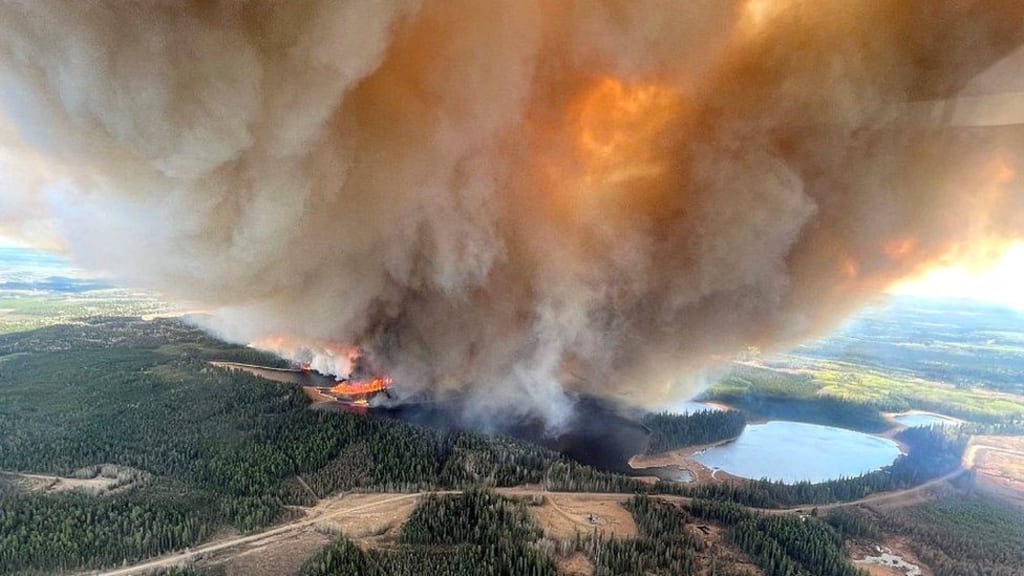
In recent weeks, a string of dangerous wildfires throughout Canada have gained international attention, along with images of hazy, orange-hued landscapes.
Tens of thousands of people had to be evacuated as a result of the flames, which also caused air quality to worsen throughout the nation and into the neighboring US. It is now on course to be the worst wildfire season in the history of the country, with more than four million hectares (10 million acres) already burned.
Some Canadian politicians jumped at the opportunity to link the catastrophe to global warming. Justin Trudeau, Canada's prime minister, stated on Twitter that "more and more of these fires" were occurring as a result of climate change. They "remind us that carbon pollution carries a cost on our society, as it accelerates climate change," wrote Canada's environment and climate minister in a tweet. Doug Ford, the premier of Ontario, who has attempted to reverse a number of climate initiatives, declined to draw the connection.
Climate change and the number and severity of wildfires around the world are clearly related. But it can be challenging to link a specific fire or a wave of fires to climate change.
According to the most recent report from the Intergovernmental Panel on Climate Change (IPCC) in 2021, fire weather—dry, hot, windy conditions that increase the likelihood of fires taking hold—is already becoming more of a problem in many parts of the world and will spread to more places if climate change worsens.
According to Nathan Gillett, a research scientist with the Canadian government's environment department, "We know that human-induced climate change is warming Canada at nearly double the global average pace. Canadian scientists' 2018 study revealed that since 1959, there has been a marked increase in the number of big fires and the area burned across the country, with the fire season beginning roughly one week sooner and concluding one week later.
But could we
Wildfires, however, result from a complex interaction of factors, involving short-term weather and longer term climate patterns, the type of forests involved and what people are doing to them. And they all need something to spark them off.
The Bulkley Valley Research Centre and University of British Columbia researcher Kira Hoffman, who specializes in fire ecology, emphasizes that fire is a natural and frequent component of the environment in western Canada, which is drier and more vulnerable to lightning strikes.
However, the 2017 fire season in British Columbia was so catastrophic that it set new records for the amount of acreage destroyed. Later research revealed that climate change had a "profound influence" and significantly increased the likelihood of underlying extremely warm and dry conditions as well as the area burned by a factor of seven to eleven.
According to Carly Phillips, a research scientist at the US-based Union of Concerned Scientists, this year's fire season is distinct in that it is not limited to a single region. The provinces are connected by unusually warm temperatures for this time of year and a protracted dry spell, both of which increase the risk of wildfires and are becoming worse in some areas owing to climate change.
According to Hoffman, Canada's ecosystems are very diversified. And in the plains, mountainous ecosystems, and the Maritimes [provinces], we are witnessing drought. As a result, areas like Nova Scotia and Halifax, which ordinarily wouldn't have as much fire activity, are now experiencing significantly more ignitions.
Natural Resources Canada's Lynn Johnston, a specialist in forest fire studies, says that this year, the fire season began far earlier than typical in several areas.
The current Canadian wildfires will be examined by World Weather Attribution researchers, who investigate the links between extreme weather and climate change, but they first need to improve their methods for analyzing fires.
Despite the fact that the origins and spread of a wildfire are "complicated," Johnston said she is less reluctant than she formerly was to draw a connection to climate change. Hoffman is particularly troubled when calamities brought on by climate change are not mentioned in media coverage on wildfires. A very different story is being told by science.
However, they all agree that there are additional crucial elements at play.
According to Phillips, the likelihood of people or their infrastructure starting fires grows as human expansion spreads into forested areas.
Researchers have also long highlighted how Canadian forestry laws have shifted away from traditional and Indigenous managed burning techniques that protect both people and important timber supplies. Regular, controlled burning decreases the likelihood of major fires getting out of control by clearing the forest understory, although this practice has been discontinued in a lot of the nation.
In recent years, there has been a shift in perspective, with forestry experts and managers increasingly realizing that suppression of fires is "not always necessary or desirable". More often than not, fires are allowed to burn unattended in areas where they do not immediately endanger lives or property, and in some regions, organized burning has returned.
It has become simpler for fires to spread, nevertheless, due to the legacy of suppression as well as the planting of more commercial but less fire-tolerant tree species. "Fire suppression in naturally fire-adapted ecosystems" is one of the ways that people are failing to adapt to climate change, according to a recent IPCC summary report.
Arson is a different possible cause of some of the fires that is being discussed more frequently on social media and in certain journalistic stories. According to one online conspiracy theory, some of the fires were started by "ecoterrorists'' who were seeking to dramatically raise awareness of climate change or push a constructive climate agenda.
Police are looking into a few of these events, but analysts believe there is no proof that these are the root of the issue. Hoffman points out that although the proportion is typically higher later in the summer, lightning strikes typically start around half of all wildfires in Canada each year. Overnight on June 1, in Quebec, 200 fires were started by lightning.
Wildfires are started by people just half of the time. However, most of this is unintentional and results from mishaps like car crashes, off-road vehicle ignitions, pyrotechnics, or people who fail to put out campfires.
Because we have maps showing the prevalence of lightning strikes, Hoffman claims that the majority of the current fires are caused by lightning. "We can see the systems approaching, the lightning strikes that go from cloud to ground and the subsequent ignitions.
The research is quite obvious, therefore it's incredibly alarming that there is so much misinformation regarding arson.
Johnston adds that there seem to be more lightning strikes lately, and that climate change may make matters worse.
Former firefighter Hoffman claims that discussions regarding fire management have already improved since 20 years ago. However, she believes that in order to effectively respond to wildfires like those in Canada this year, it is essential to understand all the various elements involved, the majority of which are ultimately human. "Fire is coming, and it will spread faster. We must improve our readiness for it.
About the Creator
Keep reading
More stories from writers in Earth and other communities.
‘A Militia That Kills’: Uproar in Italy Over ICE Security Role at the Winter Olympics
Italy’s preparations for the upcoming Winter Olympics were meant to showcase unity, excellence, and international cooperation. Instead, they have ignited a heated controversy. The source of the uproar is the reported involvement of ICE, a private security entity described by critics as “a militia that kills,” in providing security-related services for the Olympic Games.
By Aarif Lashari5 days ago in Earth
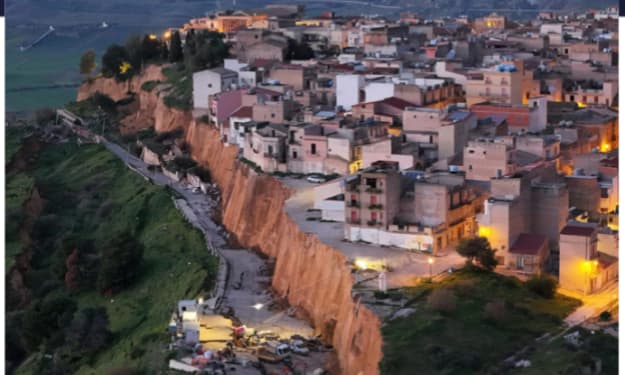
Huge Landslide Leaves Sicilian Homes Teetering on Cliff Edge
A massive landslide in Sicily has left dozens of homes perched dangerously on the edge of a collapsing cliff, forcing evacuations and raising urgent concerns about safety, climate resilience, and long-term urban planning. The dramatic incident unfolded after days of heavy rainfall weakened the soil beneath a coastal residential area, causing large sections of land to slide away into the sea.
By Sajida Sikandar4 days ago in Earth
Time to change your life.
Is it even possible for you to change your life? A lot of people, more than there should be, are unhappy with their lives. But what are they doing about it? Usually nothing. People talk about how shitty their lives are and want change, but are they not taking the actions to change?
By Jen Phillipsa day ago in Humans


Comments
There are no comments for this story
Be the first to respond and start the conversation.