
Did Earth Swallow Another Planet? The Shocking Truth Behind Theia and the Moon's Origin
4.5 billion years ago Earth collided with a mysterious planet an impact that created the Moon and left traces of the lost world deep within our planet. Discover the fate of Theia!

Did Earth Swallow Another Planet? The Shocking Truth Behind Theia and the Moon's Origin
4.5 billion years ago Earth collided with a mysterious planet an impact that created the Moon and left traces of the lost world deep within our planet. Discover the fate of Theia!
Billions of years ago our planet Earth wasn’t the quiet blue marble we know today. In fact it was a chaotic violent place constantly bombarded by space rocks meteorites and rogue planetary bodies. Among the most dramatic events in Earth’s ancient history is the story of a mysterious planet that Earth may have eaten. This planetary body called Theia plays a central role in one of the most widely accepted theories about the formation of our Moon. But what exactly happened to Theia and how do we even know it existed?
Let’s explore the fascinating cosmic mystery of the planet Earth swallowed.
Theia: A Missing Planet
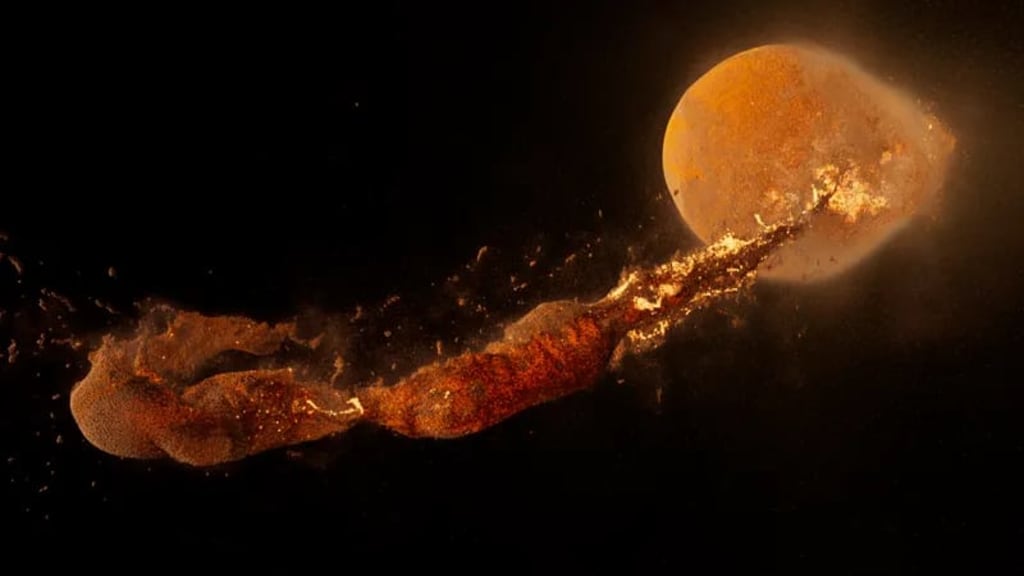
Theia is the name scientists gave to a Mars sized planet that is believed to have existed around 4.5 billion years ago not long after the formation of the solar system. According to the Giant Impact Hypothesis Theia collided with the early Earth in a cataclysmic event. This wasn’t a small crash it was a collision so massive that it changed Earth forever. This theory suggests that Theia struck Earth at a glancing angle ejecting a huge amount of debris into space. That debris eventually clumped together due to gravity forming what we now call the Moon.
Evidence for the Impact
The idea of a planetary collision may sound like science fiction but there’s real scientific evidence to support it:
1. Composition of Moon Rocks:
When NASA’s Apollo missions brought Moon rocks back to Earth scientists were surprised to find that the composition of the Moon was nearly identical to Earth's outer layers. If the Moon had formed somewhere else in the solar system this wouldn’t make sense. The similarity suggests the Moon formed from the Earth’s material likely thrown into orbit by a massive impact.
2. Earth's Tilt and Spin:
Earth’s unusual tilt (about 23.5 degrees) and rapid rotation may be the result of such a powerful collision. It would have added angular momentum and could explain why our day is roughly 24 hours long.
3. Computer Simulations:
Supercomputer models of the early solar system show that a collision between Earth and a Mars sized object could produce a Moon with the size and composition we observe today.
What Happened to Theia?
So if Theia was real, where is it now? Did Earth truly eat it?
The answer is: partially yes. Scientists believe that much of Theia’s mass was absorbed into the Earth during the collision. Some of Theia’s core may have merged with Earth’s core while the rest was blasted into space eventually coalescing to form the Moon. In fact a 2021 study proposed a shocking new idea: parts of Theia may still be hiding inside Earth’s mantle. These massive chunks called Large Low Shear Velocity Provinces (LLSVPs) sit deep beneath Africa and the Pacific Ocean. They are denser and hotter than the surrounding mantle and could be remnants of Theia’s material that was buried and preserved after the impact.
How This Changed Earth Forever
The collision with Theia may have been the most important event in Earth’s history.
1. Formation of the Moon:
Without the Moon Earth would be a very different planet. The Moon stabilizes Earth’s tilt, which regulates the climate and seasons. It also causes ocean tides which play a vital role in marine life.
2. Metal Rich Core:
The impact might have added important metals like iron and nickel to Earth’s core. This helped form our planet’s magnetic field which protects us from harmful solar radiation.
3. Life Itself:
Some scientists believe the impact might have helped Earth become habitable. The Moon’s influence on tides may have supported early life in the oceans while the added heat and elements from Theia could have sparked geological activity necessary for life to develop.
The Ghost Planet Within Us
Theia may be gone, but its fingerprints are all around us. From the Moon in our sky to the iron in our blood this lost planet lives on in surprising ways. Earth didn’t just eat Theia it became part of it. As we continue to study Earth’s interior and the Moon’s surface we may uncover more secrets of this ancient cosmic collision. Theia’s story reminds us that our planet’s history is full of dramatic universe shaping events and sometimes the pieces of missing worlds are hidden just beneath our feet.
About the Creator
Adnan Rasheed
Author & Creator | Writing News , Science Fiction, and Worldwide Update| Digital Product Designer | Sharing life-changing strategies for success.
Keep reading
More stories from Adnan Rasheed and writers in Earth and other communities.
NASA Discovers Skull Shaped Rock on Mars Real Evidence of Alien Life or Optical Illusion?
NASA Discovers Skull Shaped Rock on Mars Real Evidence of Alien Life or Optical Illusion? Strange Martian rock formation sparks debate among scientists and UFO enthusiasts is it proof of life on Mars or just a trick of the eye?
By Adnan Rasheed11 months ago in Earth
Nuclear Transmutation: The Accidental Dream of Making Gold
Picture a laboratory humming with quiet intensity, banks of instruments blinking in the low light, and somewhere inside a shielded reactor chamber, something almost magical is happening. An element is changing. One thing is becoming another. What was mercury is now, atom by atom, becoming gold.
By CurlsAndCommas6 days ago in Earth


Comments
There are no comments for this story
Be the first to respond and start the conversation.