
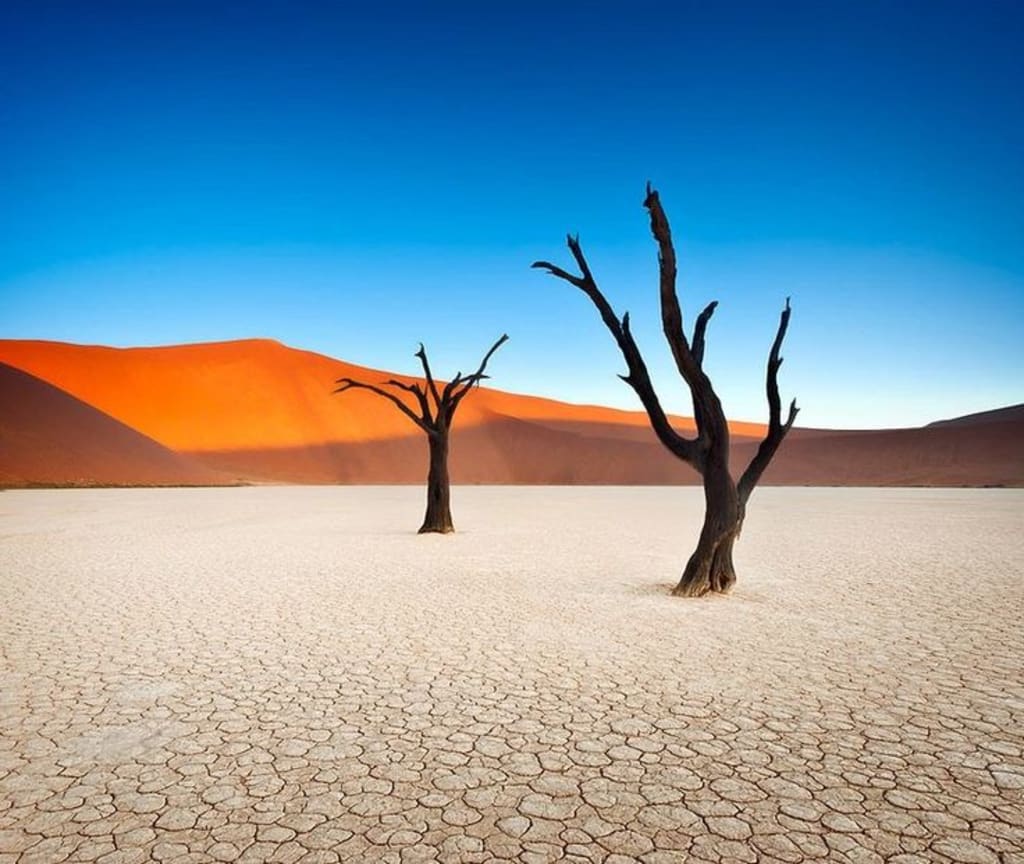
Start The early morning light had just begun to warm the edges of the Namib Desert as I stepped out of the jeep and into a landscape that felt otherworldly. I had come to visit Deadvlei, a remote and eerie clay pan in Namibia, one of the oldest deserts on Earth. The stillness around me was immediate, the air heavy with silence and the weight of history. Before me, a vast, flat expanse stretched out, bordered by towering, fiery-red sand dunes, some of the tallest in the world. Yet, it was the sight within the pan that captivated me—the ancient, blackened skeletons of dead trees, standing like forgotten sentinels in the midst of a land that hadn’t seen rain in centuries.
Deadvlei is unique not only because of its striking, surreal beauty but also for its story. Long ago, the Tsauchab River flooded this area, allowing acacia trees to grow in what was once a fertile marsh. But when the climate changed and the dunes shifted, the water was cut off, leaving the trees to wither and die. They didn’t decompose; instead, they were scorched by the desert sun, their black trunks preserved in a kind of natural mummification. The contrast of the dark, gnarled trees against the bleached white clay and the bright red dunes was unlike anything I had ever seen.
The closer I got to the center of Deadvlei, the more intense the stillness became. It was a silence so profound that it pressed down on me, as if the landscape itself had absorbed all sound. The wind that occasionally whispered across the dunes seemed to die as soon as it reached the pan. My footsteps crunched softly on the cracked ground, the intricate patterns beneath my feet stretching in every direction like the fractured surface of another planet. Time, here, felt suspended. It was as if I had wandered into a place where the world had simply stopped turning.
There were no signs of life—no birds, no insects, not even the smallest stir of movement. The sky above was a piercing blue, cloudless and vast, stretching endlessly across the horizon. And yet, despite the emptiness, Deadvlei felt alive in its own way, as though the land itself was breathing in the stillness. Each of the trees, standing crooked and contorted, seemed to tell a story of resilience and quiet defiance. They were ghosts, yes, but they were also survivors, their twisted limbs reaching toward a sky that had long since abandoned them.
I wandered among the trees, drawn to their alien beauty. Up close, the bark was black and cracked, as if charred by some ancient fire, though they had simply baked under the unrelenting sun for hundreds of years. Their twisted forms cast long, sharp shadows on the pale ground, making the entire scene feel like a painting come to life. I couldn’t help but touch one of the trees, half expecting it to crumble into dust beneath my fingers, but it was as solid as stone, as enduring as the desert itself.
As I stood there, soaking in the raw, unfiltered beauty of this place, I realized how small I felt in the presence of such timelessness. Deadvlei had been untouched for centuries, an oasis that had long since died but remained preserved in its death, a monument to nature’s power and impermanence. This was a place where time had stopped, yet it was filled with a kind of eternal stillness that made the moment feel infinite.
I decided to climb one of the massive dunes that encircled the pan to get a different perspective. The climb was slow and arduous, the sand shifting under my feet with each step. But when I reached the top and looked down, the view was breathtaking. The white of the clay pan, the red of the dunes, the black of the trees, and the endless blue sky combined into a scene that felt almost surreal, as though the colors themselves were too vivid to belong to the natural world.
From up here, Deadvlei looked like an abstract painting, the kind that made you question reality. The emptiness, the silence, the stark beauty—it all made sense in a way that only a place like this could. Deadvlei wasn’t just a destination; it was an experience that made you confront the scale of nature and the fleetingness of human life. It was a reminder that even in death, there is beauty, and in stillness, there is a profound sense of peace.
As I descended back into the pan, I knew that Deadvlei would stay with me long after I left, its timeless landscape etched into my memory as a place where the world had stopped, but nature’s quiet strength endured.
writing...
About the Creator
China Sets a New Benchmark: 22.13-Kilometer Highway Tunnel Breaks World Record
China has once again captured global attention by pushing the limits of civil engineering with the completion of a 22.13-kilometer highway tunnel. This extraordinary feat has not only set a new world record but also highlights China’s relentless drive to expand and modernize its transportation network. The tunnel, which threads through challenging mountainous terrain, promises to revolutionize travel efficiency, boost regional connectivity, and further cement China’s reputation as a global leader in mega infrastructure projects.
By Muhammad Hassanabout 24 hours ago in Earth
Global Tea Market Size and Forecast 2025–2033: Tradition Meets Innovation in a US$ 122.59 Billion Industry
Global Tea Market Outlook at a Glance The global tea market is entering a new era of sustained growth, blending centuries-old traditions with modern health, lifestyle, and sustainability trends. According to Renub Research, the tea market is expected to grow from US$ 69.26 billion in 2024 to US$ 122.59 billion by 2033, registering a compound annual growth rate (CAGR) of 6.55% from 2025 to 2033.
By Janine Root about 18 hours ago in Earth



Comments
There are no comments for this story
Be the first to respond and start the conversation.