
Crow Pheasant
An Enigmatic Bird of Mystery and Elegance
Introduction :
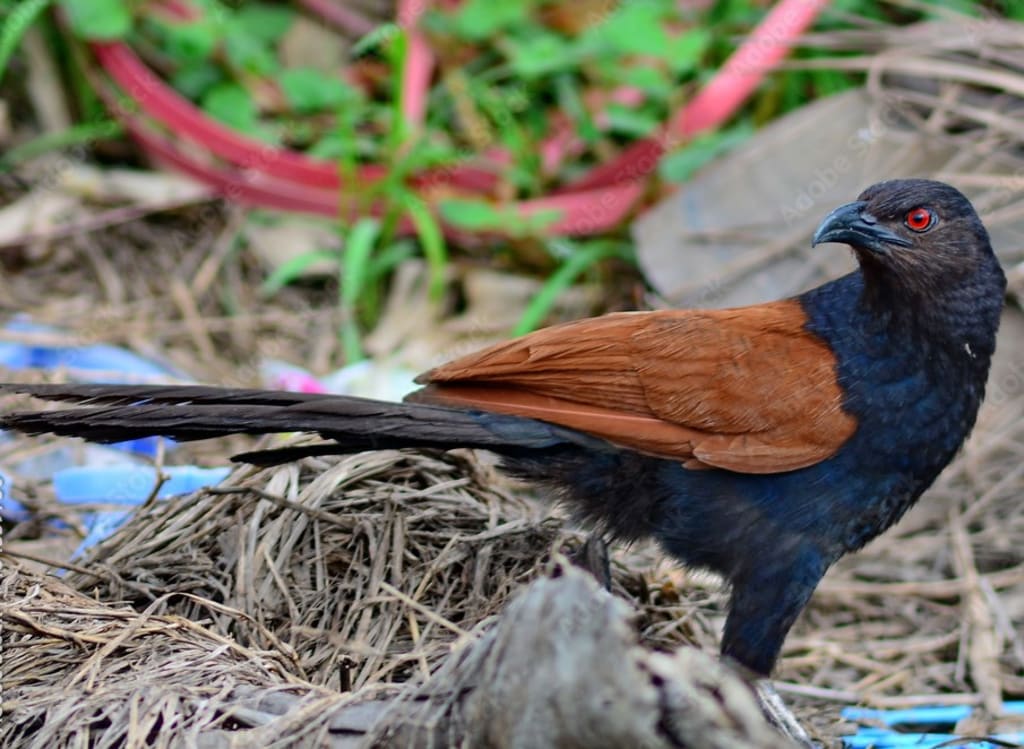
The Crow Pheasant, also known as the Asian Koel (Eudynamys scolopaceus), is a remarkable bird that holds a unique place in the avian world. Its intriguing behavior, melodious calls, and distinctive appearance have captured the fascination of bird enthusiasts and researchers alike. This article delves into the intriguing life of the Crow Pheasant, exploring its physical characteristics, habitat, behavior, and ecological significance.
1. Physical Characteristics :
The Crow Pheasant is a medium-sized bird with a length ranging from 39 to 46 cm and a wingspan of approximately 66 cm. The male and female display marked sexual dimorphism. The male has glossy bluish-black plumage with striking red eyes and a long tail, while the female has brown plumage with white streaks, providing effective camouflage for nesting. Both sexes possess a distinctive curved beak that aids in their feeding habits.
2. Habitat and Distribution :
The Crow Pheasant is widely distributed across the Indian subcontinent, Southeast Asia, and parts of China. It can be found in a variety of habitats, including deciduous and evergreen forests, urban parks, and gardens. These adaptable birds have also successfully colonized agricultural landscapes and human settlements.
3. Behavior and Breeding :
One of the most captivating aspects of the Crow Pheasant is its intriguing breeding behavior. The male is known for its resonant, repetitive call, often rendered as "ko-el," which gives the bird its common name. These vocalizations serve as territorial displays and also play a role in courtship. Interestingly, the female does not build a nest but lays its eggs in the nests of other bird species, particularly crows and babblers. This behavior is known as brood parasitism, and the surrogate parents unknowingly raise the Crow Pheasant chicks as their own.
4. Diet and Feeding Habits :
The Crow Pheasant has an omnivorous diet, consisting mainly of fruits, berries, and insects. Its bill is perfectly adapted for picking fruits and extracting seeds. It also consumes a variety of invertebrates, including caterpillars, spiders, and insects. This diverse diet allows the Crow Pheasant to thrive in a wide range of habitats.
5. Ecological Significance :
The Crow Pheasant plays a crucial role in its ecosystem as both a seed disperser and predator of insects. By consuming fruits and berries, it helps disperse seeds over long distances, contributing to the regeneration and diversity of plant species. Additionally, its insect predation helps control pest populations, making it an important ecological ally for farmers and gardeners.
6. Conservation Status and Threats :
The Crow Pheasant is currently listed as a species of "Least Concern" by the International Union for Conservation of Nature (IUCN). However, it faces various threats, including habitat loss due to deforestation, urbanization, and agricultural expansion. The use of pesticides in agricultural areas may also impact its food sources and indirectly affect the population. Conservation efforts should focus on protecting its habitat, raising awareness about its ecological importance, and promoting sustainable agricultural practices.
Conclusion :
The Crow Pheasant, with its enigmatic behavior and elegant appearance, continues to captivate bird enthusiasts and researchers alike. Its remarkable breeding strategy, adaptability to different habitats, and ecological significance make it a species worth studying and protecting. By understanding its behavior and conserving its habitat, we can ensure the survival of this intriguing bird and appreciate its unique place in the avian world. Let us work together to celebrate and safeguard the beauty and diversity of our natural world, which includes the magnificent Crow Pheasant.
---------
About the Creator
Subhash C
As a naturalist, I am passionate about conservation and educating others about the importance of biodiversity and ecological balance. My work involves field research, wildlife observation, and environmental advocacy.
O-Ring Seals Market Size and Forecast 2025–2033
Introduction In an era defined by advanced engineering, sustainability goals, and performance efficiency, the smallest components often play the biggest roles. Among these unsung heroes of modern manufacturing are O-ring seals—simple, circular devices that quietly prevent leaks, ensure safety, and keep critical systems functioning under extreme conditions.
By Aaina Oberoi5 days ago in Earth
The Refrigerant Transition
Cooling seldom features in climate headlines, yet it is one of the quietest success stories of the last decade. Under the Kigali Amendment to the Montreal Protocol, countries are phasing down hydrofluorocarbons (HFCs)—super-pollutant refrigerants—while retailers and manufacturers rapidly switch to ultra-low-GWP “natural” refrigerants such as carbon dioxide (R744) and propane (R290). Fully implemented, Kigali alone can avert roughly 0.4–0.5°C of warming by 2100; paired with efficiency improvements, the avoided warming can be closer to ~1°C—an enormous contribution from a single policy family [1–2].
By Futoshi Tachino7 days ago in Earth



Comments
There are no comments for this story
Be the first to respond and start the conversation.