
Cool Wheels in a Hot Land: Afghan Taxi Drivers Innovate with Homemade Air Coolers
In a country battling climate extremes and poverty, drivers craft life-saving solutions with limited means.
Cool Wheels in a Hot Land: Afghan Taxi Drivers Innovate with Homemade Air Coolers
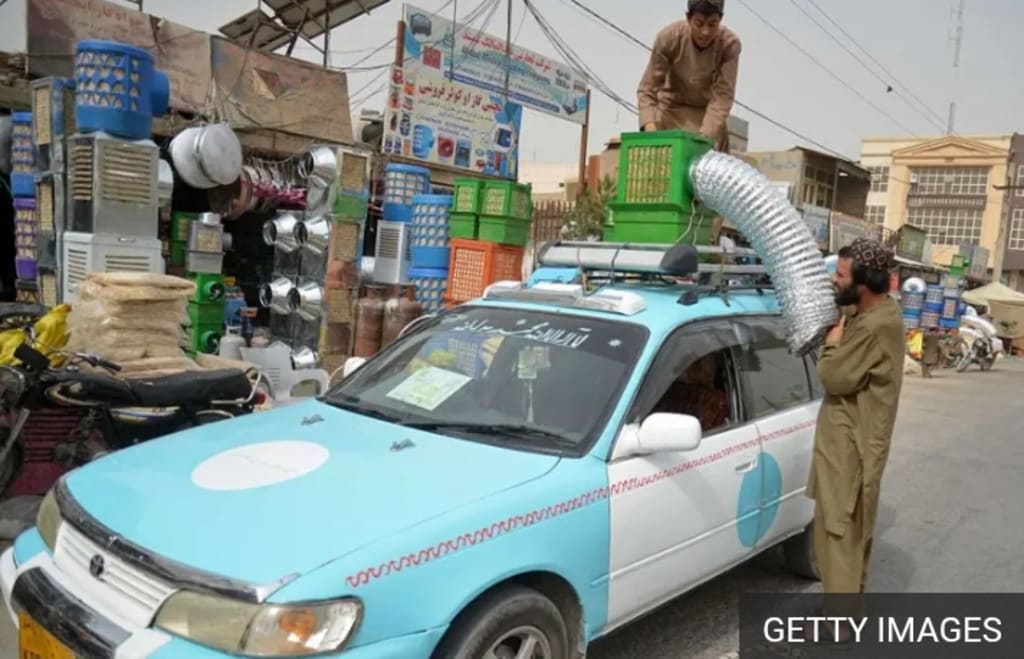
In the scorching heat of Afghanistan, especially in the southern city of Kandahar, temperatures often exceed 40°C (104°F). Amid such extreme weather, taxi drivers are turning to innovative solutions to keep their vehicles—and their passengers—cool. Their unique invention? Handmade air coolers installed on the roofs of their taxis, complete with large pipes that run inside the car.
These DIY cooling systems are gaining popularity as traditional car air-conditioners often fail in Afghanistan’s searing summer temperatures. Drivers in Kandahar claim that not only are these homemade coolers more effective, but they also circulate air throughout the entire vehicle, unlike factory-fitted AC units that typically only cool the front.
One of the taxi drivers, Abdul Bari, explained to AFP (Agence France-Presse), “These handmade air coolers work better than the AC. The AC only cools the front of the car, but this cooler spreads air throughout the vehicle.”
Videos shared by news agencies show Abdul Bari securing a large pipe through the window of his taxi while another man fastens the cooler unit on top of the roof. Despite being homemade, these coolers seem to be making a big difference for drivers and passengers alike. The only downside, according to Bari, is that they need to be manually refilled with water twice a day. “But for me,” he added, “it’s working perfectly.”
A Low-Cost, High-Impact Innovation
Afghanistan is one of the poorest countries in the world and is also facing severe impacts from climate change. According to government warnings, the country is expected to experience even more intense heat in the coming weeks. Amidst economic hardship and a lack of reliable infrastructure, residents are often forced to rely on their ingenuity to cope with harsh environmental conditions.
Another taxi driver, Gul Mohammad, shared that he began using this makeshift air-cooling system a few years ago when summer temperatures became unbearable. “The ACs in these cars don’t work,” said the 32-year-old driver. “And repairing them is very expensive. So I went to a local technician and asked him to make this cooler for me.”
Gul Mohammad said he spent around 43 US dollars to build the cooler. While that might seem like a modest amount, in a country where poverty is widespread, it’s a significant investment. Still, for these drivers, it's a necessary one.
Passengers too are praising the innovation. Noorullah, a 19-year-old commuter, recalled how he fell ill due to extreme heat just a few days ago. “It becomes really hard to travel in vehicles without coolers during the summer,” he said. “I even carry heat-relief tablets in my pocket when I travel.”
Record-Breaking Heat and a Country in Crisis
Afghanistan experienced its hottest spring on record between April and June this year. The rising temperatures are not just an inconvenience—they pose a serious threat to lives, especially for vulnerable groups such as children, the elderly, and the poor.
Last week, the United Nations Food and Agriculture Organization (FAO) warned that drought conditions in Afghanistan were devastating crops and rural livelihoods. Combined with political instability, economic sanctions, and ongoing conflict, climate change is becoming an unbearable burden for the Afghan population.
Environmental experts have warned that the humanitarian crisis in Afghanistan is likely to worsen due to the increasing severity of climate-related impacts. As access to international forums has been limited since the Taliban’s return to power in August 2021, the country is largely excluded from global climate discussions. This isolation hampers its ability to secure aid, resources, or strategic partnerships that could help address climate-related challenges.
Ingenuity in the Face of Adversity
The story of these taxi drivers is a powerful reflection of how ordinary people in Afghanistan are adapting in the face of enormous challenges. While global discussions on climate action continue, people like Abdul Bari and Gul Mohammad are doing what they can with the limited resources available to them.
Their homemade air coolers are a testament to local resilience, creativity, and survival. These drivers are not just providing transport—they’re offering their passengers a safer, more comfortable environment in otherwise unbearable conditions.
The systems they use are simple but effective: a fan connected to a water tank that blows moist air into the car through a pipe. The principle is basic evaporative cooling—a method well-suited for dry and hot climates like that of southern Afghanistan.
While such methods may seem rudimentary compared to modern air-conditioning systems, they are both energy-efficient and affordable, especially in areas where electricity is unreliable and fuel prices are high. More importantly, they are life-saving innovations in a context where heat-related illnesses are on the rise.
The Bigger Picture
Beyond the streets of Kandahar, these innovations also raise larger questions: What happens when governments and international systems fail to protect people from environmental extremes? What role can local ingenuity play when formal infrastructure is either absent or inaccessible?
In a world facing rapid climate change, the story of Afghan taxi drivers reminds us that solutions don’t always have to be high-tech or expensive. Sometimes, it’s the simplest interventions that make the biggest difference.
However, such efforts also highlight the urgent need for global climate justice. Afghanistan contributes very little to global carbon emissions, yet it remains among the most affected. Without political recognition and international collaboration, communities like these will continue to suffer silently—even as they invent their own ways to cope.
As temperatures continue to rise and the country braces for even hotter days, these homemade air coolers may become a more common sight—not just in taxis but in homes, shops, and other spaces across Afghanistan.
Until larger systemic changes are made, the people of Afghanistan will continue to rely on their resourcefulness and resilience to beat the heat, one cooler at a time.
About the Creator
Keep reading
More stories from Ikram Ullah and writers in Earth and other communities.
The Sun: The Life-Giving Star of Our Solar System
Details About the Sun The Sun is the most essential and powerful star in our solar system. It is the primary source of light, heat, and energy for the Earth and all other planets. Without the Sun, life as we know it could not exist. From providing energy to driving weather patterns and enabling photosynthesis in plants, the Sun plays a crucial role in the stability and continuity of life on Earth. Below are detailed insights into the Sun's characteristics, structure, and influence.
By Ikram Ullah8 months ago in Earth
Supreme Court to Review Monsanto’s Bid for Immunity in Roundup Lawsuits
The U.S. Supreme Court has agreed to review Monsanto’s appeal seeking immunity from lawsuits related to its popular herbicide, Roundup. This decision marks a critical moment for both the company and individuals claiming health damages from the chemical, which contains glyphosate—a substance under scrutiny for potential links to cancer. The review could have wide-reaching implications for corporate accountability, public health, and the legal landscape surrounding chemical products. Background on Roundup and Legal Challenges Roundup, a herbicide produced by Monsanto (now owned by Bayer), has been a staple in agriculture and home gardening for decades. Glyphosate, its active ingredient, was introduced as a highly effective solution for weed control. However, in recent years, scientific studies and lawsuits have raised concerns about its potential carcinogenic effects. Thousands of plaintiffs have claimed that exposure to Roundup caused non-Hodgkin lymphoma and other health issues. Numerous state and federal courts have seen extensive litigation, with some plaintiffs receiving multimillion-dollar verdicts. Monsanto has consistently defended the product, emphasizing that regulatory agencies worldwide have deemed glyphosate safe when used as directed. Monsanto’s Bid for Immunity Monsanto is appealing for legal immunity, arguing that its use of Roundup was regulated and approved by federal agencies, and therefore the company should not be held liable in civil lawsuits. The company contends that federal oversight should preempt individual claims, a legal doctrine known as federal preemption. In essence, Monsanto is asserting that because the Environmental Protection Agency (EPA) has evaluated and permitted glyphosate use, states or courts should not hold the company personally accountable for alleged harm. Why the Supreme Court’s Review Matters The Supreme Court’s decision to hear the case is significant for several reasons: Corporate Accountability: A ruling in favor of Monsanto could strengthen corporate defenses in cases where products are federally regulated, potentially limiting lawsuits against companies producing similar chemicals or pharmaceuticals. Public Health: Plaintiffs and advocacy groups argue that a corporate victory could undermine accountability for harmful products and reduce incentives for companies to rigorously test safety. Legal Precedent: The case could set a nationwide precedent regarding federal preemption, influencing how courts balance regulatory approval with civil liability. The Supreme Court’s interpretation could reshape the legal landscape for product liability and consumer protection in the United States. Stakeholder Perspectives Plaintiffs and Advocacy Groups For those affected by Roundup, the Supreme Court review is a critical opportunity to hold a powerful corporation accountable. Many plaintiffs argue that Monsanto failed to adequately warn users of the potential risks associated with glyphosate exposure. “People shouldn’t have to choose between using a product as intended and risking their health,” says Laura Mitchell, an attorney representing multiple plaintiffs in Roundup lawsuits. “A ruling that shields Monsanto from liability could leave victims without recourse.” Advocacy groups, such as environmental and cancer prevention organizations, emphasize that transparency and accountability are essential, particularly for chemicals widely used in agriculture and landscaping. Monsanto and Bayer Monsanto, now part of Bayer, maintains that Roundup is safe when used according to label instructions. Bayer has publicly stated that legal challenges have cost billions but that the company continues to stand behind its products. The firm argues that courts must respect federal regulatory authority to avoid creating conflicting standards between federal law and state-level lawsuits. “If companies could be held liable despite following federal regulations, it would set a concerning precedent for innovation and regulatory compliance,” a Bayer spokesperson said. Broader Implications The Supreme Court review has implications far beyond Monsanto and Roundup: Agricultural Industry: Glyphosate and similar herbicides are widely used in crop production. Legal outcomes could influence labeling, usage guidelines, and liability risk for other companies in agriculture. Consumer Products: The ruling could affect cases involving pharmaceuticals, chemicals, and other regulated products, particularly when federal agencies approve them. Regulatory Authority vs. Civil Liability: The decision may clarify the balance between federal oversight and state-level tort claims, potentially shaping how courts interpret the limits of corporate immunity. Previous Court Decisions Lower courts have issued mixed rulings in Roundup lawsuits. Some courts awarded substantial damages to plaintiffs, while others limited awards or found in favor of Monsanto. These inconsistent outcomes underscore the complexity of balancing scientific evidence, regulatory approval, and legal responsibility. Federal appeals courts have previously sided with both sides in separate cases, making Supreme Court intervention necessary to establish uniform legal standards nationwide. Public and Media Reaction Media coverage of Monsanto’s legal challenges has been extensive, reflecting public concern over chemical safety and corporate responsibility. Many reports highlight the tension between regulatory approvals and individual health claims, questioning whether federal endorsements automatically protect companies from lawsuits. Public sentiment is divided. Supporters of corporate immunity argue that companies need protection to operate and innovate without fear of excessive litigation. Opponents worry that such immunity could prioritize corporate interests over public health. What to Expect The Supreme Court will now evaluate key questions: Does federal regulatory approval preempt state-level claims of harm? Can companies be held liable even if they followed federal guidelines? How should courts balance scientific uncertainty with civil justice? The decision, expected within the next year or two, will be closely watched by lawyers, plaintiffs, corporations, and advocacy groups alike. Conclusion The Supreme Court’s review of Monsanto’s bid for immunity in Roundup lawsuits represents a landmark moment in American legal history. The case has the potential to redefine corporate liability, influence public health policy, and set precedent for future disputes involving federally regulated products. For plaintiffs, the stakes are deeply personal—seeking justice for alleged health impacts caused by widespread chemical exposure. For Monsanto and other corporations, the outcome could determine the limits of accountability in a regulated marketplace. As the Supreme Court deliberates, the nation watches closely, recognizing that the ruling will resonate far beyond Monsanto, affecting consumers, companies, and the broader debate over safety, regulation, and responsibility in the United States.
By Muhammad Hassan3 days ago in Earth
Oil Well Abandonment Services: Responsible Closure for Long-Term Environmental Safety
Oil and gas production is only one chapter in the life of a well. When extraction ends, what happens next is just as important as the energy once produced. Oil well abandonment services ensure that inactive wells are closed in a safe, controlled, and permanent manner, preventing environmental damage and protecting surrounding land for future use. 🌍
By andersenintusabout 3 hours ago in Earth


Comments
There are no comments for this story
Be the first to respond and start the conversation.