
The Northern Lights: Nature’s Mesmerizing Nighttime Spectacle
Why the Aurora Borealis Continues to Dazzle Skies and Scientists Alike
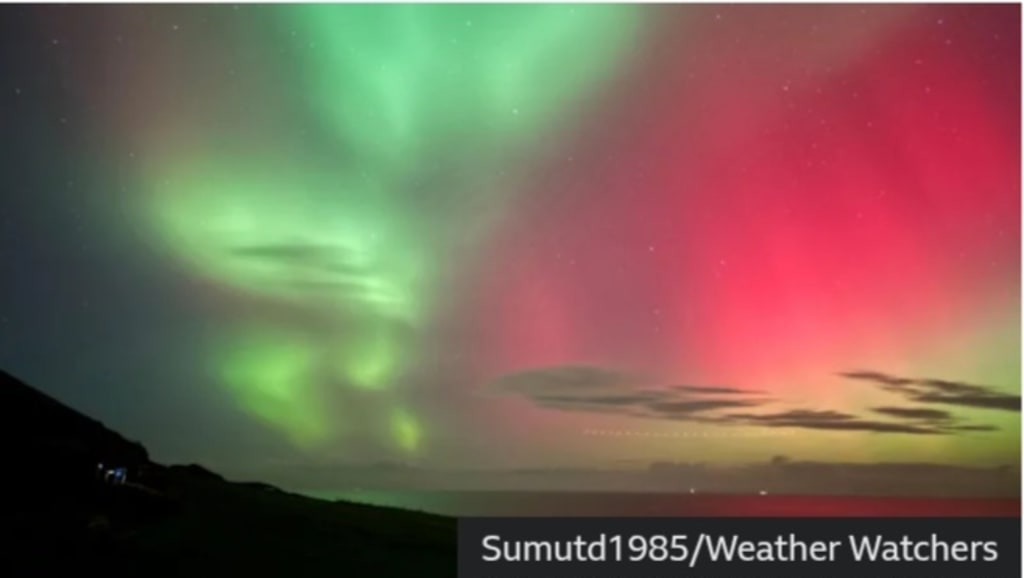
The Northern Lights, or Aurora Borealis, have fascinated humans for centuries. Their mysterious, shimmering waves of green, purple, and pink light dance across the Arctic skies, inspiring myths, legends, and scientific curiosity. But what causes this spectacular display, and why does it keep appearing, year after year, even today?
At the heart of the Northern Lights is a fascinating interaction between the Sun and Earth’s magnetic field. The Sun constantly emits a stream of charged particles known as the solar wind. These particles, mostly electrons and protons, travel millions of kilometers through space. When they reach Earth, they are funneled by our planet’s magnetic field toward the polar regions. Here, the particles collide with gases in the atmosphere, such as oxygen and nitrogen. These collisions release energy in the form of light, creating the colorful ribbons we see in the night sky.
The Northern Lights are most commonly visible in regions close to the magnetic poles, including northern Norway, Sweden, Finland, Canada, and Alaska. The intensity and frequency of auroras vary with solar activity. During periods of high solar activity, such as solar storms or solar flares, the Northern Lights become brighter and can even be seen at lower latitudes, far from the Arctic Circle. Scientists closely monitor the Sun’s behavior to predict when these dazzling displays will occur, giving photographers, travelers, and astronomy enthusiasts the chance to witness them in real time.
Interestingly, the colors of the aurora depend on which gases are involved in the collisions and at what altitude they occur. Oxygen tends to produce green and red colors, the most common hues seen in the aurora. Nitrogen, on the other hand, produces purples, pinks, and blues. The exact patterns, including arcs, curtains, and spirals, are influenced by the shape of Earth’s magnetic field lines and the strength of the solar wind. This complex interaction of celestial forces ensures that no two auroral displays are ever exactly the same.
Beyond their scientific explanation, the Northern Lights hold deep cultural significance. Indigenous peoples of the Arctic, including the Sami of Scandinavia and various First Nations in Canada, have passed down stories about the aurora for generations. Some view the lights as spirits of ancestors dancing in the sky, while others interpret them as omens or signs. In modern times, these lights have become a symbol of natural beauty, drawing thousands of tourists annually to experience their magic firsthand. The aurora has also inspired artists, writers, and musicians worldwide, serving as a bridge between the natural world and human creativity.
Despite their beauty, the Northern Lights also remind us of the Sun’s immense power and the delicate balance of Earth’s magnetic shield. Solar storms that cause auroras can sometimes disrupt satellites, power grids, and communications systems. Understanding the science behind auroras is not only fascinating but also essential for protecting technology that modern life depends on. Space weather forecasting, including monitoring solar winds and geomagnetic activity, has become a crucial part of scientific research. The more we learn about auroras, the better we can prepare for the potential impacts of intense solar events.
The Northern Lights are also an important tool for scientists studying Earth’s atmosphere and magnetic field. By analyzing auroral activity, researchers gain insights into how the solar wind interacts with Earth’s magnetosphere, as well as the structure and behavior of the upper atmosphere. This research can help us better understand climate patterns, atmospheric chemistry, and even the potential habitability of planets beyond our solar system. In essence, the Northern Lights serve as both a mesmerizing spectacle and a natural laboratory for scientific exploration.
For those lucky enough to witness the aurora in person, the experience is unforgettable. Observers often describe a sense of awe and wonder, a feeling that connects them to the broader universe. Photographers and tourists alike travel to remote locations with little light pollution to capture the elusive dance of color across the sky. With modern technology, live streams and high-quality images allow people around the world to experience the Northern Lights virtually, spreading their beauty beyond the Arctic regions.
The persistence of the Northern Lights is a testament to the enduring power of nature. As long as the Sun continues to emit charged particles and Earth maintains its magnetic field, these lights will continue to grace our skies. Unlike many natural phenomena affected by climate change or human activity, the aurora remains a reliable and recurring display of cosmic wonder. Yet, every display is unique, influenced by solar cycles, atmospheric conditions, and geomagnetic fluctuations, ensuring that the Northern Lights never lose their sense of mystery and excitement.
In conclusion, the Northern Lights are more than just a visual spectacle—they are a profound reminder of the connection between our planet and the Sun. They combine the beauty of natural art with the complexity of physics, the intrigue of folklore with the rigor of scientific study. Each shimmering curtain and swirling ribbon carries stories from the past, insights for the future, and an ever-present sense of wonder. As we continue to study, observe, and marvel at the aurora, one thing remains clear: the Northern Lights will keep appearing, lighting up our skies and our imaginations for generations to come.
About the Creator
Keep reading
More stories from Ayesha Lashari and writers in Earth and other communities.
Dozens of Flood Warnings Issued in England After Days of Relentless Rain
England is grappling with widespread flooding after several days of continuous heavy rain, prompting the Environment Agency to issue dozens of flood warnings across multiple regions. The intense rainfall has overwhelmed rivers and drainage systems, causing water levels to rise dangerously in both urban and rural areas. Emergency services are on high alert, assisting communities affected by the deluge.
By Ayesha Lasharia day ago in Earth
The Holiday Cactus Conundrum: Tell Your Thanksgiving, Christmas, and Easter Cactus Apart
A Trio of Holiday Classics First, a little botanical history to understand the confusion. All three plants are tropical cacti (epiphytes) native to the rainforests of Brazil, where they grow on trees. The Thanksgiving (Schlumbergera truncata) and Christmas (Schlumbergera × buckleyi) cacti are close cousins within the same genus. The Easter cactus (Hatiora gaertneri), however, has been reclassified into a different genus altogether, which explains its more significant differences.
By Emma Wallacea day ago in Earth
Muslim Countries Condemn Israel’s Gaza Strikes, Allege ‘Repeated Violations’ of Ceasefire
Several Muslim-majority countries have condemned recent Israeli strikes in Gaza, alleging that the attacks represent repeated violations of ceasefire agreements. The statements, issued through official government channels and regional organizations, reflect growing diplomatic tensions and renewed concern about stability in the Middle East.
By Aarif Lashari7 days ago in Earth




Comments
There are no comments for this story
Be the first to respond and start the conversation.