
Climate Change: A Global Crisis Requiring Urgent Action
Understanding the Impacts and Mobilizing for a Sustainable Future

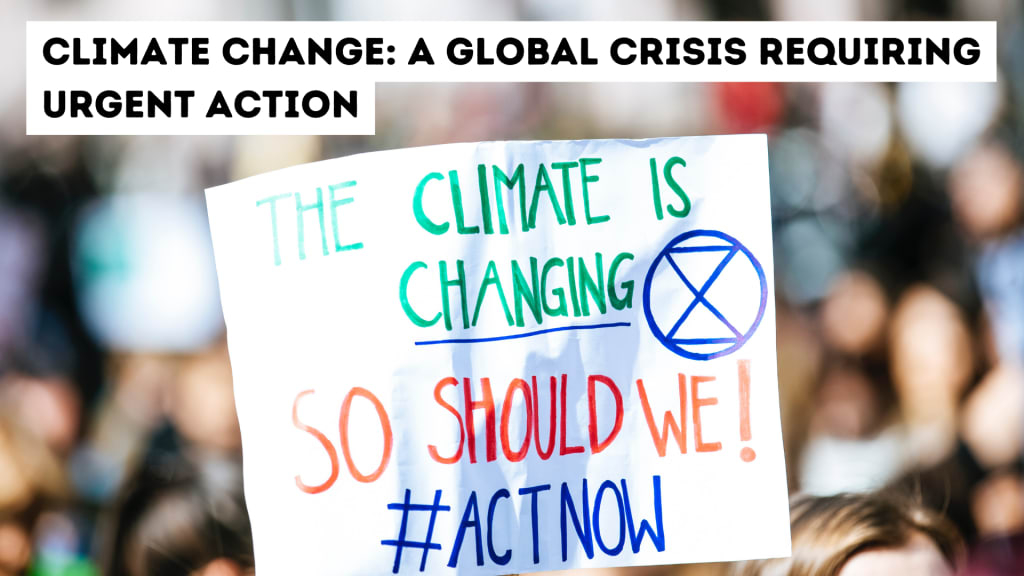
In an era marked by numerous global challenges, there is one issue that stands out as the most pressing of all: climate change. The alarming reality is that our planet is warming at an unprecedented rate, primarily due to human activities. The consequences of this phenomenon are already evident and are impacting every corner of the globe. It is high time we acknowledge the urgency of the situation and take collective action to combat climate change.
The scientific consensus on climate change is overwhelming. The Intergovernmental Panel on Climate Change (IPCC), a leading authority on the subject, has unequivocally stated that human activities, particularly the burning of fossil fuels, are the primary drivers of global warming. This warming trend is causing rising sea levels, more frequent and intense extreme weather events, the loss of biodiversity, and the disruption of ecosystems. The consequences are far-reaching and affect not only the environment but also human health, economies, and social stability.
The impacts of climate change are already being felt around the world. Coastal regions are increasingly vulnerable to flooding and erosion as sea levels rise. Heatwaves and droughts are becoming more frequent, leading to water scarcity and agricultural losses. Extreme weather events such as hurricanes, wildfires, and heavy rainfall are on the rise, causing significant damage to infrastructure and human lives. Moreover, climate change exacerbates existing inequalities, as marginalized communities are often the most vulnerable to its effects, lacking the resources and infrastructure to adapt.
Beyond the immediate consequences, climate change poses a long-term threat to our planet. If we fail to take substantial action now, we risk crossing tipping points that could lead to irreversible damage. The melting of polar ice caps, for example, not only contributes to rising sea levels but also reduces the Earth's capacity to reflect sunlight, thereby amplifying the warming effect. This positive feedback loop could result in catastrophic consequences, such as the collapse of ecosystems and the disruption of global weather patterns.
Addressing climate change requires a multi-faceted approach involving governments, businesses, communities, and individuals. International cooperation is vital to effectively mitigate greenhouse gas emissions and adapt to the changing climate. The Paris Agreement, adopted by nearly every nation in 2015, set the framework for global action by aiming to limit global warming to well below 2 degrees Celsius above pre-industrial levels. However, mere commitments are not enough; we need concrete and ambitious actions to meet these targets.
Transitioning to a low-carbon economy is a fundamental step towards mitigating climate change. This entails reducing our dependence on fossil fuels and embracing renewable energy sources such as solar, wind, and hydropower. Governments must provide incentives and support for the development and adoption of clean technologies. Simultaneously, businesses have a crucial role to play by implementing sustainable practices, reducing emissions, and promoting environmentally friendly products and services. Individuals can contribute by adopting greener lifestyles, conserving energy, and advocating for change within their communities.
Education and awareness are key in fostering a global understanding of climate change and its implications. By educating future generations about the science of climate change and the importance of sustainable practices, we can ensure a more informed and engaged citizenry. Furthermore, promoting climate literacy can drive innovation and empower individuals to participate actively in finding solutions.
While climate change is a global issue, it requires local solutions tailored to the unique challenges faced by different regions. Developing countries, for instance, often bear the brunt of climate change impacts despite having contributed less to the problem. They need support in adapting to changing conditions and accessing sustainable technologies. International cooperation must include financial assistance and technology transfer to ensure a fair and equitable response to climate change.
In conclusion, climate change is undeniably the most pressing global issue of our time. It threatens our planet's ecosystems, economy, and social fabric
About the Creator
Plantera Digital Media
welcome to my page here i share
- Stories
- Interesting facts about the world around us
- Thought-provoking theories about the nature of reality
- Useful information that can help people in their lives
Keep reading
More stories from Plantera Digital Media and writers in Earth and other communities.
Cloud Seeding: An Innovative Approach to Weather Modification
Introduction Weather patterns play a crucial role in shaping the environment and impacting various aspects of human life. Over the years, scientists and researchers have explored numerous methods to modify weather conditions for the benefit of mankind. One such method gaining attention is cloud seeding. In this article, we will delve into the concept of cloud seeding, its potential applications, and the ongoing research surrounding this innovative approach to weather modification.
By Plantera Digital Media 3 years ago in Earth
Industrial Deployment of Biochar in Modern Metal Smelting Systems
Biochar is increasingly examined as a functional carbonaceous material in high-temperature metallurgical operations. Traditionally dominated by fossil-derived coke and coal, metal smelting processes are under pressure to decarbonize while maintaining reductive efficiency and structural reliability. Biochar, when properly engineered, presents a technically viable supplementary reductant in the production of steel, silicon, and ferroalloy. Its application, however, requires stringent control of physicochemical properties and integration within existing furnace infrastructure.
By Wayne Shen2 days ago in Earth




Comments
There are no comments for this story
Be the first to respond and start the conversation.