

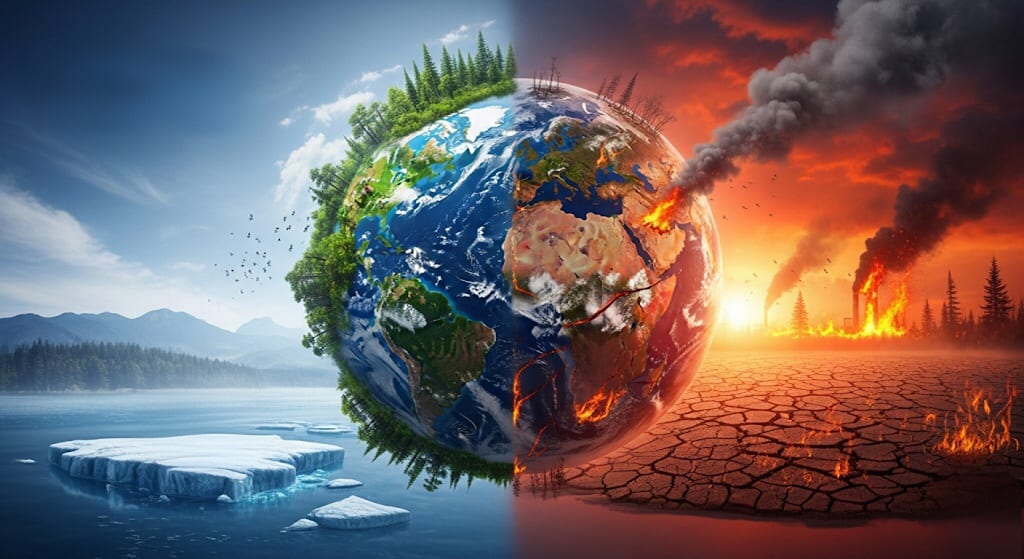
Humanity is no longer on the brink of environmental crisis—we are living in it. The sixth mass extinction is not a prediction; it is our present reality. Climate change is not a problem waiting on the horizon. It is here, devastating ecosystems, destroying livelihoods, upending economies, and placing human life itself at risk. What’s unfolding around us is not a distant emergency—it’s a rapidly ticking clock toward irreversible damage. The question now is not whether we can respond, but whether we will.
Beyond Rising Temperatures: The Real Cost of Climate Change
Climate change is often misunderstood as merely a temperature issue or a concern for polar ice caps. In truth, it’s a complete system breakdown that touches every part of human life—from agriculture to economics, from public health to social stability.
In countries like India, where agriculture is a key livelihood for over half the population, the impact has been catastrophic. Crops are failing due to unpredictable rainfall patterns, relentless heatwaves, and extended periods of drought. Without healthy pollinator populations, even the most resilient crops are at risk of failing. And when food systems collapse, it sets off a chain reaction: hunger, migration, job loss, and economic destabilization.
This isn’t hypothetical. It's already happening. Entire communities are being displaced by floods and droughts, creating massive migration patterns that cities are ill-equipped to handle. This, in turn, leads to overburdened infrastructure, rising unemployment, and growing social unrest.
Even service-based economies—which rely on consumer spending—are at risk. If agriculture and manufacturing falter, disposable income dries up. Fewer people go out to eat, travel, or engage in non-essential spending. The notion that the economy can thrive while the environment collapses is not just false—it’s dangerously naive.
Urban Centers on the Frontlines
Coastal cities are among the most immediate casualties of rising sea levels. Mumbai, Chennai, and Kolkata are already showing the early signs of crisis. These are not minor inconveniences or seasonal floods—these are existential threats to some of the world’s most densely populated urban hubs.
Meanwhile, inland regions are not spared. Cities like Delhi are experiencing unprecedented heatwaves, with temperatures soaring far beyond historical averages. This isn’t just uncomfortable—it’s deadly. Heat stress affects energy grids, reduces worker productivity, and leads to a surge in heat-related illnesses and deaths. Infrastructure is buckling under the weight of a new climate reality, and yet, responses remain slow and inadequate.
A Public Health Disaster in Motion
The climate crisis is also a health emergency. It amplifies both chronic and infectious diseases. With rising temperatures, diseases once contained to tropical zones are spreading. New threats are also emerging—some potentially released from melting glaciers and permafrost that have kept ancient viruses frozen for millennia.
Scientists have already found signs of bacteria and viruses long trapped in Arctic ice now being re-exposed. If the COVID-19 pandemic showed how unprepared we are for a global health crisis, the idea of multiple unknown pathogens surfacing is deeply alarming—and entirely plausible.
The Danger of Denial and False Optimism
Despite mounting evidence—raging wildfires, deadly floods, record-shattering temperatures—we still see widespread denial and delusion. Climate denial, whether in the form of outright rejection or quiet minimization, remains a major obstacle.
Even worse is the belief that humanity will somehow “adapt” as we always have. This ignores the scale and speed of current changes. Adaptation requires foresight, investment, and time—none of which we currently have in abundance. Believing that we will engineer our way out of collapse, while refusing to make real sacrifices, is not optimism. It’s escapism.
India: High Stakes, Low Awareness
India is among the nations most vulnerable to climate change—and yet one of the least prepared. Environmental concerns remain largely absent from public discourse and political agendas. Climate education is minimal, and national strategies often fall short of urgency or scale.
The economy is deeply rooted in sectors that are extremely climate-sensitive: informal labor, agriculture, and resource extraction. Manufacturing and infrastructure also lack climate resilience. As the impacts worsen, each sector faces compounding risks. The country is also falling behind on global climate commitments. Rather than reducing emissions, projections suggest a continued increase—exactly the opposite of what is needed.
A Crisis of Responsibility
Understanding climate change is not complex. The science is clear and accessible. What’s lacking is not intelligence—it’s honesty and courage. We’re not acting because the truth demands uncomfortable choices, and too many people in power are unwilling to make them. It's easier to pretend the problem isn’t urgent than to face the demands of real change.
This Is Our Final Warning
We are living in the Anthropocene—an age where human activity shapes the fate of the planet. Unfortunately, we’re using that power recklessly. More than 75% of wildlife has vanished in the last 50 years. Ecosystems are collapsing. The Earth's ability to regenerate is breaking down.
But there is still time—barely. This is not the end unless we allow it to be. Change is still possible, but only through immediate, collective action. That means rethinking policy, reforming education, holding industries accountable, and making climate consciousness central to everyday decisions.
The alternative is not inconvenience or discomfort.
It is extinction.
About the Creator
Taimoor Khan
Hi, I’m Taimoor Khan. Writing is my way of capturing the quiet moments of life that often go unnoticed.
Keep reading
More stories from Taimoor Khan and writers in Earth and other communities.
Will the World Go Dark on August 2?
In recent weeks, a viral claim has captured public attention, suggesting that the entire world will be plunged into six minutes of darkness on August 2 due to a rare solar eclipse. The story, widely circulated on social media, has raised curiosity—and in some cases, unnecessary alarm. However, astronomers and space science experts have stepped forward to set the record straight. The truth is far less dramatic: there is no scientific evidence to support the claim of a global blackout on that date.
By Taimoor Khan7 months ago in Earth


Comments
There are no comments for this story
Be the first to respond and start the conversation.