
China’s Agricultural Revolution: Feeding a Nation, Sustaining the Future
Tackling Challenges, Harnessing Innovation, and Building a Resilient Food System for 1.4 Billion

China, the world’s largest agricultural producer, feeds 20% of the global population on just 7% of its arable land. Contributing 7% to GDP and employing 170 million people, agriculture is a cornerstone of the nation’s economy. Yet, climate change, resource constraints, and rural-urban disparities pose significant challenges. Through cutting-edge technology, robust policies, and sustainable practices, China is transforming its agricultural landscape. Let’s explore the challenges, impacts, and visionary solutions driving this powerhouse forward.
Challenges Facing Chinese Agriculture
China’s agricultural sector faces formidable hurdles. Climate change threatens yields, with the Ministry of Agriculture estimating a 5-10% production drop by 2030 due to rising temperatures and erratic rainfall. Arable land, reduced by 6% since 2000 to 120 million hectares, is further strained by urbanization and soil degradation, with 40% of farmland contaminated by heavy metals like cadmium. Water scarcity is acute, with agriculture consuming 60% of China’s freshwater, and 70% of northern regions facing severe shortages.
Smallholder farmers, numbering 230 million and managing 98% of farms, average just 0.6 hectares, limiting economies of scale. Only 20% access modern equipment, and low incomes—$2,000 annually—drive rural migration, reducing the agricultural workforce by 5% yearly. Post-harvest losses, at 15% of output, cost $50 billion annually due to inadequate storage and logistics. Overuse of fertilizers, at 350 kg per hectare (double the global average), pollutes 30% of waterways, threatening ecosystems.
Impacts on Society and Economy
The consequences are significant. Food security remains a priority, with 130 million people facing undernourishment, per FAO’s 2023 report. Contaminated soil affects rice safety, with 10% of production unfit for consumption, impacting health. Economically, inefficiencies reduce agricultural GDP by 3%, while environmental degradation from farming practices costs $200 billion yearly in cleanup and health expenses. Air pollution from crop residue burning, particularly in Henan and Shandong, contributes to 1.5 million premature deaths annually.
Despite challenges, China’s agricultural output—$1.2 trillion in 2024—leads globally, producing 25% of the world’s grain. However, rural-urban income gaps, with urbanites earning three times more, fuel social inequality. Intensive farming practices, including livestock methane emissions, account for 12% of China’s greenhouse gases, underscoring the need for sustainable solutions.
Innovative Solutions and Progress
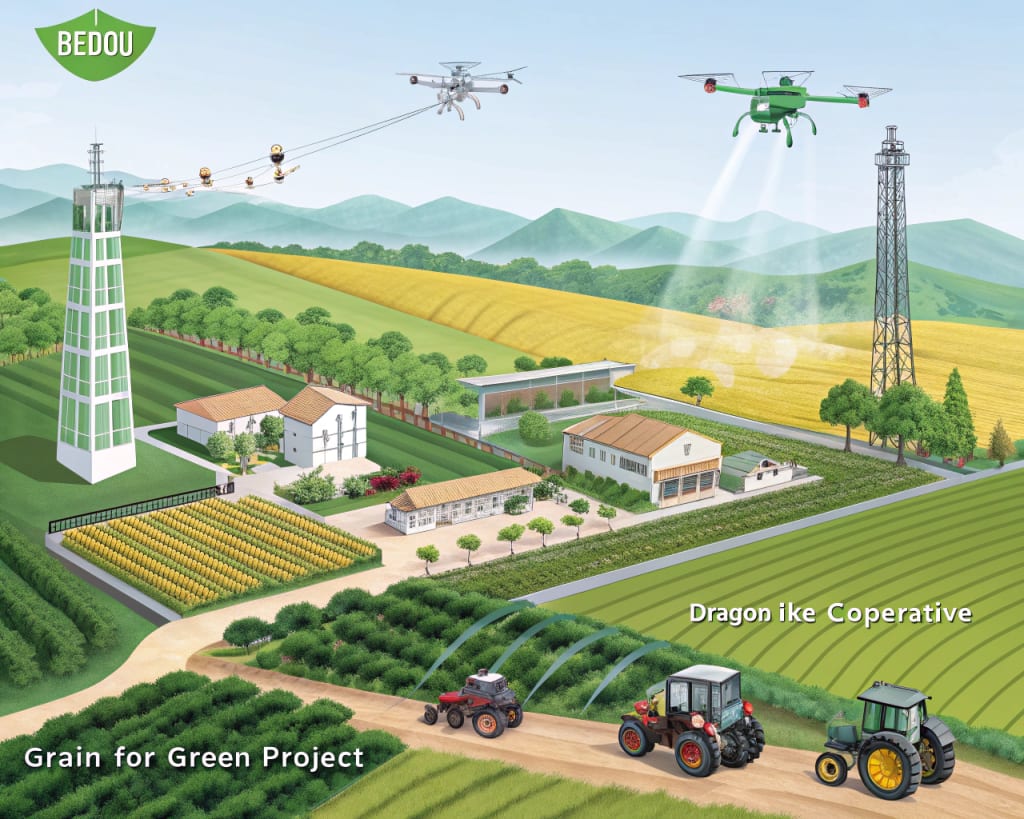
China is revolutionizing agriculture through technology and policy. Precision farming, adopted on 50 million hectares, uses drones and AI to boost yields by 15% and cut water use by 25%, per the Chinese Academy of Agricultural Sciences. The Beidou satellite system guides autonomous tractors, improving efficiency for 10 million farmers. Digital platforms like Pinduoduo connect 12 million farmers to consumers, increasing incomes by 20%. The Grain for Green Project, restoring 30 million hectares since 1999, combats soil erosion.
Policy reforms, like the Rural Revitalization Strategy, invest $700 billion to modernize agriculture by 2035. High-yield hybrid rice, developed by Yuan Longping, covers 17 million hectares, producing 8 tons per hectare—50% above global averages. Vertical farming in cities like Shanghai yields 20 times more per unit area. Organic farming, supported by $10 billion in subsidies, now spans 3% of farmland. Cold chain logistics, with 200,000 new facilities, reduce post-harvest losses by 10%.
A Call to Action
China’s agricultural future demands sustained effort. Doubling R&D investment to 2% of agricultural GDP can scale innovations like gene-edited crops. Training 100 million farmers in sustainable practices and digital tools is critical. Expanding cooperatives, now 2.2 million strong, can empower smallholders. Consumers must embrace eco-friendly produce to curb chemical use.
International collaboration, through initiatives like the Belt and Road’s agricultural exchanges, can share expertise. By prioritizing climate-smart farming, equitable resource access, and tech-driven efficiency, China can ensure food security and environmental health. The time is now to cultivate a sustainable, resilient agricultural system that feeds the nation and inspires the world.
About the Creator
Arjun. S. Gaikwad
Truth Writing unveils reality beyond illusion, power, and propaganda words that awaken conscience and challenge comfort. Fearless, honest, and thought-provoking, it explores politics, humanity, and spirit to inspire awareness and change.
Keep reading
More stories from Arjun. S. Gaikwad and writers in Earth and other communities.
India’s Agricultural Renaissance: Cultivating a Sustainable Future for 1.4 Billion
India, the world’s second-largest agricultural producer, feeds 1.4 billion people while shaping global food systems. Contributing 18% to GDP and employing 44% of the workforce, agriculture is the nation’s backbone. Yet, climate change, resource constraints, and systemic inefficiencies threaten its potential. Through cutting-edge technology, policy reforms, and sustainable practices, India is poised for an agricultural revolution. Let’s explore the challenges, impacts, and transformative solutions driving this vital sector forward.
By Arjun. S. Gaikwad6 months ago in Earth
Without Democracy, Donald Trump’s Venezuelan Oil Quest Will Fail
Donald Trump’s renewed interest in Venezuelan oil may seem, on the surface, like a hard-nosed geopolitical calculation. Venezuela holds the world’s largest proven oil reserves, and amid global energy uncertainty, access to those resources is undeniably tempting. But history, economics, and politics all point to the same conclusion: without democratic reform in Venezuela, any attempt by a Trump-led US administration to secure reliable Venezuelan oil will ultimately fail.
By Aarif Lashari3 days ago in Earth




Comments
There are no comments for this story
Be the first to respond and start the conversation.