
Carbonic Anhydrase
"Carbonic Anhydrase is strongly inhibited by the drug acetazolamide, which is used as a diruetic"


Introduction to Enzymes:
Enzymes: Enzymes are proteins molecules that are required to catalyze biological processes. They exhibit the properties of proteins. Enzymes usually catalyze a reaction by lowering the activation energy that is required to complete a reaction. That is why, enzymes are effectively regulated to control the biological processes and ensure the product concentration does not rise up to desire level. Enzymes can be denatured by a small change in pH and concentration.
Inhibitors: Some biological compounds have potential to attach with specific enzymes but they do not act as a substrate and ultimately block catalysis. Such biological compounds are called inhibitors. Important types of inhibitors can be explained as;
1. Irreversible inhibitors
2. Reversible inhibitors
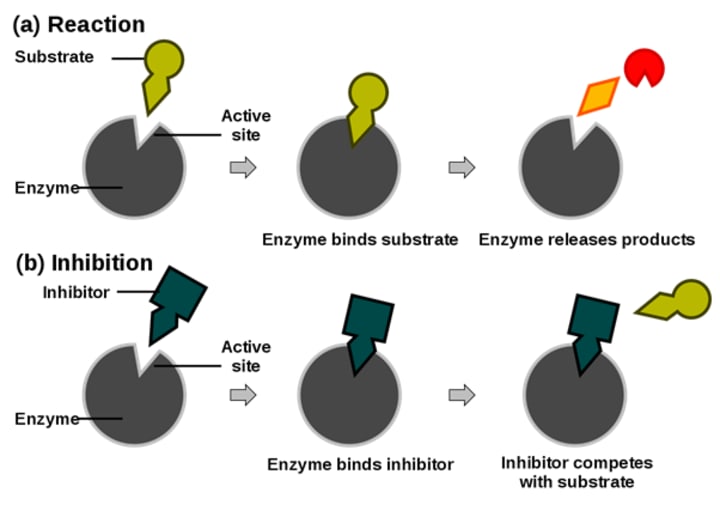
Irreversible inhibitors: They bind to the enzyme active site and completely destroy it. For example, Suicide inhibitors, they are activated by normal catalytic activity, but it denatures the active site. Suicide inhibitors look like substrate but attack on active site. Malathion and other Organophosphates are such types of “Suicide Inhibitors”.
Reversible Inhibitors: There are two types of reversible inhibitors, Competitive and Non-competitive.
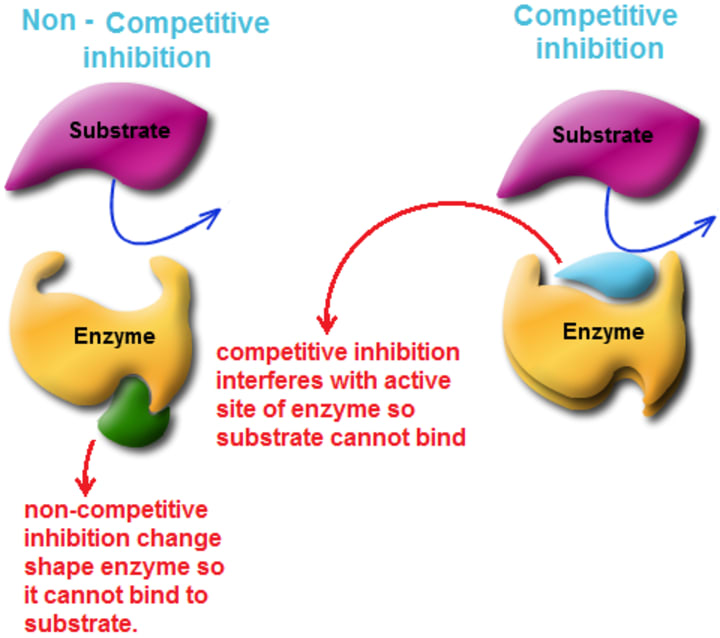
1-Competitive Inhibitors: In competitive inhibitors, Substrate and inhibitor both attach with the enzyme and formed two different complexes. So there is a competition between substrate and inhibitor. ES complex is formed that degenerate into products. When a compound has strong resemblance with substrate, it competes with substrate and binds with active site, called competitive inhibitors. Malonic acid acts as competitive inhibitors for succinate dehydrogenase.
2-Non-competitive inhibitors: Those types of inhibitors that bind with enzymes to that site other than active site and denature the enzyme. So, the ES complex does not formed in this case. These inhibitors reduce the rate of product formation.
Action of Acetazolamide in the body:
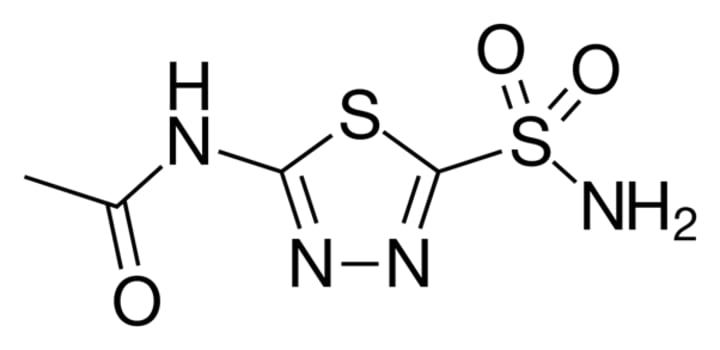
Acetazolamide is described as sulfonamide derivative having diuretic, antiglaucoma properties. It is an example of non-competitive inhibitors of an enzyme called, carbonic anhydrase. The enzyme found in the proximal tube of the eye and kidney cells. The enzyme known as carbonic anhydrase is responsible for the again absorption of compounds like bicarbonate and protons. In our body bicarbonates dissociates into proton and bicarbonate ion. These bicarbonate ions are then moved to the other side of the cell and the remaining proton ions are moved to the other side of the cell. During the transport of hydrogen ions in response the sodium ions are moved into the cell through the special pumps. The sodium ion is now added into the cell and then it is moved to the side of the cell where bicarbonate ions where moved and then they are again absorbed just like bicarbonate ions. Second step is the fate of hydrogen ions that were moved out of the cell. It binds with bicarbonate ions laying outside the cell and make bicarbonates. This process is maintained by carbonic anhydrase that is outside the cell. The bicarbonate thus formed is now degraded into water and CO2. These products are then again passed into the cell where again the cycle starts.
Now as the acetazolamide starts its action the carbonic anhydrase action is resisted and the reactions are stopped. Due to such resistance the formation of protons and bicarbonate ions are diminished. The result of which is that there is no again absorption of sodium ions and bicarbonate ions. Hence all these functions are stopped.
Demonstration by Graph:
Graph which is plotted to show the action of acetazolamide is for non-competitive. Here when there is no involvement of acetazolamide the position of line is high while after adding this inhibitor the graph line is lowered showing the action of this inhibitor.
Results of Inhibitor:
It does not have many good results on the human body. It could be the cause of different diseases in the body such as acidosis, renal stones, bicarbonaturia etc.
Conclusion
Enzymes usually catalyze a reaction by lowering the activation energy that is required to complete a reaction. Some biological compounds have potential to attach with specific enzymes but they do not act as a substrate and ultimately block catalysis. Suicide inhibitors, they are activated by normal catalytic activity, but it denatures the active site. When a compound has strong resemblance with substrate, it competes with substrate and binds with active site, called competitive inhibitors. Acetazolamide is described as sulfonamide derivative having diuretic, antiglaucoma properties. The enzyme known as carbonic anhydrase is responsible for the again absorption of compounds like bicarbonate and protons. During the transport of hydrogen ions in response the sodium ions are moved into the cell through the special pumps. The sodium ion is now added into the cell and then it is moved to the side of the cell where bicarbonate ions where moved and then they are again absorbed just like bicarbonate ions. Acetazolamide starts its action the carbonic anhydrase action is resisted and the reactions are stopped.
About the Creator
Fatima Jamil
In a world where you can be anyone, be yourself.
Keep reading
More stories from Fatima Jamil and writers in Earth and other communities.
Polymerization of Teflon
1-Properties of Teflon In the all above discussion we saw that Teflon has remarkable properties. It shows chemical inertness, electrical resistance properties, heat insulation, and shows non friction and non-stick properties over a wide range of temperature and pressure.
By Fatima Jamil3 years ago in Earth
‘We Are Heartbroken’: The Traitors Winner Rachel Duffy Announces the Death of Her Mum
A Heartbreaking Announcement Rachel Duffy, the recent winner of The Traitors, has announced the death of her mother, sharing the deeply personal news with fans in an emotional statement. Known for her resilience, intelligence, and warmth on the hit TV show, Duffy revealed that her family is “heartbroken” as they grieve a profound loss.
By Aarif Lasharia day ago in Earth




Comments
There are no comments for this story
Be the first to respond and start the conversation.