
Carbon Removal
A Crucial Tool in Combating Climate Change


As the world grapples with the urgent need to address climate change, innovative solutions are emerging to mitigate the devastating effects of greenhouse gas emissions. Among these solutions, carbon removal has gained significant attention as a powerful tool in the fight against climate change. This article explores what carbon removal is, its role in combating climate change, its effectiveness, and the challenges it faces in scaling up its implementation.
What is Carbon Removal?
Carbon removal, also known as negative emissions, refers to the process of removing carbon dioxide (CO2) from the atmosphere and storing it in a manner that prevents it from re-entering the Earth's climate system. This can be achieved through various techniques, such as:
Direct Air Capture (DAC): Direct Air Capture involves the use of large-scale technologies to remove CO2 directly from the ambient air. These systems use chemical processes to capture CO2 molecules and separate them from the air. The captured CO2 can then be either stored underground or utilized for various purposes, such as producing synthetic fuels or for industrial processes.
Afforestation and Reforestation: Afforestation refers to the process of establishing forests in areas where they did not previously exist, while reforestation involves replanting trees in areas where forests have been cleared or depleted. Both afforestation and reforestation play a vital role in carbon removal by allowing trees to absorb CO2 through photosynthesis and store carbon in their biomass. Forests act as natural carbon sinks, and their preservation and expansion contribute to reducing atmospheric CO2 levels.
Ocean Fertilization: Ocean fertilization is an experimental technique that involves adding nutrients, such as iron or nitrogen, to stimulate the growth of phytoplankton in the ocean. Phytoplankton naturally absorb CO2 from the atmosphere through photosynthesis. By enhancing their growth, the idea is to enhance the ocean's capacity to sequester carbon. However, the potential environmental impacts of large-scale ocean fertilization are still under study, as altering ocean ecosystems may have unintended consequences.
Carbon Capture and Storage (CCS) Technologies: CCS technologies involve capturing CO2 emissions from industrial processes, power plants, or other large-scale sources, and then storing the captured CO2 underground, typically in geological formations. This prevents the CO2 from being released into the atmosphere and contributing to climate change. CCS can also be combined with bioenergy (BECCS) to remove CO2 from the atmosphere by capturing emissions produced during biomass combustion.
Role in Fighting Climate Change
Carbon removal plays a crucial role in fighting climate change by addressing the excess CO2 already present in the atmosphere. While efforts to reduce greenhouse gas emissions are essential, they alone are insufficient to limit global warming to the targets set by the Paris Agreement. Carbon removal technologies provide a means to actively remove CO2, helping to offset emissions from hard-to-abate sectors like aviation, shipping, and heavy industries.
Effectiveness of Carbon Removal
Carbon removal has the potential to effectively reduce atmospheric CO2 concentrations and mitigate climate change impacts. Direct air capture technologies, for instance, can capture CO2 directly from the air and permanently store it underground or convert it into useful products. Afforestation and reforestation projects enable the absorption of CO2 by growing trees and restoring ecosystems, enhancing the planet's natural capacity to sequester carbon.
Challenges
Despite its promise, carbon removal faces several challenges that need to be addressed for its widespread adoption. One of the main challenges is the scalability and cost-effectiveness of carbon removal technologies. Many of these techniques are still in the early stages of development and require significant investments to become economically viable on a large scale. Additionally, the potential environmental impacts and ethical considerations associated with some carbon removal approaches, such as ocean fertilization, require careful evaluation.
Current and Potential Scale
Currently, carbon removal initiatives are relatively small in scale compared to the magnitude of the climate crisis. However, there is growing recognition of the need to accelerate the deployment of these technologies. Governments, businesses, and research institutions are investing in the development and scaling of carbon removal solutions. Promising advancements in direct air capture, enhanced weathering, and reforestation techniques offer hope for achieving significant carbon removal in the future.
Carbon removal holds immense potential in the fight against climate change, offering a complementary approach to reducing greenhouse gas emissions. As the urgency to address climate change intensifies, the effectiveness and scalability of carbon removal technologies will play a critical role. To fully harness the benefits of carbon removal, further research, innovation, and policy support are required.
About the Creator
Chela Kikwai
Passionate about climate action and sustainability, I raise awareness and promote climate education through my articles. Read, Learn, Follow, Tip and Share
Keep reading
More stories from Chela Kikwai and writers in Earth and other communities.
Transforming Plastic Waste into Opportunity
Plastic waste poses a significant environmental challenge in Kenya, threatening ecosystems, public health, and sustainable development. However, a group of innovative companies is stepping up to tackle this issue head-on, offering sustainable solutions to combat plastic pollution. In this article, we will explore five remarkable companies at the forefront of Kenya's fight against plastic waste: Mr. Green Africa, EcoPost, Gjenge Makers, Vintz Plastics, and Takataka Solutions. These companies not only address the detrimental effects of plastic waste but also exemplify the urgent need for sustainable innovations in waste management.
By Chela Kikwai3 years ago in Earth
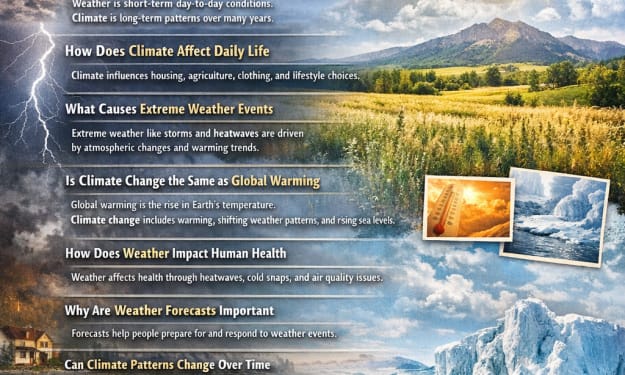
Weather and Climate Understanding the Forces That Shape Our Daily Lives
Weather and Climate Understanding the Forces That Shape Our Daily Lives Weather and climate play a central role in how people live work travel and plan for the future. From daily temperature changes to long term climate patterns these natural systems influence agriculture health economies and even global stability. Understanding the difference between weather and climate and knowing how they affect human life has become more important than ever especially as the world experiences more extreme conditions.
By America today a day ago in Earth
Autonomy Is The Real Privilege
Good morning, freedom-seekers! Today we’re gonna be looking at autonomy. A strange word, I know; one many would probably look at blankly and run away from on sight. We’re gonna figure out what it actually means, consider how it’s achieved, and decipher just how deeply most of us are tangled up in dependence without realising it.
By That ‘Freedom’ Guy6 days ago in Humans



Comments
There are no comments for this story
Be the first to respond and start the conversation.