
Built to Survive: How Animals Adapt to the World’s Harshest Places
From scorching deserts to the vacuum of space, these creatures defy the limits of survival.

Camels: The Desert’s Living Water Tanks
Camels are iconic survivors of blistering deserts like the Sahara. They endure temperatures over 40°C during the day and near freezing at night — all while walking miles with minimal food or water.
What makes them so special? First, camels don’t store water in their humps. The hump is actually fat, which they metabolize for energy. Their true hydration power lies in their blood cells, which are oval-shaped and extremely flexible. This allows camels to retain water longer and avoid dehydration.
They can lose up to 25% of their body weight through sweating and still survive — something that would kill most mammals. Their thick eyelashes, nostrils that close, and wide feet protect them from sandstorms and scorching terrain.
Camels aren’t just built for deserts — they are engineered for endurance.
Emperor Penguins: Thriving in Antarctic Ice
The emperor penguin is the largest penguin species and lives in Antarctica, the coldest place on Earth. They breed during winter, when temperatures can drop below -60°C, and winds reach speeds of 200 km/h.
To survive, these birds have a four-layer feather system, which provides insulation better than any human-made coat. Their fat reserves also help maintain body heat. But the true secret lies in group cooperation: penguins huddle in massive circles, rotating positions so that no one stays at the freezing edge for too long.
Male emperor penguins endure weeks of starvation while protecting their eggs on their feet, covered by a skin flap called a brood pouch. They incubate the eggs through sheer body heat.
These birds show that even in the most unforgiving cold, life finds a way to persist with resilience and unity.
Tardigrades: Indestructible Survivors of Space
Tardigrades — also known as water bears — are tiny, eight-legged micro-animals barely visible without a microscope. Despite their size, they are among the toughest creatures on the planet.
Tardigrades can survive in boiling heat, freezing cold, high radiation, and even the vacuum of space. When conditions become extreme, they enter a state called cryptobiosis — curling into a dry ball and shutting down almost all metabolism.
In this state, they can survive for decades, then rehydrate and resume life like nothing happened.
Scientists sent tardigrades into low-Earth orbit in 2007, and many survived exposure to space radiation and vacuum. That means they’re not just built for Earth’s extremes — they’re built for the cosmos.
Axolotls: Regrowing What’s Lost in Icy Waters
The axolotl, a Mexican salamander, lives in cold, high-altitude lakes like Lake Xochimilco. While many amphibians adapt to the cold by hibernating, axolotls remain active in chilly water — and carry a superpower.
They can regenerate entire limbs, parts of their heart, spinal cord, and even parts of the brain. This makes them nearly invincible in the wild, as injuries don’t permanently damage them.
Axolotls don’t undergo full metamorphosis like other amphibians. They remain aquatic, with external gills, throughout their lives — a condition called neoteny.
Even in polluted or freezing water, axolotls adapt through slow metabolism, cellular repair, and regeneration — making them symbols of survival and hope in biological science.
Deep-Sea Fish: Living in Darkness and Crushing Pressure
The deep sea, thousands of meters below the ocean surface, is pitch black, near freezing, and under immense pressure — hundreds of times more than on land.
Yet, creatures like the anglerfish, viperfish, and blobfish survive and even thrive there.
These animals have special adaptations:
- Soft, flexible bodies to withstand pressure
- Bioluminescence to attract prey or mates
- Highly sensitive eyes (or no eyes at all)
- Slow metabolisms to conserve energy in a food-scarce environment
They often look bizarre or frightening — but their biology is perfectly designed for survival where no light, warmth, or human presence reaches.
Wood Frogs: Frozen Solid but Still Alive
Imagine being frozen for months, heart stopped, and blood turned to ice — and then waking up like nothing happened.
That’s the reality for the wood frog, found in Alaska and northern Canada. These frogs survive winter by freezing completely, thanks to a special type of sugar in their blood called glucose cryoprotectant.
This sugar prevents their cells from rupturing due to ice crystals. During winter, their organs shut down. No heartbeat, no breathing. In spring, the ice thaws, and the frog “reboots” — heart beating, lungs breathing, and muscles moving again.
This natural antifreeze system lets them survive temperatures as low as -20°C.
The wood frog teaches us that even death-like states can be reversible, in the right biological context.
Bar-Headed Geese: Breathing in the Thin Air of the Himalayas
Flying at over 29,000 feet, higher than Mount Everest, the bar-headed goose is one of the highest-flying birds on Earth. At that altitude, oxygen levels are dangerously low, and temperatures are freezing.
But these geese have adapted in extraordinary ways. Their blood contains hemoglobin with a stronger affinity for oxygen, meaning it captures more oxygen with every breath.
They also have larger lungs and more efficient muscle cells, which allow them to fly long distances through the thin air over the Himalayas during migration.
Their wings beat slower but stronger, conserving energy in a place where most life can’t survive. This bird doesn’t just climb mountains — it flies over them, powered by evolutionary brilliance.
Community
Survival isn’t just about strength — it’s about adaptation. From the coldest ice to the hottest deserts, and even the vacuum of space, animals have evolved to conquer environments that seem impossible.
They don’t rely on tools, machines, or technology. Their resilience is written into their DNA — in every scale, feather, and instinct.
In a world facing climate change and growing uncertainty, these creatures remind us:
Life doesn’t wait for comfort — it adapts, endures, and thrives.
If this article amazed you, share it with someone who believes in the power of nature — and the brilliance of survival against all odds.
About the Creator
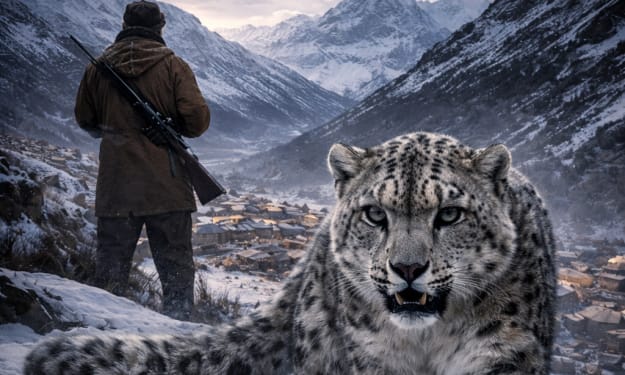
Human Revenge: A Hidden Cause Behind the Decline of Snow Leopards
High in the rugged mountains of Central and South Asia lives one of the world’s most mysterious and beautiful big cats—the snow leopard. Known for its thick grey-white fur, long tail, and incredible ability to blend into rocky landscapes, this elusive predator has fascinated scientists and wildlife lovers for decades. Yet despite its beauty and ecological importance, the snow leopard faces a growing threat: human revenge.
By Irshad Abbasi 7 days ago in Earth
History of The Three Stooges (Part I: The Beginnings and Columbia Pictures - 1920s-1936)
I have been itching to write about The Three Stooges on Vocal for close to two years, but I couldn't figure out how to do it. I wanted to do it by third Stooge, but that's a bit complicated. I know this much. I was about eight or nine years old when I first saw The Three Stooges. I remember one of my local channels had the Stooges on for hours, and I tried my damnedest to be up for those shorts. I remember that the Family Channel actually had an hour of the Stooges on from 11PM to midnight, and it was the entire library on during that time.
By Clyde E. Dawkins4 days ago in Geeks



Comments
There are no comments for this story
Be the first to respond and start the conversation.