
Building a giant "curtain" over Antarctica through geoengineering could lead to serious problems.
Antarctica is the only continent on Earth that has never experienced war.

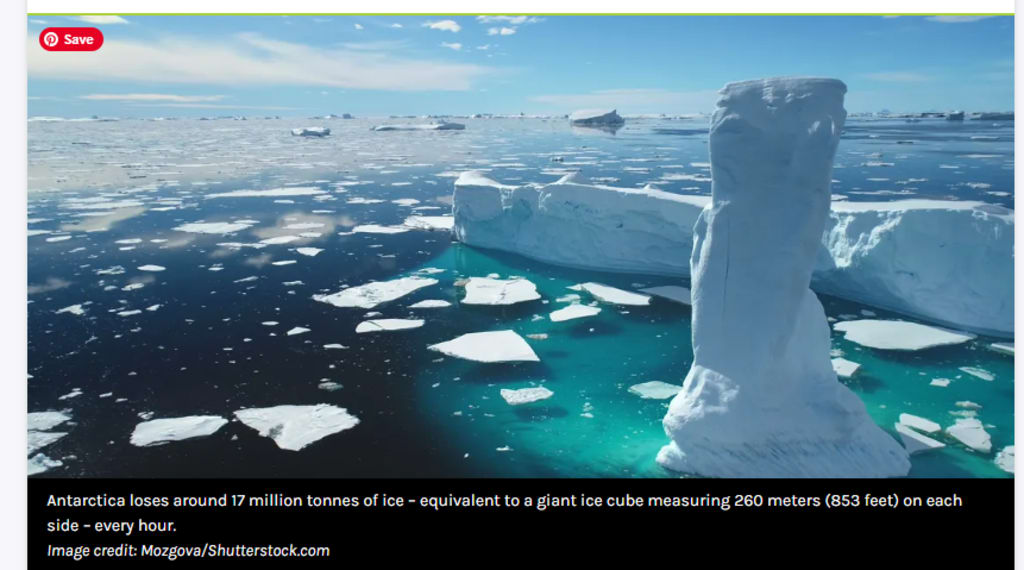
Scientists have considered building enormous underwater 'curtains' around ice sheets to shield the rest of the planet from rising sea levels due to the polar areas of the world melting at an alarming rate. In addition to the dangers of extreme geoengineering initiatives, international relations specialists caution that the proposal may lead to unprecedented political unrest.
According to a January 2024 news item in Nature, the speculative concept would involve constructing a floating "curtain" that is 100 meters (328 feet) high and attached to the seafloor. It would be 80 kilometers (49.8 miles) long and would encircle the threatened ice sheets, like the West Antarctic Ice Sheet.
While acknowledging that they "absolutely don't know if [the idea] is going to work or not," the researchers said that it should be investigated as a potential solution to stop catastrophic sea level rise in the ensuing decades.
A recent report adds fuel to the controversy by claiming that the geoengineering megaproject might make the southernmost continent the "object of international discord."
In terms of international relations, Antarctica is a huge outlier. The 1959 Antarctic Treaty System, which forbids mining, nuclear testing, and military operations in the area, has been ratified by dozens of nations.
The has essentially "frozen" the territorial claims that seven nations—Argentina, Australia, Chile, France, New Zealand, Norway, and the United Kingdom—have made in Antarctica. Even though there are certain territorial overlaps, specifically between Argentina, Chile, and the United Kingdom, the agreement has prevented conflict over the continent—at least thus far.
According to the new report, the Ice Sheet Curtain project might disrupt this long-standing calm by igniting fresh conflicts over security, sovereignty, and authority.
There is potential for conflict when actions like geoengineering could be interpreted as supporting or damaging the interests or claims of particular countries, even though the Antarctic Treaty System suspends territorial claims but does not settle them.
In a statement, Shibata Akiho, study author and international law researcher at Kobe University in Japan, said, "This paper sheds light on the political and legal shadows' hidden behind the exciting surface of science and technology. However, we believe that it is necessary for the members of society to make decisions on the development of these technologies based on a thorough understanding of such negative aspects." In one of the most startling scenarios examined by the paper, the researchers wonder if the Antarctic structure could be "sabotaged or targeted for political or terrorist blackmail" as a way to harm low-lying nations.
The paper examines past disputes to determine how the hypothetical situation ahead could be handled. For example, the researchers note that a heated debate over mineral extraction in Antarctica erupted in the 1980s but was successfully resolved by the "Protocol on Environmental Protection to the Antarctic Treaty." "As far-fetched as these scenarios might be, the mere possibility of these security risks has securitizing implications for the proposed public goods. Accordingly, the infrastructures will need to be monitored and protected, which would have major consequences for policing and the use of force in the Antarctic [...] bearing in mind that this is a continent that is currently demilitarized and the only one on the planet to have seen without war," the paper reads.
However, we might be overestimating the situation. The incapacity of the international community and policymakers to implement significant global change is primarily to blame for the failure to address climate change, which is the primary cause of melted ice sheets and increasing sea levels.
It appears even less possible that we could manage a huge engineering megaproject of this magnitude, let alone reach the geopolitical consensus required to prevent conflict, as the globe enters a new era of increased tensions.
"Securing the level of international cooperation […] required for the proposed glacial geoengineering infrastructures would be an extremely unlikely diplomatic achievement in the current climate, with growing international rivalry and great power strategic competition," the study authors write in the paper.
About the Creator
Keep reading
More stories from Francis Dami and writers in Earth and other communities.
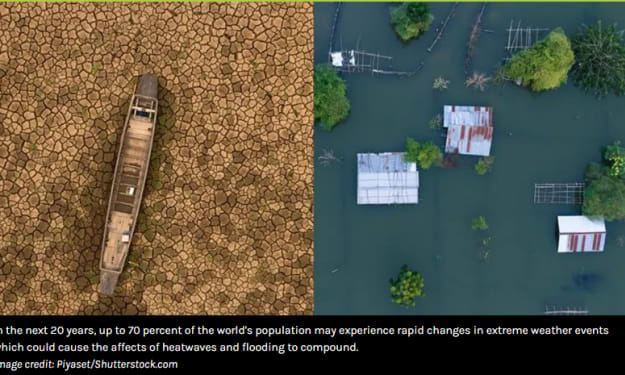
In the next 20 years, 70% of the world's population may be affected by increases in extreme weather.
According to a recent analysis, almost three-quarters of the world's population will see notable and swift changes in rainfall and temperature over the course of the next 20 years. This is a sobering message to many people everywhere. Reducing greenhouse gas emissions dramatically is the only way to prevent this.
By Francis Damiabout a year ago in Earth
The Star That Keeps Dimming for No Known Reason
In 2015, astronomers analyzing data from NASA's Kepler Space Telescope discovered a star designated KIC 8462852, located about 1,470 light-years from Earth in the constellation Cygnus, that was exhibiting brightness fluctuations unlike anything that had been observed in over 150,000 stars surveyed by the Kepler mission, and the pattern of dimming was so unusual and irregular that it could not be explained by any known natural phenomena including planets orbiting the star, stellar pulsations, or dust clouds, leading some scientists to seriously propose that the dimming might be caused by artificial structures built by an advanced alien civilization, specifically something like a Dyson swarm of solar collectors orbiting the star to harvest its energy, though this explanation while exciting was considered a hypothesis of last resort only to be entertained after all natural explanations had been exhaustively ruled out. The star, which became known informally as Tabby's Star after astronomer Tabetha Boyajian who led the research team studying it, showed dimming events where its brightness dropped by up to 22 percent, far more than could be explained by a planet passing in front of it, which typically causes dimming of only a fraction of a percent, and the dimming events were irregular and aperiodic, meaning they did not repeat on any predictable schedule, and different dimming events had different characteristics with some showing gradual dimming over days and others showing more sudden brightness drops.
By The Curious Writerabout 14 hours ago in Earth
Pandora’s Burden
“My brother warned me to not accept gifts from the one who commissioned you,” said Epimetheus to the woman clad in silvery raiments standing at the entrance to the temple. Her silver tiara and the silver rings on her fingers and toes glinted in the firelight cast by torches set on either side of the doorway. Lingering in the shadows, beyond the reach of the flames as she was, he could not tell what she held in her hands. At first what appeared to be a box was perhaps a funerary urn, or maybe merely an apple.
By J. Otis Haas3 days ago in Fiction


Comments
There are no comments for this story
Be the first to respond and start the conversation.