
Big Bang Theory
Science explains that this is how the universe began.
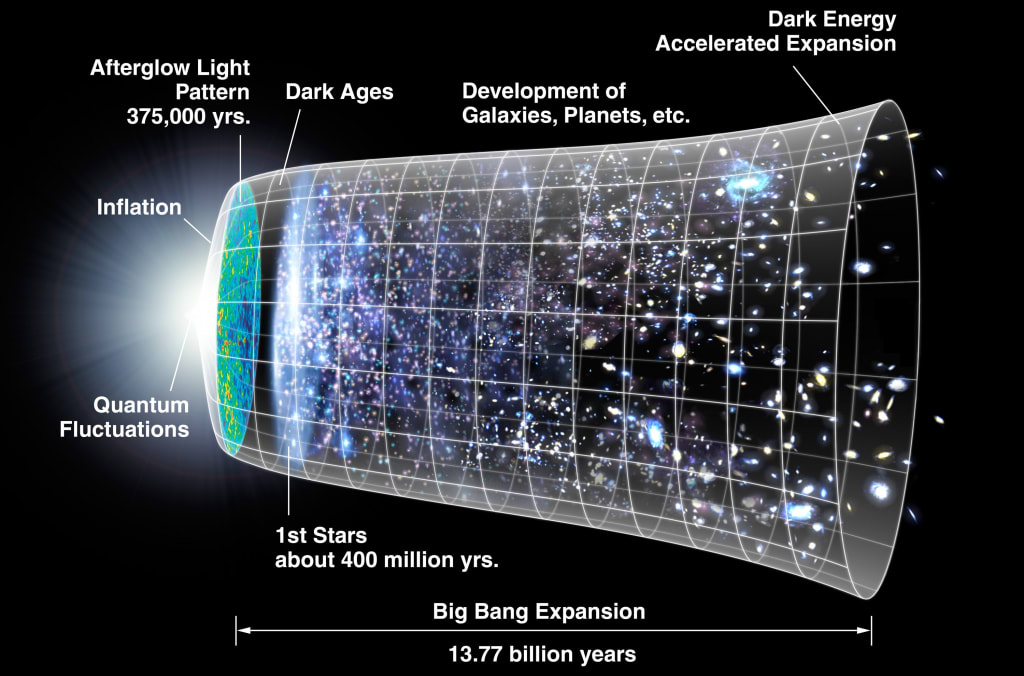
The Big Bang Theory is the prevailing scientific model of the origin of the universe. According to this theory, the universe began as a hot and dense point, known as a singularity, approximately 13.8 billion years ago. At this time, all the matter and energy in the universe was concentrated in a space smaller than the size of an atom. The Big Bang theory suggests that the universe began to expand rapidly and cool down after this initial singularity, resulting in the formation of subatomic particles, atoms, stars, and galaxies. As the universe expanded and cooled, it also became less dense, the particles that remained began to combine into atoms which eventually formed into galaxies and clusters of galaxies. One of the key pieces of evidence supporting the Big Bang theory is the cosmic microwave background radiation, which is a faint, uniform glow of microwave radiation that fills the universe. This radiation is thought to be the leftover heat from the Big Bang, and its characteristics match the predictions of the Big Bang model. This all began roughly 13.8 billion years ago, and is thus considered to be the age of the universe. Through the testing of theoretical principles, experiments involving particle accelerators and high-energy states, and astronomical studies that have observed the deep universe, scientists have constructed a timeline of events that began with the Big Bang and has led to the current state of cosmic evolution. The Big Bang theory is a cosmological model that describes the universe's evolution from its earliest moments to its present state. It is based on a few fundamental principles of physics and cosmology, such as general relativity, the laws of thermodynamics, and the concept of cosmic inflation. The theory suggests that the universe began as a singularity, which was an infinitely hot and dense point. This singularity contained all the matter, energy, space, and time that exists in the universe. Then, the universe began to expand rapidly, and as it did so, it cooled down, and matter and energy began to form. As the universe expanded, it went through different phases of development, and different structures emerged. After the initial phase of expansion, the universe was dominated by radiation, and particles and antiparticles annihilated each other. Another important concept in the Big Bang theory is cosmic inflation. Cosmic inflation is a period of exponential expansion that is thought to have occurred in the very early universe, just moments after the Big Bang. This rapid expansion is thought to have smoothed out any irregularities in the universe and created the uniformity that we see in the CMB. This is a faint radiation that is present throughout the universe, and it is thought to be a relic of the intense heat and energy released during the Big Bang. The CMB was first discovered in 1965 by Arno Penzias and Robert Wilson, and it is now one of the most important pieces of evidence supporting the Big Bang theory. Most cosmological models suggest that the Universe at this point was filled homogeneously with a high-energy density, and that the incredibly high temperatures and pressure gave rise to rapid expansion and cooling. This began at 10-37 seconds, where the phase transition that caused for the separation of forces also led to a period where the universe grew exponentially. It was also at this point in time that baryogenesis occurred, which refers to a hypothetical event where temperatures were so high that the random motions of particles occurred at relativistic speeds. As a result of this, particle–antiparticle pairs of all kinds were being continuously created and destroyed in collisions, which is believed to have led to the predominance of matter over antimatter in the present universe. After inflation stopped, the universe consisted of a quark–gluon plasma, as well as all other elementary particles. From this point onward, the Universe began to cool and matter coalesced and formed. The theory predicts that that definite amount of hydrogen, helium and lithium were produced. The radiation that also filled the universe was then free to travel through space. Somehow, some excess matter survived—and it's now the stuff that people, planets, and galaxies are made of. Our existence is a clear sign that the laws of nature treat matter and antimatter slightly differently. Researchers have experimentally observed this rule imbalance, called CP violation, in action. Physicists are still trying to figure out exactly how matter won out in the early universe.
FIRST STARS TILL TODAY:
There wasn't a single star in the universe until about 180 million years after the big bang. It took that long for gravity to gather clouds of hydrogen and forge them into stars. Many physicists think that vast clouds of dark matter, a still-unknown material that outweighs visible matter by more than five to one, provided a gravitational scaffold for the first galaxies and stars. Even now the universe is expanding, and to astronomers' surprise, the pace of expansion is accelerating. It's thought that this acceleration is driven by a force that repels gravity called dark energy. We still don't know what dark energy is, but it’s thought that it makes up 68 percent of the universe's total matter and energy. Dark matter makes up another 27 percent. In essence, all the matter you've ever seen—from your first love to the stars overhead—makes up less than five percent of the universe.
Today, the consensus among scientists, astronomers and cosmologists is that the Universe as we know it was created in a massive explosion that not only created the majority of matter, but the physical laws that govern our ever-expanding cosmos.
About the Creator
Keep reading
More stories from writers in Earth and other communities.
Here’s What the Fed’s Highly Anticipated Rate Decision This Week Means for Bitcoin and the Dollar
Every time the U.S. Federal Reserve meets to decide interest rates, global markets hold their breath. Stocks, bonds, currencies, and increasingly cryptocurrencies react almost instantly to the Fed’s signals. This week’s highly anticipated rate decision is no different, especially for two assets that often move in opposite directions: Bitcoin and the U.S. dollar. At its core, the Fed’s interest rate policy determines how expensive or cheap money is. When rates rise, borrowing becomes costlier and investors often shift toward safer assets. When rates fall, risk appetite increases, benefiting assets like stocks and cryptocurrencies. Understanding this relationship helps explain why Bitcoin traders and currency markets are watching the Fed so closely. A Quick Refresher: What Is the Fed Deciding? The Federal Reserve uses interest rates as a tool to manage inflation and economic growth. By raising rates, it aims to cool inflation by slowing spending. By cutting rates, it encourages borrowing and investment during economic slowdowns. This week’s decision comes at a delicate moment. Inflation has cooled from its peak but remains a concern, while economic growth shows mixed signals. Markets are divided over whether the Fed will: Hold rates steady Signal future rate cuts Maintain a “higher for longer” stance Each of these outcomes carries different implications for Bitcoin and the dollar. What the Decision Means for the U.S. Dollar Interest Rates and Dollar Strength The U.S. dollar tends to strengthen when interest rates rise or are expected to stay high. Higher rates attract global investors seeking better returns on dollar-denominated assets such as U.S. bonds. This increased demand pushes the dollar upward. If the Fed keeps rates high or signals caution about cutting, the dollar is likely to remain strong. A strong dollar often pressures other currencies and commodities, making imports cheaper but exports less competitive. If the Fed Turns Dovish On the other hand, if the Fed hints at future rate cuts, the dollar could weaken. Lower interest rates reduce the appeal of holding dollars, especially compared to higher-yielding currencies or alternative assets. A weaker dollar tends to support risk-on assets, including equities and cryptocurrencies. This is where Bitcoin enters the conversation. What the Decision Means for Bitcoin Bitcoin and Interest Rates: An Inverse Relationship Bitcoin is often described as a “risk asset,” meaning it tends to perform better when financial conditions are loose and liquidity is abundant. When interest rates are low, investors are more willing to take risks, and capital flows into assets like Bitcoin. If the Fed signals rate cuts or a softer policy stance, Bitcoin could benefit. Lower rates reduce the opportunity cost of holding non-yielding assets like Bitcoin, making it more attractive compared to cash or bonds. High Rates Are a Headwind If the Fed remains hawkish, Bitcoin may face short-term pressure. High interest rates strengthen the dollar and make safer investments more appealing. This environment can reduce speculative demand for cryptocurrencies. However, Bitcoin’s reaction isn’t always immediate or predictable. While short-term moves often follow Fed announcements, long-term trends depend on broader adoption, regulation, and market confidence. Bitcoin’s “Digital Gold” Narrative One reason Bitcoin still draws attention during Fed decisions is its evolving role as a potential hedge. Supporters argue that Bitcoin protects against inflation and currency debasement, similar to gold. When investors fear that central banks may eventually return to money-printing or prolonged low rates, Bitcoin’s fixed supply becomes attractive. If the Fed signals concern about economic growth or future easing, this narrative may strengthen Bitcoin’s appeal. That said, Bitcoin has not yet consistently behaved like a traditional safe haven. It remains volatile and sensitive to broader market sentiment. Short-Term Volatility vs. Long-Term Trends Fed decisions often trigger sharp short-term moves in both Bitcoin and the dollar. Traders react to headlines, press conferences, and even subtle wording changes. These immediate reactions, however, don’t always reflect long-term direction. For Bitcoin, long-term performance depends on: Institutional adoption Regulatory clarity Technological development Broader trust in traditional financial systems For the dollar, long-term strength depends on U.S. economic performance, global demand for dollar-denominated assets, and monetary policy consistency. What Investors Are Watching Closely Beyond the rate decision itself, investors will analyze: The Fed chair’s tone during the press conference Updated economic projections Language around inflation and labor markets Even if rates remain unchanged, the Fed’s guidance can move markets significantly. A single phrase suggesting patience or concern can shift expectations—and prices. Final Thoughts This week’s Federal Reserve rate decision highlights the growing connection between traditional finance and digital assets. A strong dollar and high interest rates generally challenge Bitcoin, while easing financial conditions tend to support it. Still, Bitcoin’s story is bigger than one Fed meeting. While short-term volatility is almost guaranteed, long-term trends depend on trust, adoption, and the evolving role of cryptocurrencies in the global economy. For everyday investors, the key takeaway is perspective. Fed decisions matter, but reacting emotionally to every announcement can be costly. Understanding the broader forces at play helps navigate both the crypto market and traditional currencies more confidently.
By Muhammad Hassan6 days ago in Earth
Disappeared Bodies, Mass Burials and ‘30,000 Dead’
For years, reports emerging from Iran have painted a grim and often confusing picture of death tolls tied to political unrest, state violence, pandemics, and human rights abuses. Allegations of disappeared bodies, mass burials, and claims of “30,000 dead” have circulated widely among activists, exiled communities, and international media. Yet, inside Iran, official figures often tell a very different story.
By Aarif Lashari5 days ago in Earth


Comments
There are no comments for this story
Be the first to respond and start the conversation.