

Africa has a warm winter climate that attracts birds from colder regions. Many migratory species make this their winter home.
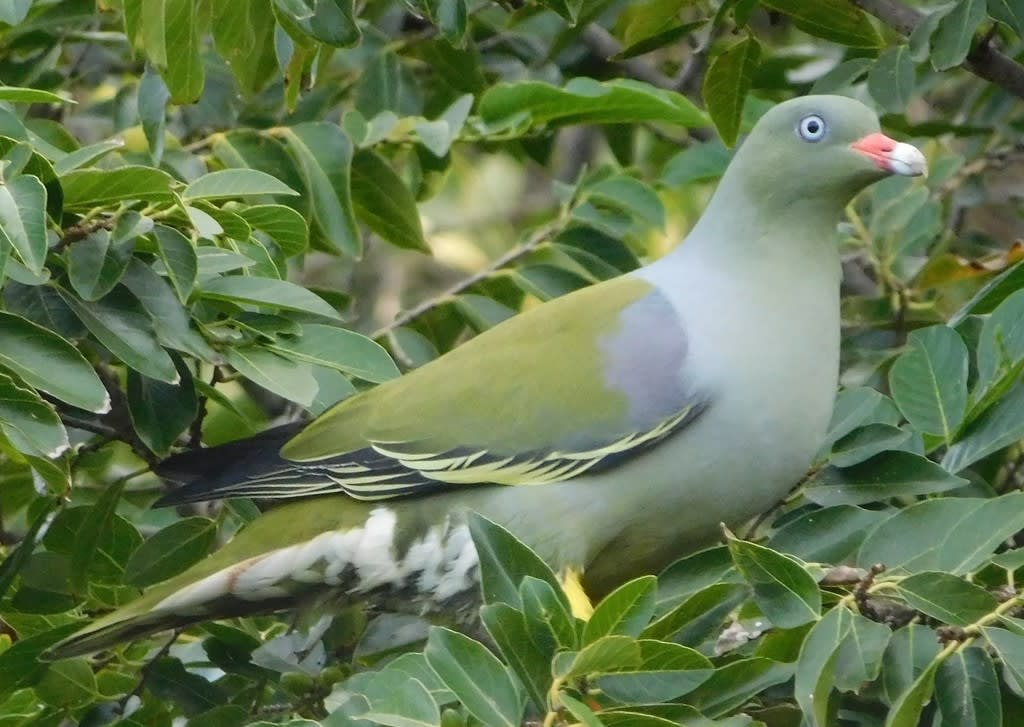
African green pigeons live in sub-Saharan Africa, inhabiting savannas and woodlands. They forage for fruit in the canopy. They are recognized by their series of whinnies, whistles, clicks, and cackles. African green pigeons are known for their climbing ability. Their plumage color is gray-green above and yellow-green below, with yellow thighs and purple-red shoulder patches. They have red bills and red feet.
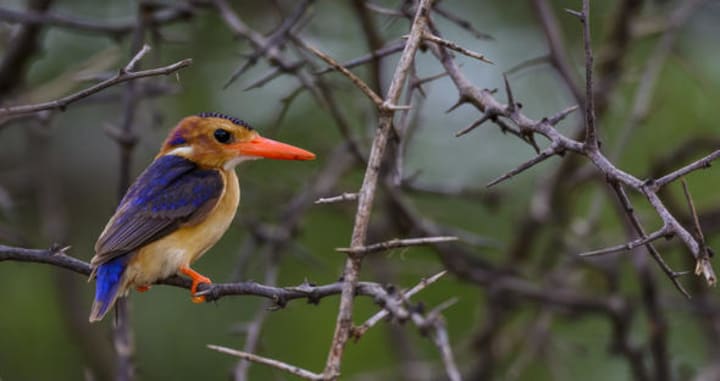
African pygmy kingfishers have vibrantly colored plumage with tawmy underparts and various shades of blue or violet hues. They have deep blue crowns and backs. These birds are a shy species, found alone or in pairs across sub-Saharan Africa. They inhabit savannas, woodlands, and coastal forests, where they feed on insects, spiders, and small reptiles.
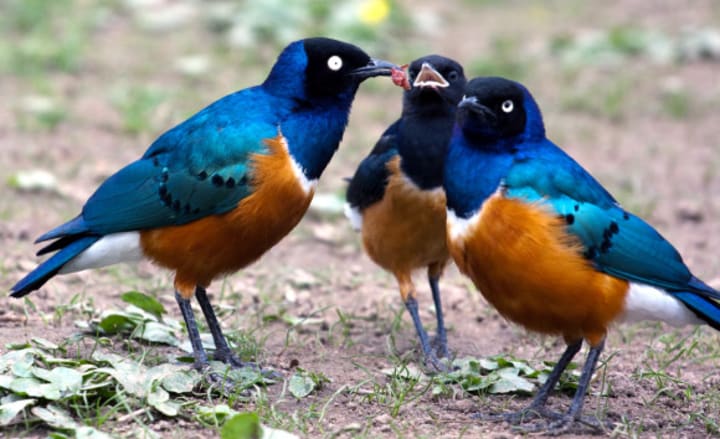
African starlings are known for their glossy, iridescent plumage. They are a small, short-tailed species with a distinct plumage pattern. Their faces are black, and they have reddish-brown bellies, while the rest of their plumage is blue-green. These birds are native to East Africa, inhabiting savannas, open woodlands, and thornveld. Small flocks are often seen foraging on the ground for insects and worms. They also eat grains, berries, and small fruit.

European bee-eaters love to spend their winters in tropical Africa. These are slender birds with plumage in shades of red, orange, and green with sky-blue underparts. They have long, curved black bills. European bee-eaters nest colonially in burrows along sandy banks near rivers. They prefer to inhabit savannas, grasslands, woodlands, and shrublands. These insectivores primarily feed on bees as well as other flying insects.
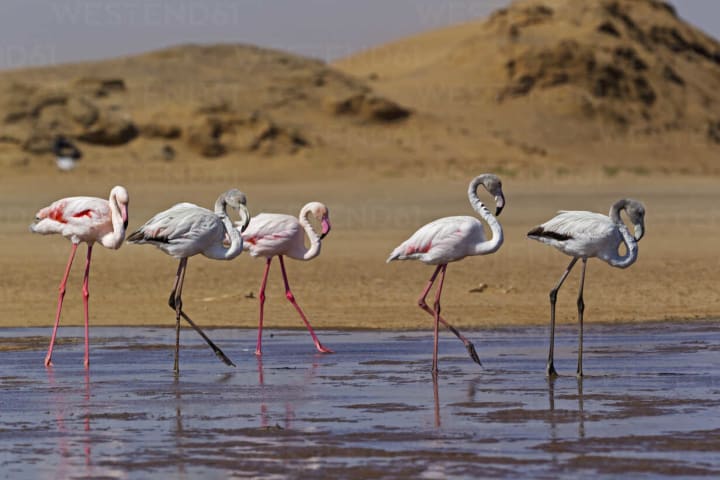
Greater flamingos are the largest and most widespread flamingo species. Their plumage is mostly pinkish-white with red wing coverts and black flight feathers. They are recognizable by their large, down-bent bills and long, pink legs. Flamingos get their pink coloration from their carotene-rich diet of brine shrimp and algae and also feed on seeds and mollusks. They inhabit shallow coastal lagoons and mudflats.
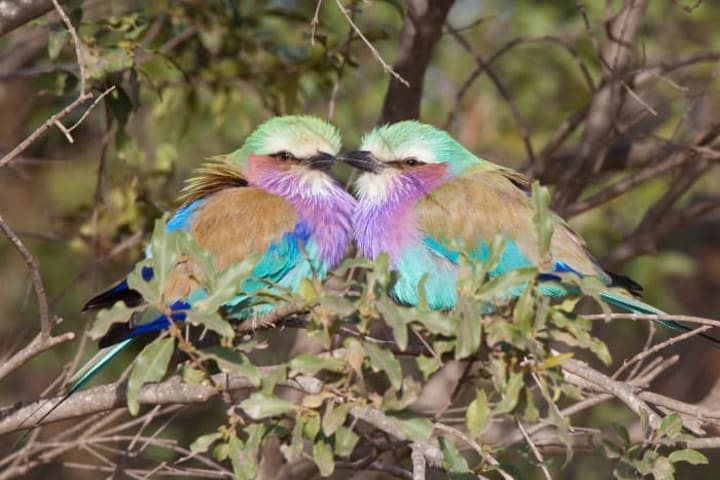
Lilac-breasted rollers are a lovely species of birds making their homes in the east and the south of Africa. These birds were named for the lilac plumage on their throats and upper breasts. Their pastel plumage is a mix of eight colors, among them turquoise, green, royal blue, black, and tawny brown. Their guttural cackle sounds loud and far. These birds eat arthropods and small vertebrates.

Purple-crested turacos are birds with long tails, chunky bodies, small heads, and mohawk-style crests. These birds have emerald green foreheads, lime-green throats and underparts, and mantles with crimson-red flight feathers. Purple-crested turacos are known for their raucous croaks that echo through the forests. They are native to East and South Africa and the national birds of Swaziland. These birds inhabit evergreen forests, riverine woodlands, and savannas and forage the treetops for buds, fruit, and berries.
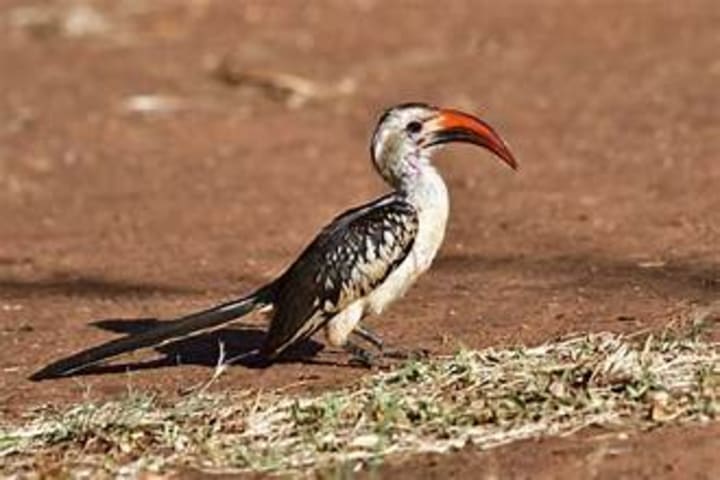
Red-billed hornbills were presented in Disney’s animated movie “The Lion King.” These are large, quirky birds known for their gray, black, and white speckled plumage, long tails, and prominent downward-curved red bills. These birds inhabit woodlands and savannas across sub-Saharan Africa. They can be seen perched in trees or foraging on the ground for seeds, fruits, and insects.
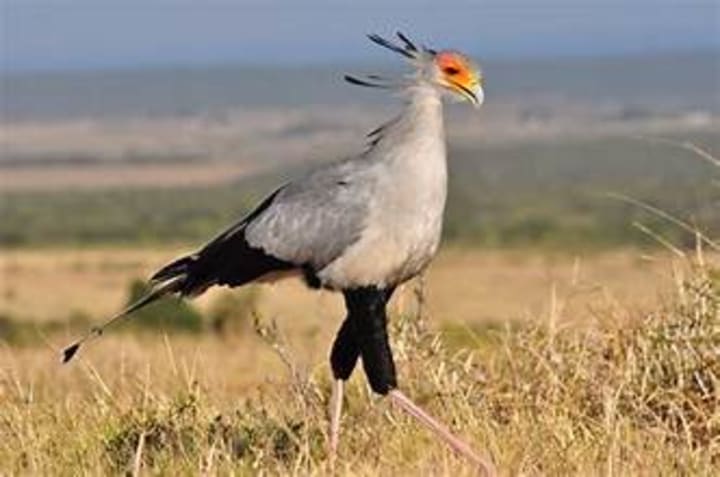
Secretary birds are large, distinctive raptors with eagle-like faces, legs like cranes, and dramatic crests of long, black quills. They are tall and slender with gray and white plumage. These birds inhabit grasslands and savannas of sub-Saharan Africa. Secretary birds stalk their prey on foot and dine on snakes and small vertebrates.

Sunbirds are also known as African hummingbirds and are small nectar feeders. This tiny species has plumage in iridescent shades of metallic green and red with velvety black throats, bellies, and upper wings. They are native to tropical Africa. Sunbirds have down-curved bills and tubular tongues adapted to feeding on nectar.
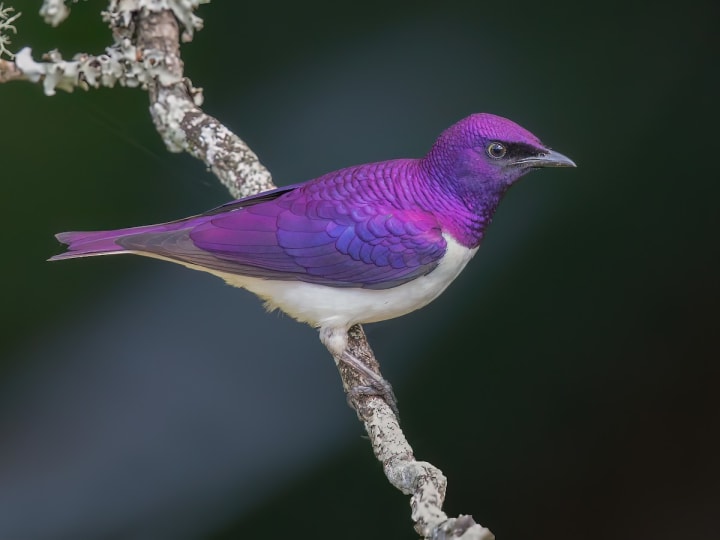
Violet-backed starlings were named for the iridescent violet of the plumage on the male birds. They have grayish-black bills. These birds inhabit open woodlands, gallery forests, and forest clearings, foraging in canopies for fruit, seeds, and invertebrates.

Yellow-collared lovebirds are native to Tanzania. These birds have apple-green plumage with bright yellow collars. Their bills are red and they have white eye rings that contrast with their brown faces. Yellow-collared lovebirds are very social, coming together in small flocks. They mainly inhabit savannas, woodlands, and croplands. Feeding on seeds and grains.
About the Creator
Rasma Raisters
My passions are writing and creating poetry. I write for several sites online and have four themed blogs on Wordpress. Please follow me on Twitter.
Keep reading
More stories from Rasma Raisters and writers in Earth and other communities.
The Amazing Birds of Australia
Australian King parrots have striking red heads and vibrant green bodies. They inhabit the forests of eastern and southeastern Australia and are often seen in woodlands and rainforests. These birds dine on seeds and fruits. King parrots are shy and prefer blending in with the dense foliage.
By Rasma Raistersabout a month ago in Earth
Workers Recover 15,000 Crabs After Lorry Crashes Into Field
An extraordinary scene unfolded when a lorry carrying an estimated 15,000 live crabs crashed into a field, spilling its cargo across farmland and prompting a large-scale recovery effort. The unusual accident quickly drew attention from local residents, emergency services, and animal welfare groups, as workers scrambled to rescue as many crabs as possible before they succumbed to exposure.
By Aarif Lashari3 days ago in Earth
US Balks as UK and France Pledge Troops to Postwar Ukraine
As the war in Ukraine grinds on with no clear end in sight, the debate over what comes after the fighting has taken a sharper turn. The United States has signalled reluctance about committing troops to Ukraine once the war ends, even as the United Kingdom and France openly pledge to consider deploying forces in a postwar security role. The divergence has exposed differing strategic priorities among Western allies and raised new questions about how Ukraine’s future security will be guaranteed. While all three nations remain united in their support for Kyiv during the war, the emerging split over postwar troop commitments highlights the complexity of planning for peace in a conflict that continues to reshape Europe’s security landscape. What the UK and France Are Proposing British and French leaders have increasingly spoken about the need for long-term security arrangements for Ukraine once active hostilities end. Their position reflects a growing concern that any ceasefire or peace agreement could be fragile, leaving Ukraine vulnerable to renewed aggression. The idea under discussion is not a combat deployment in an active war zone, but rather a stabilisation or reassurance force. Such troops could help train Ukrainian forces, protect critical infrastructure, and serve as a visible deterrent against future attacks. Supporters argue that a limited but credible international presence would help ensure that any peace settlement is respected. For London and Paris, this approach fits within a broader European push to take more responsibility for continental security. Both governments see Ukraine not only as a partner but as a frontline state whose stability directly affects Europe as a whole. Why Washington Is Hesitant The United States, while remaining Ukraine’s most significant military backer during the war, has taken a more cautious stance on postwar troop deployments. American officials have stressed that there are no plans to send US forces into Ukraine, even after a potential peace agreement. This hesitation is rooted in several factors. First, Washington remains wary of any move that could risk a direct confrontation with Russia. Even in a postwar scenario, the presence of US troops on Ukrainian soil could be portrayed by Moscow as a provocation, escalating tensions rather than reducing them. Second, domestic considerations play a major role. After years of overseas military engagements, there is limited appetite among the American public and political class for new long-term deployments abroad, particularly in a region where risks remain high and outcomes uncertain. Finally, US strategy has increasingly emphasised supporting allies through funding, training, and equipment rather than large-scale troop commitments. From Washington’s perspective, enabling Ukraine to defend itself may be preferable to stationing American forces on the ground. A Question of Deterrence At the heart of the debate lies a fundamental question: what will actually deter future aggression against Ukraine? The UK and France appear to believe that a physical presence, however limited, would send a powerful signal of commitment. Troops on the ground would demonstrate that Ukraine’s security is directly tied to that of major European powers, raising the cost of any future attack. The US, by contrast, seems to place greater faith in alternative mechanisms such as long-term military aid, security guarantees, and sanctions frameworks. American officials argue that deterrence does not necessarily require boots on the ground, especially if Ukraine emerges from the war better armed and more integrated with Western institutions. This difference reflects broader strategic cultures. European powers, facing the immediate proximity of the conflict, may feel a stronger need for visible reassurance measures, while the US assesses risks from a more global perspective. Implications for NATO Unity Although Ukraine is not a NATO member, the discussion has clear implications for the alliance. Any deployment of UK or French troops would be closely scrutinised for what it means for NATO’s role and credibility. NATO operates on consensus, and the absence of US support for a postwar troop presence could complicate coordination. Even if London and Paris act independently or as part of a smaller coalition, questions would remain about command structures, rules of engagement, and the political backing required for such a mission. At the same time, the situation underscores a broader shift within NATO, with European members increasingly expected to shoulder more responsibility. If the UK and France proceed with their plans, it could mark a significant step toward a more autonomous European security posture. Ukraine’s Perspective For Kyiv, the debate is both encouraging and frustrating. On one hand, the willingness of major European powers to consider troop deployments signals long-term commitment and recognition of Ukraine’s security concerns. On the other hand, uncertainty from the US—Ukraine’s most powerful ally—adds another layer of unpredictability. Ukrainian leaders have consistently argued that security guarantees must be concrete, not symbolic. From their perspective, any postwar arrangement must ensure that Russia cannot simply regroup and strike again. Whether this is achieved through foreign troops, binding treaties, or accelerated integration with Western institutions remains an open question. What is clear is that Ukraine wants assurances that go beyond promises and declarations. The Risk of Mixed Signals One potential danger of the current divergence is the message it sends to Moscow. Differing positions among Western allies could be interpreted as hesitation or lack of unity, potentially weakening deterrence rather than strengthening it. At the same time, open debate is not necessarily a sign of weakness. Allies often disagree on tactics while remaining aligned on broader goals. The challenge will be ensuring that these differences do not undermine the core objective of securing a stable and sovereign Ukraine. Diplomats on both sides of the Atlantic are likely to continue working behind the scenes to narrow the gap, even if public statements suggest a clear divide. Looking Ahead The question of postwar Ukraine remains largely theoretical while fighting continues. Yet the discussion itself reveals how seriously Western governments are taking the long-term consequences of the conflict. The UK and France’s willingness to pledge troops reflects a belief that peace must be actively protected. The US reluctance highlights concerns about escalation, sustainability, and domestic support. Reconciling these approaches will be one of the most important diplomatic challenges once the guns eventually fall silent. For now, the disagreement does not signal a breakdown in alliance unity, but it does expose the difficult choices ahead. As the war continues, planning for peace is proving almost as complex—and politically sensitive—as managing the conflict itself.
By Muhammad Hassan6 days ago in Earth



Comments
There are no comments for this story
Be the first to respond and start the conversation.